
For most patios, a short-wave or medium-wave infrared wall-mounted heater in the 2kW to 3kW range is the best all-round choice. It warms people directly rather than heating the air, works reasonably well in breezy conditions (especially short-wave models), mounts flush to the wall to save floor space, and costs roughly 50p to 80p per hour to run at current UK electricity rates.
Best Wall Mounted Patio Heaters UK: Electric vs Infrared Guide

Caleb Vale
3 Jun 2026
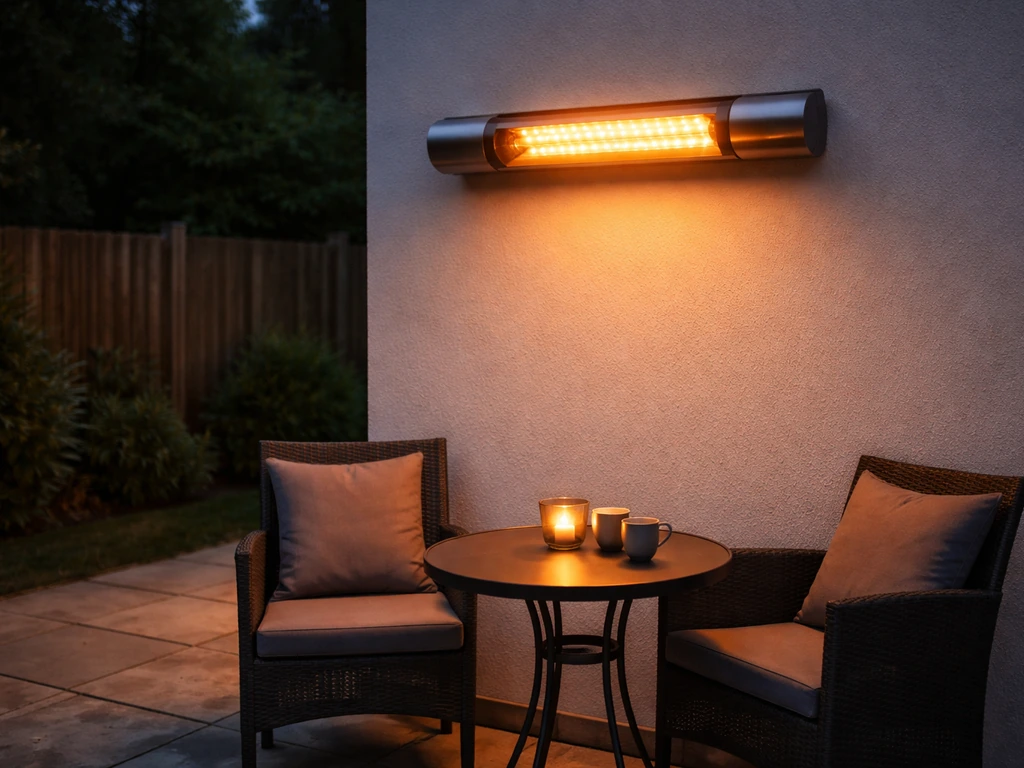
Thermogroup explains that short-wave infrared operates at very high emitter temperatures and delivers heating directly by radiation, so the heating effect is not dependent on air temperature and is less affected by wind works reasonably well in breezy conditions.
Electric wall-mounted heaters without an infrared element are simpler and cheaper upfront, but they lose more heat in open-air conditions. The right pick depends on your patio size, how exposed it is to wind, your wall structure, and whether you want a plug-in unit or a hardwired installation.
Wall-mounted patio heater types to consider
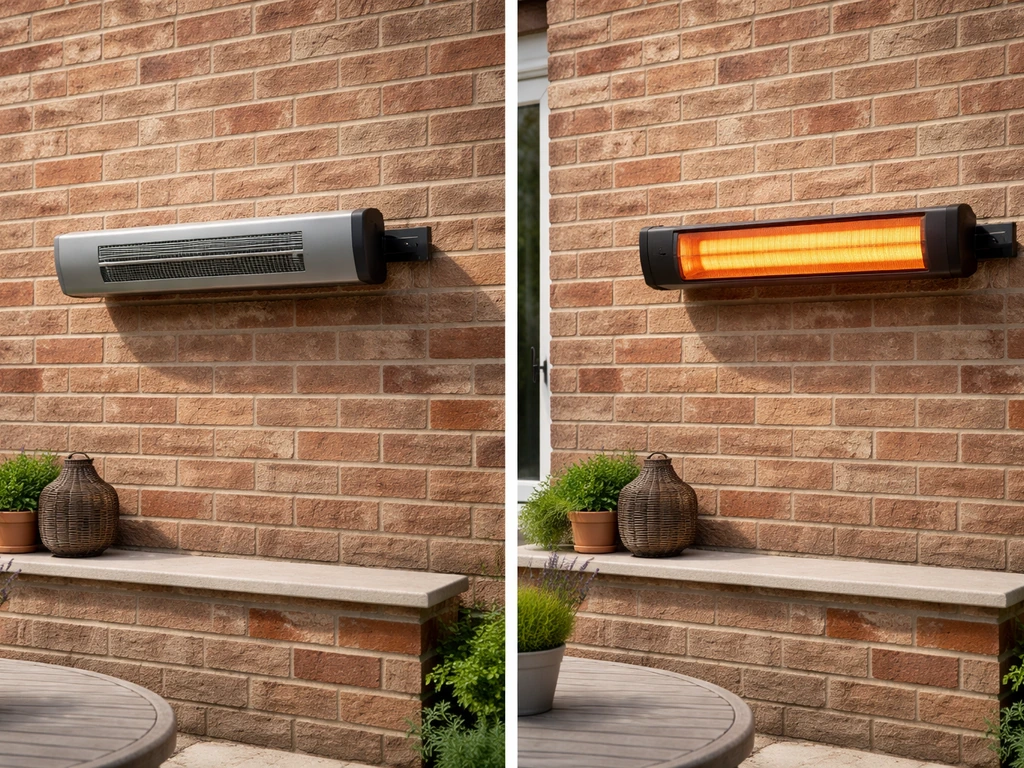
Wall-mounted patio heaters broadly split into two camps: electric resistance heaters and infrared heaters. Within infrared, there are three sub-types based on wavelength, and the differences matter a lot outdoors.
Electric (resistance/convection) wall heaters
These work by heating air, which then circulates around the space. They're familiar, simple to control, and often cheaper to buy. The problem outdoors is that heated air disperses quickly, especially with any breeze. On a sheltered, semi-enclosed patio they can work fine. On an exposed decking area or pergola with open sides, you'll find most of the heat has drifted away before it reaches anyone sitting down.
Short-wave infrared wall heaters
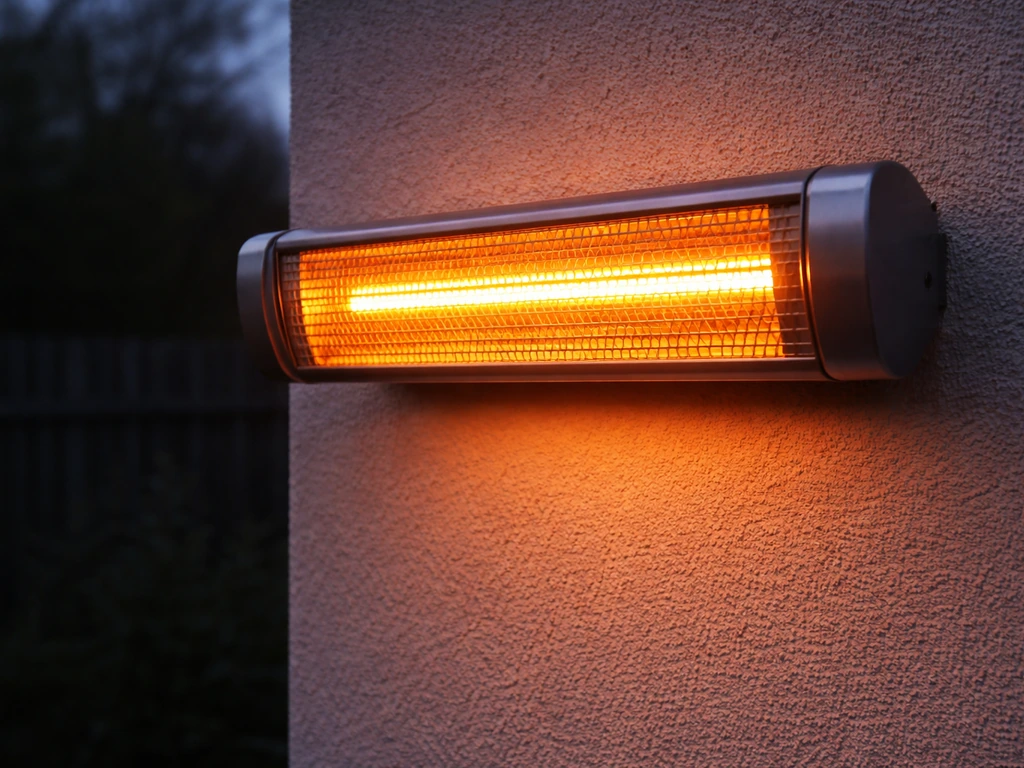
Short-wave infrared operates at very high emitter temperatures and transfers heat directly to objects and people through electromagnetic radiation, it does not depend on air temperature at all. This is why short-wave units perform well in windy outdoor environments: the wind simply can't carry the heating effect away. Products like the Victory Lighting HLW20BG specifically market this property, and the physics backs it up. Short-wave heaters tend to produce an intense, immediate warmth, though some people find the bright glow uncomfortable at close range.
Medium-wave and far-infrared wall heaters
Medium-wave infrared (often carbon fibre elements, like the Veito Blade 2000) runs cooler than short-wave, produces a softer light, and is generally more comfortable at closer distances. Far-infrared (long-wave) is the least suitable for open outdoor use, UK retailer guidance and manufacturer installation manuals both acknowledge that far-infrared spread can reduce by a third to a half in areas with air movement or wind. Herschel's own installation documentation for the Aspect XL2 recommends mounting at the lowest recommended height and increasing heater count in windy locations. Far-infrared can still work on a covered, sheltered patio, but it's a poor choice for any space with regular airflow.
It's also worth knowing that wall-mounted units compete with ceiling-mounted, overhead, and free-standing options. If you are open to other placements, overhead patio heaters can be a strong alternative because they warm from above and free up wall space. If your wall structure is unsuitable for mounting, or if you want heat to come directly from above the seating area, ceiling-mounted electric patio heaters or overhead patio heaters may be worth comparing. But for most walled patios and garden rooms, wall mounting is practical and keeps the floor clear.
| Type | Wind tolerance | Warmth feel | Best for |
|---|---|---|---|
| Electric resistance | Poor | Diffuse | Enclosed/sheltered patios |
| Short-wave infrared | Good | Intense, immediate | Open or exposed patios |
| Medium-wave infrared | Moderate | Softer, comfortable | Partially sheltered patios |
| Far-infrared (long-wave) | Poor | Gentle | Fully covered, calm spaces only |
Choosing the best electric wall-mounted model
When people search for 'electric wall-mounted patio heaters,' they often mean heaters without a visible infrared glow, units with conventional heating elements or halogen elements rather than carbon or quartz tubes. These are worth considering if you want a lower purchase price, simpler controls, and a more discreet look. Here's what to actually compare between listings.
Power output and coverage
For outdoor use, treat wattage-to-coverage claims conservatively. A 2000W wall-mounted electric heater like the Zink Radiant Flare claims 12m² of coverage, that's a reasonable guide for a calm, semi-enclosed space, but you'll likely feel the difference in an exposed setting. The BN Thermic 3kW wall-mounted heater steps up to larger areas and includes detailed coverage tables in its datasheet, with figures varying by mounting height. As a rough rule: budget around 1kW per 4 to 5m² of patio you want to heat in mild UK conditions, and go a step higher if the space is exposed.
IP rating, what you actually need
Any heater left outdoors year-round needs at least IP44, but IP55 is the standard you should insist on. IP55 means the unit is protected against dust ingestion and low-pressure water jets from any direction, so rain, garden hosing nearby, and condensation are all handled. Both the Zink Radiant Flare (IP55) and BN Thermic 3kW (IP55) meet this threshold, and the BN Thermic listing explicitly states it can be 'installed and left outdoors throughout the year.' Don't accept anything lower for a permanent outdoor installation.
Controls and usability
Look for multi-power settings (at minimum two, ideally three), a remote control, and ideally a timer or smart control option. Having to walk to the heater to switch it off defeats the purpose. The electriQ 2kW wall-mounted model includes a remote control and IP55 rating at a competitive price point, that combination is a good baseline expectation for 2026. If you want thermostat control, check the product spec carefully: not all budget wall heaters include a thermostat, only an on/off or fixed-power toggle.
Build quality signals
Aluminium housings dissipate heat better and resist rust, look for that in the spec. Powder-coated steel is also common and acceptable. Avoid plastic-bodied units for permanent outdoor installation; UV degradation and heat cycling will shorten their life considerably. Herschel's UK buying guide makes the point that cheaper heaters often waste usable infrared output due to poor reflector design and inefficient components, the nominal wattage on the box doesn't tell the full story.
Choosing the best infrared wall-mounted model
If you're specifically searching for the best wall-mounted infrared patio heaters, you already know you want that direct radiant warmth rather than air heating. If you want the best hanging patio heaters, focus on output, coverage, and the right mounting height for your space best wall-mounted infrared patio heaters. The key decisions are wavelength (covered above), element type, and whether the unit's real-world output matches the spec sheet.
Shortwave vs carbon fibre elements
Short-wave quartz elements heat up in seconds, produce a bright amber glow, and maintain output even in windy conditions. Carbon fibre elements (medium-wave, used in heaters like the Veito Blade 2000) are slower to heat, produce a dimmer light, and are generally considered more comfortable at closer seating distances, the Veito Blade 2000 covers around 25m³ at 2kW and includes a thermostat and remote. For a table or seating area 2 to 3 metres away on an exposed patio, go short-wave. For a covered terrace where people sit within 1.5 to 2 metres, medium-wave carbon fibre is comfortable and efficient.
Wattage for realistic outdoor coverage
A 2kW infrared wall heater is a practical starting point for a seating group of 2 to 4 people in a sheltered spot. Step up to 3kW (like the CED HTIR3WL, which comes with a UK plug) if the space is larger or more exposed. For serious exposure, a garden wall with open sides, consider mounting two 2kW units rather than a single 4kW unit, since spread coverage from two points is more even than one hot spot.
What the efficiency claims actually mean
Infrared heaters are often marketed as '100% efficient' because they convert electricity directly to radiant heat with minimal losses inside the unit. That's true in a technical sense, but outdoor efficiency depends heavily on the quality of the reflector and the emitter. A cheap unit with a poorly shaped reflector scatters heat in the wrong directions, wasting a significant proportion of its output. When comparing models, look at the reflector design (parabolic aluminium reflectors outperform flat or chrome ones), check for certifications, and read real-user feedback on warmth at the quoted coverage distances.
UK-specific buying considerations
If you're buying in the UK, there are a few things that trip people up and are worth knowing before you buy.
UK climate realities
The UK patio season is roughly April through October, with useful heating demand from late September through to October and again in April and May when evenings drop to 8 to 12°C. Summer evenings can still feel cool after 8pm, especially in northern England and Scotland. UK gardens are also frequently damp, morning condensation, light rain, and mist are normal. This is exactly why IP55 is non-negotiable, and why heaters marketed with 'leave outdoors year-round' credentials (as the BN Thermic range states) are worth paying a little more for.
Power and plug requirements
Most 2kW wall-mounted heaters in the UK come with a standard 13A plug, meaning you can connect to an existing outdoor socket without any wiring work. Some 3kW models also come plug-ready (the CED HTIR3WL does), which keeps installation simple for most homeowners. Step above 3kW and you're almost certainly looking at a hardwired connection requiring a qualified electrician. Even for plug-in models, the outdoor socket itself must be RCD-protected, if yours isn't, that's a job for an electrician before the heater goes up.
Electrical regulations and who does the work
In the UK, any new fixed electrical installation outdoors falls under Part P of the Building Regulations. This means the work must either be notified to your local authority or carried out by a registered installer under a Competent Person Scheme, GOV. UK maintains the current list of approved schemes and explains how to find a registered electrician in your area. For a hardwired heater, always use a registered professional.
Installing one yourself and not notifying the local authority is technically non-compliant and can cause problems with home insurance or when selling the property. If the heater installation is in a wet zone (near a pool, outdoor shower, or similar), a 30mA residual current circuit breaker is mandatory under UK electrical standards, this is documented in manufacturer installation manuals and is a legal requirement, not just a recommendation.
Running costs at current UK electricity rates
Under Ofgem's April to June 2026 price cap, electricity costs 24.67p per kWh. From 1 July 2026, this rises to 26.11p per kWh. At those rates, here's what typical wall-mounted heaters cost to run per hour at full power. Ideal Home’s cost-per-hour framing uses typical wattages and shows how different power settings translate into roughly 11p to 33p per hour for halogen settings, depending on wattage and tariff cost-per-hour framing for different heater power settings.
| Heater wattage | Cost/hr (Apr–Jun 2026) | Cost/hr (Jul–Sep 2026) |
|---|---|---|
| 1.5kW | ~37p | ~39p |
| 2kW | ~49p | ~52p |
| 2.5kW | ~62p | ~65p |
| 3kW | ~74p | ~78p |
A 2kW heater used for two hours on a Friday evening costs about £1. Over a full season of around 60 evenings at two hours per session, that's roughly £60 per year at current rates. Choosing a heater with multiple power settings is a real cost saver, running at 1kW instead of 2kW when the evening is only slightly cool halves your running cost.
Installation and placement for maximum heat
Getting the positioning right makes the difference between a heater that feels effective and one that sits ignored because it doesn't reach anyone. This is worth thinking through carefully before you drill anything.
Mounting height
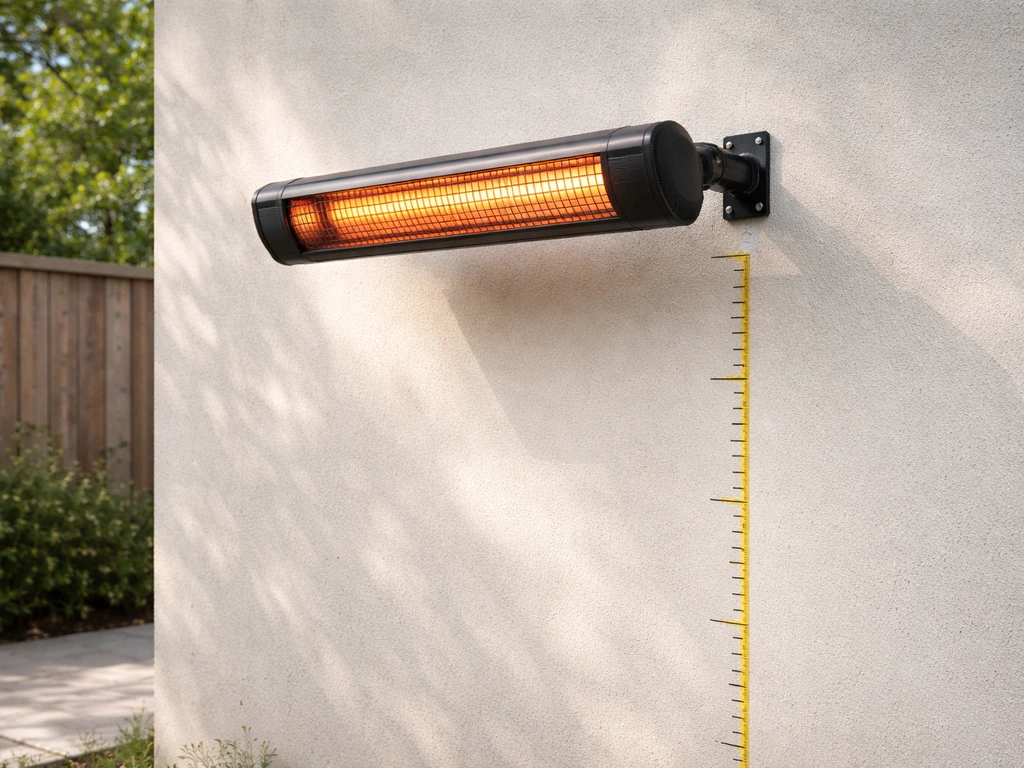
For most wall-mounted patio heaters, a mounting height of 1.8m to 2.5m from the ground is the sweet spot. The Heatscope installation manuals specify a minimum of 180cm from the ground for their models, and this is a common minimum across brands. Too low and you risk people inadvertently touching or looking directly at the element. Too high and the heating angle becomes inefficient, you're warming the top of people's heads rather than their bodies. If your patio has a higher wall or pergola beam, mount closer to 2m and angle the heater downward toward the seating area rather than mounting at 3m or above.
Aiming angle and coverage distance
Most wall-mounted infrared heaters have an adjustable bracket allowing a 30 to 90 degree downward tilt. Aim the centre of the beam at roughly chest/shoulder height of a seated person. For a 2kW heater mounted at 2m, effective coverage is typically 2 to 3 metres out from the wall, enough for one or two rows of seating. For deeper patio layouts, either mount the heater further along the wall to reach further seating areas, or add a second unit. Don't aim a heater directly at combustible materials (timber screens, awning fabric, parasols) within 1 metre of the beam centre.
Wall structure and fixings
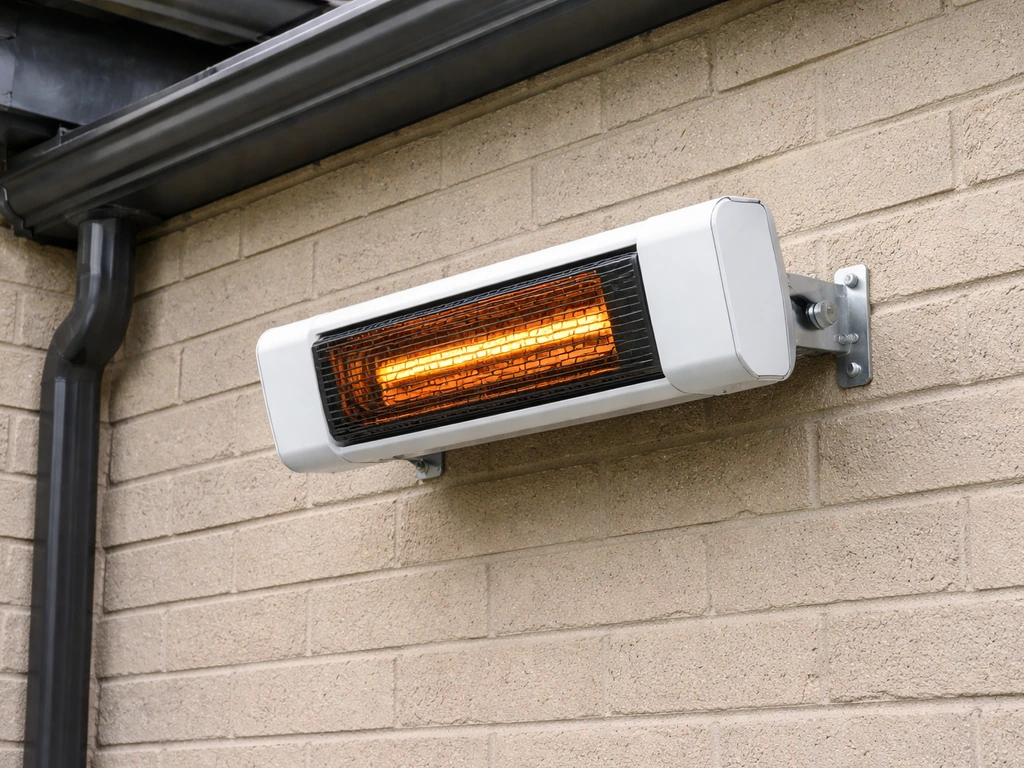
Wall-mounted heaters are not light, a 2kW to 3kW unit can weigh 4 to 8kg, plus the bracket. Always fix into masonry, brick, or solid timber with appropriate anchor bolts or coach screws. Fixing into cavity wall panels, hollow render, or lightweight cladding without backing plates is a structural failure risk. If your wall is anything other than solid masonry or concrete, get professional advice on the fixing method before mounting. Also check that the power cable route to the socket or connection point doesn't pass through a wet zone or across a path where it creates a trip hazard.
Avoiding problem zones
Keep the heater away from areas where water pools or drips concentrate, directly under a gutter drip line, for example, or below a pergola roof section that funnels rain. Even with IP55 protection, prolonged or directed water ingress beyond splash resistance will eventually cause issues, and manufacturer warranties (as Herschel's manual makes clear) won't cover damage from water ingress if the unit wasn't installed to the specified guidance. Also avoid mounting in corners where heat reflects back onto the heater body rather than projecting out into the seating area.
Safety, operating costs, and maintenance
Day-to-day safety
Wall mounting eliminates the tip-over risk that affects free-standing patio heaters, which is a genuine safety advantage with children or pets around. That said, the element housing gets very hot during use. Keep flammable materials, cushions, tablecloths, fabric windbreaks, at least 1 metre from the front of the heater. Never leave a heater running unattended in an area where it could contact furniture or awnings if the wind changes direction. Most quality models include overheat protection that cuts power automatically, but this is a fail-safe, not a substitute for sensible placement.
Installation safety (hardwired models)
For hardwired models, the job must be done by a qualified electrician registered under a Competent Person Scheme (required under Part P of UK Building Regulations). This isn't optional. An improperly wired outdoor heater is a fire and electrocution risk, particularly in wet conditions. Ask your installer for the completion certificate, you'll need it for buildings insurance purposes and if you ever sell the house.
Reducing running costs
The biggest lever on running cost is usage habits rather than heater choice. A heater with multiple power settings lets you run at 1kW or 1.5kW on mild evenings instead of always running at full power. Adding a timer means you're not paying to heat an empty patio. Smart plugs compatible with standard 13A outdoor socket models are an inexpensive way to get timer and remote control on heaters that don't include those features built in. At the July 2026 rate of 26.11p per kWh, dropping from 3kW to 1.5kW for a two-hour session saves about 78p per evening, that adds up over a season.
Maintenance routine
Wall-mounted patio heaters need very little maintenance, but they do need some. At the start and end of the season, wipe down the reflector with a dry cloth, dust and debris on the reflector reduce output efficiency noticeably. Check the mounting bracket fixings for any sign of loosening or rust, especially after a wet winter. Inspect the power cable and plug for damage or corrosion at the connection point.
If the element has dimmed or produces an uneven glow compared to when it was new, the element is likely near the end of its life, replacement elements are available for most quality brands and are much cheaper than a whole new unit. Store plug-in units indoors during winter if you want to maximise lifespan.
Quick decision checklist before you buy
Run through these before you commit to a model. They'll narrow the field faster than reading another dozen product descriptions.
- Measure your patio seating area in m² and note the furthest seat from your intended mounting wall — this sets your minimum coverage requirement.
- Assess wind exposure: is the space enclosed on three sides, partially open, or fully exposed? Open or exposed means short-wave infrared only.
- Check your wall: is it solid masonry or brick? If not, confirm the fixing method with a professional before buying.
- Check your outdoor socket: is it RCD-protected? If not, sort this before the heater arrives.
- Decide plug-in or hardwired: if the heater is over 3kW or you want a permanent, clean installation, budget for an electrician.
- Compare IP ratings — minimum IP55 for any outdoor wall-mounted installation.
- Look for multiple power settings and ideally a remote control or timer as standard.
- Calculate running cost at your preferred wattage using the current Ofgem rate (26.11p per kWh from July 2026) and your expected hours of use per week.
- For infrared models, check the reflector type (parabolic aluminium is best) and read actual user reviews on warmth at the stated coverage distance — not just the wattage claim.
FAQ
How do I choose the right coverage for my patio, beyond the m² figure on the listing?
Measure from the wall to where people will actually sit, then match that to the effective throw distance in the product’s manual (not just the marketing “area” claim). If your seating is in two rows, look for either a wider beam angle or the option to mount more than one heater, because a single unit often leaves the back row noticeably cooler.
Do wall-mounted infrared patio heaters still need a clear safety gap from furniture and awnings?
Yes, they can still be an issue even with infrared, because the element housing gets very hot. In practice, keep direct line-of-sight to seating textiles and anything that can catch or deform from heat. Also avoid aiming the beam through or behind windbreak materials, since reflected heat can overheat the heater casing or soften awning fabric.
What’s the biggest positioning mistake people make with wall-mounted patio heaters?
Look for a stated “minimum mounting height” and “beam centre” guidance in the manual, then use the tilt range. A common mistake is mounting high to “reach further,” which mainly warms higher air and the tops of heads. If you are forced higher by a beam, compensate by angling down more and reducing the distance from wall to seating, or adding a second unit.
I have an outdoor socket already, do I still need an electrician before mounting a plug-in wall heater?
If your heater is plug-in, you still need a suitable outdoor socket with RCD protection (and weatherproofing). If you are unsure whether your outdoor socket is protected, get an electrician to check before installing, because an unprotected socket is a common reason installations get delayed or fail safety checks.
Why do infrared heater coverage numbers seem inconsistent between brands?
Be careful with “coverage” units like m², m³, and “up to X people.” Those are based on specific assumptions about wind and mounting height. For exposed patios, use the lower end of any stated distance, and prefer models that publish mounting-height-based tables rather than relying on a single universal number.
How can I tell whether a wall heater’s thermostat control will actually reduce running costs?
If multiple power settings are not available, your only control may be on or off, which can feel wasteful when the evening is only slightly chilly. If thermostat control is important, confirm it is integrated into the heater (not just a remote) and that the thermostat is designed for outdoor use, because some cheap units use basic time or fixed cycling.
Will short-wave infrared heaters be too bright or uncomfortable near the seating area?
For short-wave infrared, the glow can be bright at close range, especially if the heater is mounted at the low end of the recommended height. A practical fix is to mount at the higher end of the guidance, angle the beam so the centre targets chest height, or choose a medium-wave carbon fibre model for closer seating distances.
Should I buy one high-watt heater or two lower-watt wall heaters for a deep patio?
Two smaller heaters can perform better than one larger unit on uneven layouts, because you can aim each beam at a different seating row and avoid hot spots. If the patio is deep or has corners, plan either staggered mounting points or a second unit before buying a single “big” heater.
If a heater is IP55, can I still ignore where rain runs off?
IP55 is usually the minimum for leaving outdoors year-round in typical UK garden conditions, but also check for the exact installation statement (some units expect protective mounting placement). Even IP55 units should not be placed where rain is directly driven at the front or where gutters funnel water onto the heater body.
What maintenance checks actually affect how well the heater performs?
Replace any damaged cable, damaged plug, or degraded reflector promptly. Dust on the reflector reduces the beam effectiveness, so regular dry-wiping at the start and end of the season matters. Also check bracket security after winter, because repeated wet-dry cycles can loosen fixings even on solid walls.
Which infrared type performs best on exposed patios with regular wind?
On breezy nights, short-wave models generally maintain noticeable warmth better because wind cannot easily “carry away” the radiant effect. Medium-wave can still work well but may feel less intense at the same distance when exposure is high. If you sit 2 to 3 metres out on an open patio, shortlist short-wave first.
How should I interpret “100% efficient” claims for outdoor infrared heaters?
Avoid relying on “100% efficient” marketing for outdoor heating performance. Outdoor comfort depends on reflector quality, beam direction, and how much of the emitted radiation reaches people versus walls or the ground. Compare real-world warmth at stated distances and prefer models with proper reflector design, not just higher wattage.
What should I check if my wall is not solid masonry?
If you are mounting into anything other than solid masonry or solid timber, do not guess the fixings. Cavity walls, hollow cladding, and lightweight render can require specialist backing plates or different anchors, and using the wrong method can fail structurally. Get professional advice on suitable fixings for your wall type.
My heater feels weak, what are the first three things to troubleshoot?
If the beam is heating the wrong zone, you often feel like the heater is “not powerful enough.” Recheck mounting height, confirm tilt direction, and ensure the beam is not aimed at combustible materials (within about 1 metre of the beam centre). When wind shifts, avoid placing heaters so that the beam is constantly blocked by parasols or fabric screens.
What electrical protection requirements should I expect for a wall-mounted outdoor heater in a wet zone?
For exposed or wet-zone installations, the decision is not only about the heater but also the electrical protection. In wet zones, a 30 mA RCD is mandatory, and even outside wet zones the socket or supply circuit should be properly protected. Use a qualified electrician to confirm compliance with UK outdoor electrical standards.
Next Articles
Best Price on Outdoor Patio Heaters: Compare Costs & Deals
Score the best price on outdoor patio heaters, price ranges, top picks, deal tactics, total-cost & safety checklist.
Where Can I Rent Patio Heaters Near Me Today
Find where to rent patio heaters near you today, choose the right fuel type, compare costs, and book safely.
Where to Buy a Patio Heater: Best Places and Types
Where to buy a patio heater now, plus electric vs gas vs propane tips, safety checks, and size/BTU buying checklist.