
The best overhead patio heaters right now are electric infrared models for most covered patios, natural gas radiant heaters for larger commercial or semi-open spaces, and propane overhead units where gas lines aren't an option. Overhead mounting, whether that's ceiling-flush, pole-drop, or bracket-wall, gives you the most even heat distribution across your seating area without sacrificing floor space or creating trip hazards. The right choice comes down to your fuel access, ceiling height, coverage area, and how open your patio is to wind.
Best Overhead Patio Heaters: Buying Guide and Comparisons

Caleb Vale
24 Jun 2026

How to choose the best overhead patio heater
Before you even look at product listings, you need to nail down three things: how much space you're heating, what fuel you have access to, and what kind of heat output style makes sense for your setup. Getting these wrong means buying a heater that either underwhelms or is genuinely overkill.
Size your space first
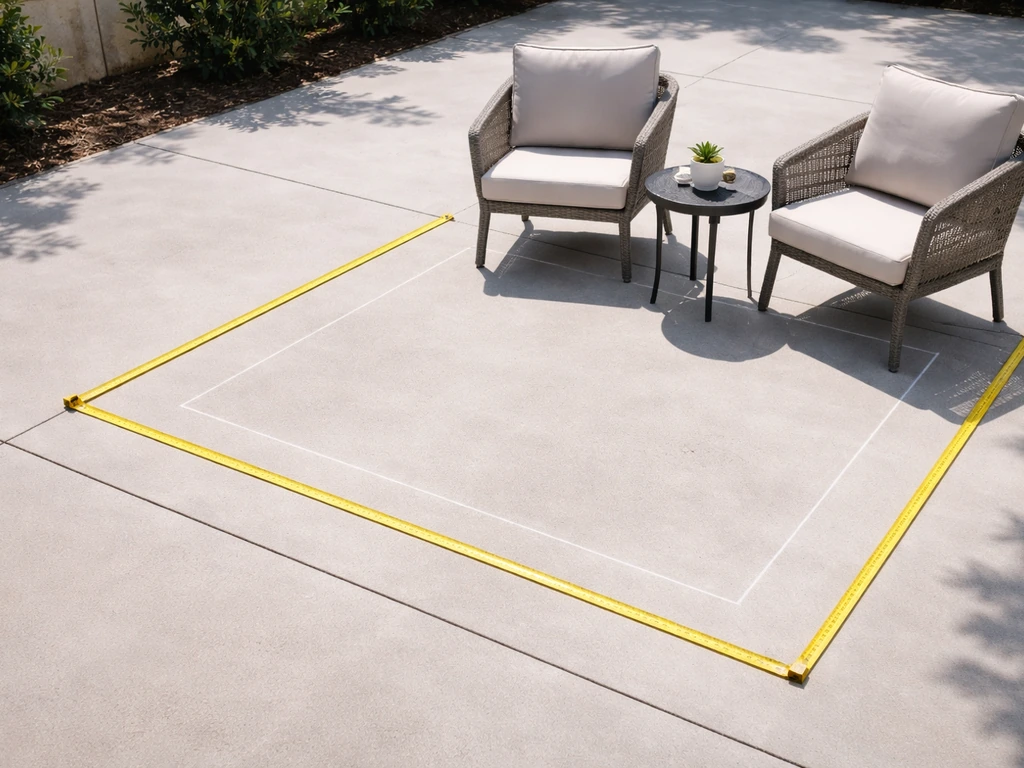
The standard starting point is 20 BTU per square foot of usable seating area. That's not the total patio square footage, it's the area where people actually sit. So a 200 sq ft covered dining area needs roughly 4,000 BTU, but bump that up 10 to 20 percent if your patio is fully open to wind, or trim it 5 to 10 percent if you have a solid roof and walls on two or more sides. For electric heaters, divide your BTU target by 3.41 to get the wattage equivalent (e.g., 4,000 BTU is roughly 1,175W).
Ceiling height matters more than most buying guides admit. If your ceiling is above 8 feet, simple square-footage math starts to break down because you're heating more air volume. In those cases, use a cubic-footage and temperature-rise formula instead: multiply your space's cubic footage by 0.133, then multiply by your desired temperature rise in degrees Fahrenheit. That gives you a more accurate BTU target for taller or partially enclosed pergola-style patios.
For reference, Bromic's Tungsten Smart-Heat Electric line covers up to 64 sq ft at 2,000W, 100 sq ft at 3,000W, 120 sq ft at 4,000W, and 144 sq ft at 6,000W. These are manufacturer claims under ideal conditions, so if your patio is even moderately exposed, size up one tier.
Radiant vs convection heat: which one belongs overhead
Almost every overhead patio heater worth buying uses radiant (infrared) heat, not convection. Here's why that matters: radiant heat warms people and surfaces directly, like sunlight, so there's essentially zero warm-up time when you flip the switch. Convection heaters warm the surrounding air first, which in an open or semi-open outdoor space means a significant portion of that heated air blows away before it reaches anyone. Overhead mounting amplifies this problem for convection, because hot air rises rather than descending to where people are sitting. Stick with radiant infrared for any overhead patio application.
Fuel type: matching your patio to the right energy source
Fuel type is largely determined by what you already have at the patio, but it also affects operating cost, installation complexity, and how often you're dealing with maintenance. Electric is the simplest to install and the cleanest to operate. Natural gas is the most cost-effective for high-usage patios once the line is run. Propane sits in the middle, more flexible than gas but more expensive per BTU at scale. Infrared is a heat style, not a fuel, though the term often gets used shorthand for electric infrared specifically. Pellet heaters exist in the overhead category but are genuinely niche and mostly irrelevant for ceiling-mount applications.
Overhead heaters vs other mounting styles
Overhead and ceiling-mounted heaters are distinct from wall-mounted, freestanding, and hanging pendant-style units, though there's some overlap. Here's how to think about each category in relation to overhead mounting specifically.
Wall-mounted heaters attach to a vertical surface and angle downward, which means their effective coverage is directional and best suited for narrow seating zones along a wall. If you want a more targeted solution for a seating area along a wall, the best wall mounted patio heaters are worth comparing as well. They're great for smaller patios or where ceiling mounting isn't structurally feasible. True ceiling-mount heaters flush-mount or drop from above, delivering more uniform downward radiation across a wider area. Hanging patio heaters (pendant or drop-style) achieve a similar ceiling-drop effect but are suspended from a chain or cable, making them better for pergolas or structures without a solid overhead surface.
Freestanding heaters are a completely different use case: portable, flexible, but they eat floor space and create flow-through problems in tight seating arrangements. If you're comparing overhead to freestanding, the overhead option almost always wins for covered patios where you want clean sightlines and even heat. The ceiling-mounted electric category in particular is worth a close look if you have a covered patio with access to a dedicated 240V circuit.
Top picks by fuel type
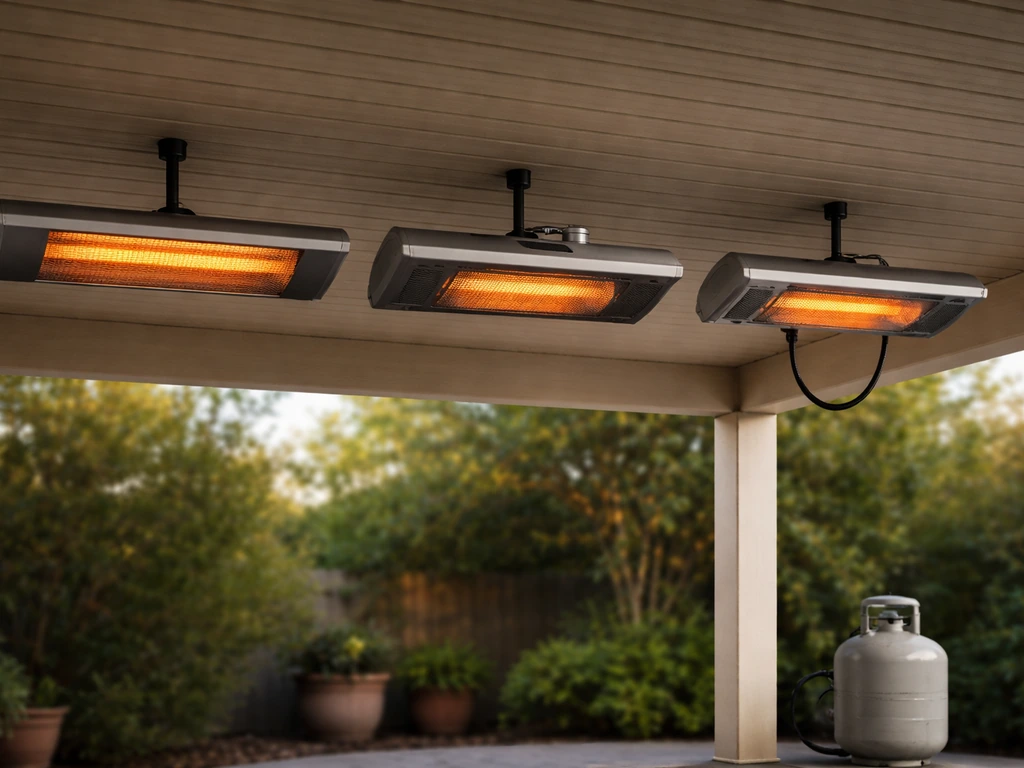
Electric overhead heaters
Electric infrared is the go-to choice for residential covered patios. No gas line, no venting requirements, no open flame. Bromic's Tungsten and Platinum Smart-Heat Electric lines are the benchmark here: slim-profile, ceiling or wall mountable, and available in 2,000W to 6,000W. The Platinum series is specifically designed for low-clearance or design-forward spaces. For a more budget-conscious option, TPI's RPH-240-A ceiling-mount infrared unit runs at 1,600W (roughly 5,461 BTU equivalent) and comes with defined mounting clearances right in the spec sheet. Aura Heaters is another solid brand, with cETLus certification to UL 2021 and CSA standards. For electric, look for IPX4 weatherproofing at minimum, 240V compatibility for serious coverage, and a unit that explicitly lists ceiling-mount as a supported configuration.
Natural gas overhead heaters
Natural gas overhead heaters make the most sense for restaurants, bars, and larger residential patios with existing gas infrastructure. Schwank's commercial lineup offers strong coverage-area-to-BTU ratios, with a 35,000 BTU/h gas model covering up to around 250 sq ft. Sunglo's A244 is a 50,000 BTU/hr suspended natural gas unit commonly used in commercial settings, though its coverage drops noticeably in wind-exposed installations. Gas overhead heaters need to be used in adequately ventilated areas, per code, and must comply with NFPA 54 venting concepts. They're not the right call for fully enclosed spaces.
Propane overhead heaters
Propane ceiling or overhead heaters make sense when you don't have a natural gas line but need more heat output than electric can deliver on a standard circuit. The trade-off is that propane costs more per BTU at current prices (the US average was $2.674 per gallon as of late March 2026, per EIA data) and you'll need to manage tank supply. A typical 40,000 BTU propane overhead heater runs about $1.70 per hour in fuel costs under those pricing conditions. Propane overhead heaters must comply with ANSI Z83.26/CSA 2.37 standards for gas-fired outdoor infrared patio heaters, so check for that listing on any model you're considering.
Infrared (radiant) heaters
"Infrared" as a marketing category covers both electric and gas-fired radiant heaters. The ReverberRay and SunStar SGL series are examples of gas-fired overhead infrared heaters designed specifically for patio and outdoor commercial use, with detailed engineering guides covering mounting angles, clearance distances, and layout patterns for multi-unit installations. These are well-suited for wide, partially open patios where you need to cover irregular seating zones with overlapping heat patterns. Some marketing claims get aggressive here, with a few units claiming up to 1,000 sq ft coverage, but treat those numbers skeptically and cross-reference with independent reviews.
Pellet overhead heaters
Pellet overhead heaters are genuinely uncommon in the ceiling-mount category. They're more relevant to freestanding or tabletop formats. If you're drawn to pellet fuel for ambiance or sustainability reasons, you'll mostly find them in standalone units rather than true overhead configurations. For a covered patio with a ceiling, pellet is not a practical overhead option right now, and it's worth focusing your search on electric, gas, or propane instead.
How these heaters actually perform
Coverage claims from manufacturers are almost always tested under ideal, still-air conditions. Real-world performance depends heavily on wind exposure, ceiling height, and how the heat is angled toward the seating zone. Here's what the data and real-world feedback consistently show across fuel types.
| Fuel Type | Warm-Up Time | Typical Coverage (per unit) | Wind Sensitivity | Typical Running Cost |
|---|---|---|---|---|
| Electric Infrared | Instant (on/off) | 64–144 sq ft (2,000–6,000W) | Low to moderate | ~$0.24/hr at $0.16/kWh (1.5kW unit) |
| Natural Gas Radiant | Near-instant (30–60 sec) | 150–250+ sq ft (35,000–50,000 BTU) | Moderate | Lower long-term; varies by local rate |
| Propane Radiant | Near-instant (30–60 sec) | 100–200 sq ft (25,000–40,000 BTU) | Moderate | ~$1.70/hr at ~$2.67/gal (40,000 BTU) |
| Gas Infrared (ReverberRay type) | Near-instant | 150–300+ sq ft (commercial) | Moderate to high | Similar to natural gas |
| Pellet (freestanding) | 5–15 minutes | Limited; ambient only | High | Varies; not practical overhead |
Radiant infrared heaters, whether electric or gas, produce heat the moment they're switched on. There's no delay warming up air volume, because they're heating surfaces and bodies directly. In side-by-side use, a 4,000W electric infrared overhead heater and a 40,000 BTU propane overhead heater will both feel warm within seconds of startup. The difference shows up in coverage area, running cost, and how well the heat holds in wind. Gas units generally push more raw BTUs and can compensate better for breeze, while electric units offer finer control and are easier to dim or zone.
Installation, mounting, and clearance
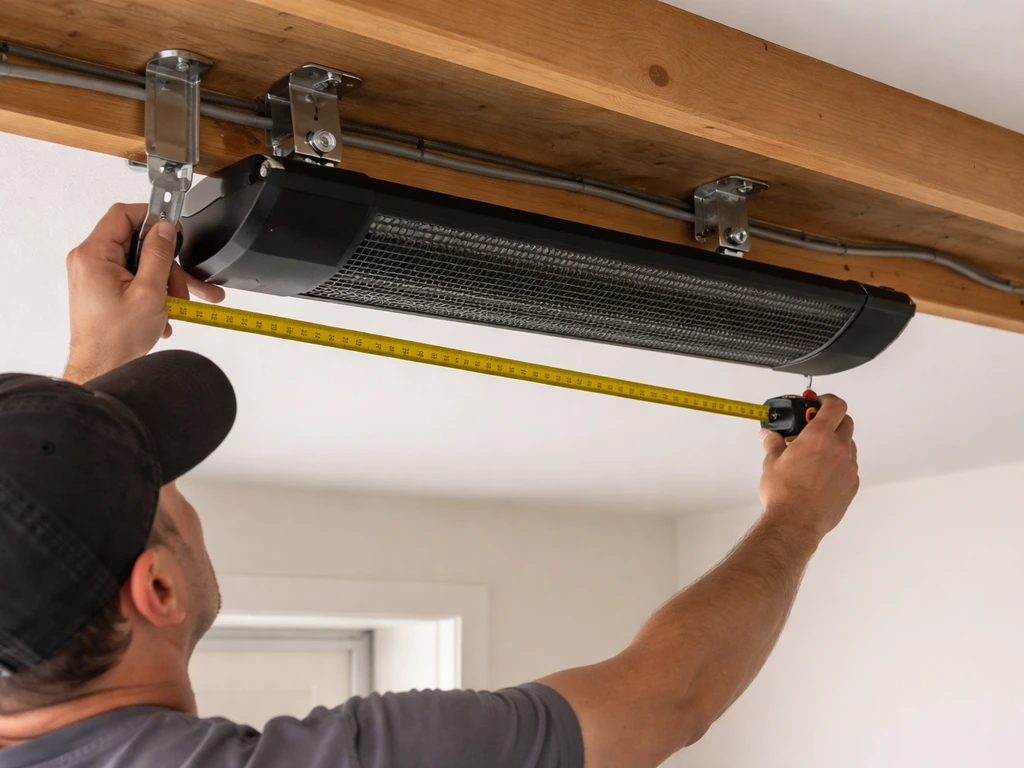
Overhead heater installation isn't a weekend DIY job for gas models, and even electric ceiling-mount heaters deserve careful attention to structural attachment, wiring, and clearance. Here are the key things you need to know before you buy.
Ceiling height and minimum clearances
Most overhead heater manufacturers specify a blank" rel="noopener noreferrer">minimum 8-foot clearance from the heater's radiant face to the floor or to people below. Bromic explicitly flags this as the standard minimum for ceiling-mount configurations and recommends pole mounts to achieve it when the ceiling itself is higher. SunStar's SGL Series manual discusses using a heat shield kit to reduce clearances toward the ceiling surface when overhead space is tight. Always read the clearance tables in the specific model's manual before mounting, because the numbers vary by model, mounting angle (flat 0 degrees vs angled 45 degrees), and combustible vs non-combustible ceiling materials.
Mounting options for covered patios
- Flush ceiling mount: attaches directly to a structural beam or joist; best for solid covered patios with 8+ ft ceilings
- Pole drop mount: heater hangs below the ceiling surface on a fixed post; useful when you need to bring the heater closer to the seating zone without it being too far from occupants
- Recess kit (electric only): some electric models like Bromic Platinum offer recess kits that sit flush with the ceiling surface for a clean architectural look
- Wall-angle bracket: technically a wall mount, but angled downward to simulate overhead coverage; good for narrow covered patios where ceiling mounting isn't feasible
Electrical and gas connections
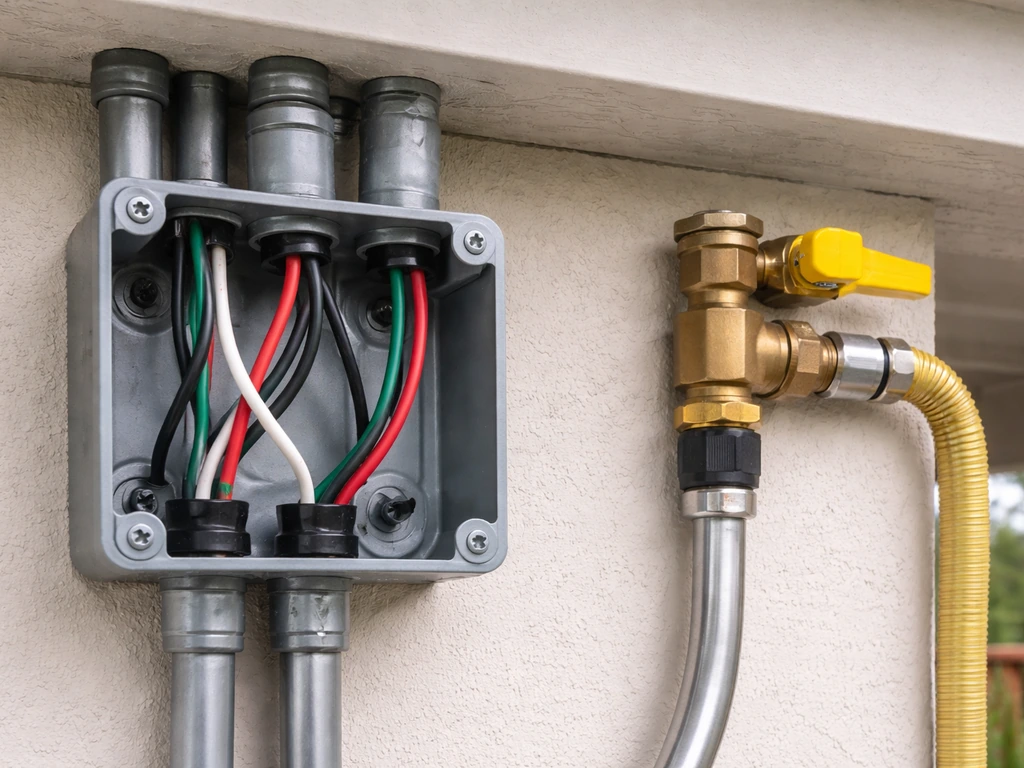
Electric overhead heaters in the 4,000W to 6,000W range typically require a dedicated 240V/20A or 240V/30A circuit. Don't assume your existing outdoor outlet will work. Run a new circuit if needed and use outdoor-rated wiring components rated to at least IPX4 (splash-resistant) for all connections near the heater. The Bromic Platinum manual specifically calls out IPX4-rated wiring components for ceiling installations. For natural gas and propane units, you'll need a licensed gas fitter to run and connect the supply line in most jurisdictions. Budget for that labor cost, typically $200 to $500 or more depending on line length and local rates.
Multi-unit layout
For patios larger than roughly 150 to 200 sq ft, one overhead heater usually isn't enough. Use overlapping coverage zones: mount units at even intervals so their heat patterns overlap by about 20 percent. ReverberRay and Schwank both publish patio heater design guides with mounting-angle diagrams and spacing tables that make this math straightforward. As a rough rule, plan one 4,000W electric or 35,000 BTU gas overhead heater per 100 to 150 sq ft of effective seating area in moderate climates, and adjust upward for wind-exposed or very cold climates.
Safety, weather resistance, and running costs
Certifications to look for
For electric overhead heaters, look for UL 2021 listing (fixed and location-dedicated electric room heaters) and CSA certification. cETLus to UL 2021 and CSA, as carried by brands like Aura Heaters, is the right baseline for a hardwired ceiling-mount unit. For gas-fired units, the relevant standard is ANSI Z83.26/CSA 2.37 (gas-fired outdoor infrared patio heaters). Any product that doesn't reference these certifications should be treated with caution, especially for hardwired or permanently mounted applications.
Ventilation requirements for gas heaters
Gas-fired overhead patio heaters must be used outdoors in adequately ventilated areas with ample fresh air. This is both a code requirement and a safety imperative: combustion products include carbon monoxide, and per NFPA 54 principles, gas appliances that aren't direct-vent or power-vented need combustion products to exhaust outdoors. Even on a covered patio, make sure at least two sides are open to free airflow. If your covered patio is more than 50 percent enclosed by walls or screens, gas overhead heaters are not appropriate without a detailed ventilation assessment.
Weather resistance ratings
For any overhead heater installed under a covered patio that gets rain exposure, you want a minimum IP44 or IPX4 rating. Models designed for true outdoor use will typically carry IP55 or higher. Check whether the rating applies to the heater body only or also includes the electrical connections and mounting hardware. Wind is the other factor: overhead heaters in open or pergola-style patios lose effectiveness quickly in sustained wind above about 10 to 15 mph, which is a physical limitation of radiant heat, not a product flaw. Positioning heaters with their radiant face angled slightly toward the prevailing wind direction helps, as does adding windscreen panels on the most exposed side.
Running costs by fuel type

At a US average residential electricity rate of about $0.16 per kWh, a 1,500W electric infrared overhead heater costs roughly $0.24 per hour to run. Scale that up to a 4,000W unit and you're looking at about $0.64 per hour. A 40,000 BTU propane heater runs approximately $1.70 per hour at current propane prices. Natural gas is generally cheaper per BTU than propane at US residential rates, though rates vary significantly by region. Over a full heating season, these differences add up fast: for a restaurant patio running 6 hours a night, 5 nights a week, a propane overhead heater costs roughly $2,652 per season vs around $998 for a comparable electric unit at average national rates.
Maintenance and longevity
Electric infrared heaters have very few moving parts. The main maintenance tasks are cleaning the reflector panel (a damp cloth once or twice per season), checking the wiring connections for corrosion annually, and inspecting the mounting hardware for any loosening. Gas overhead heaters need annual burner inspection, cleaning of the burner ports, and checking the gas connections for leaks with soapy water or a leak detector. Replace gas supply hoses every 2 to 3 years regardless of visible condition. For all overhead units, check the mounting bolts and brackets at the start of each season, especially in climates that see freezing and thawing cycles.
Your practical next steps before you buy
Here's a simple process to get from browsing to buying with confidence. If you want a quick shortlist, start with the best hanging patio heaters that match your fuel access, ceiling height, and wind exposure.
- Measure your usable seating area in square feet, then multiply by 20 to get your baseline BTU target. Adjust up 10 to 20 percent for open patios, down 5 to 10 percent for well-enclosed ones.
- Check your ceiling height. If it's under 8 feet, your mounting options are limited and you should prioritize low-profile electric models with explicit low-clearance ratings. If it's 9 feet or above, you have full flexibility.
- Confirm your fuel access. Is there a gas line within reach? If not, is there a 240V circuit (or room to run one) at the ceiling? If neither, a smaller electric unit on a standard 120V circuit is your entry point.
- Decide how many units you need. Divide your total seating area by the per-unit coverage claim, then add one extra unit if your patio is open on two or more sides.
- Check certifications before buying: UL 2021/CSA for electric, ANSI Z83.26/CSA 2.37 for gas. No certification listing is a red flag.
- Calculate your seasonal running cost using the per-hour fuel cost formula (watts divided by 1,000 times $/kWh for electric; BTU/hr divided by 91,502 times gallons times $/gallon for propane) to compare options on total cost of ownership, not just sticker price.
- Read verified purchase reviews specifically for comments about heat distribution evenness and wind performance, not just overall star ratings. Those two factors are where marketing claims most often diverge from reality.
FAQ
Can I use a 120V outdoor outlet for the best overhead patio heaters instead of hardwiring 240V?
In most cases, no. Most ceiling-mount infrared units in the 4,000W to 6,000W range require a dedicated 240V circuit, and plugging into 120V will either trip breakers or force you into much smaller heaters that cannot meet the BTU targets. If you only have 120V available, plan on using multiple smaller units or a lower-output model, and confirm the exact voltage requirement in the manual before purchasing.
What ceiling height is “safe,” and how do I handle heaters under a low pergola?
A common baseline is maintaining about 8 feet between the heater’s radiant face and people or the floor, but the allowable clearance depends on model, mounting angle, and whether the ceiling material is combustible. If you are under a low pergola, look for kits or mounting options intended for reduced clearances (for example, manufacturer heat-shield kits), and verify the clearance table for your exact ceiling type and 0 degree versus angled mounting.
Do overhead patio heaters need to be covered by a heater-specific weather rating, or is general outdoor use enough?
You should match the heater’s weatherproof rating to your exposure. For rain-prone covered patios, aim for at least IPX4 (splash-resistant) at minimum, and prefer higher ratings for direct weather. Also check whether the IP rating applies to the whole unit including electrical connections and brackets, not only the heating element.
How do I size an overhead heater for an area with lots of wind, like an open backyard?
Start with the seating-area BTU math, then size up one tier beyond the manufacturer’s coverage claim. A practical approach is adding 10 to 20 percent if the patio is fully exposed, then consider overlapping heater zones so people are still in the direct radiant path when gusts hit. If wind is sustained, electric will still work, but gas units often maintain comfort better because they deliver higher output and can better offset losses to breeze.
What’s the difference between “infrared” coverage and what I will actually feel in seconds?
Infrared (radiant) heaters warm bodies and surfaces quickly, so comfort often arrives within seconds, regardless of fuel. The main difference you will notice is not warm-up time but how far the radiant energy reaches (coverage) and how well it holds up in wind. Even if two heaters feel similar at first, the longer-term comfort depends on BTU output, mounting angle, and whether people remain within the direct radiant footprint.
If I have a partially enclosed patio (screens on two sides), can I still use a gas overhead heater?
Often, but not blindly. Gas radiant heaters require adequate fresh air exchange, and a patio that is more than about half enclosed by walls or screens typically needs a ventilation assessment rather than a default “yes.” Before buying, evaluate how air moves on both sides of the seating area and follow the appliance guidance for required outdoor airflow and safe operation.
How many overhead heaters do I need, and what spacing avoids cold zones?
For larger patios, one heater usually leaves uneven hot and cold pockets. A useful rule is to create overlapping coverage, aiming for about 20 percent overlap between adjacent heat patterns. If you are near the upper end of typical coverage for one unit, add a second heater rather than oversizing a single unit, because radiant comfort is about distribution, not only total BTU.
Is it better to angle the radiant face toward the seating area, or mount it flat?
Angling usually improves effectiveness for real seating layouts. Flat mounting can waste radiant energy higher or wider than you need, especially if furniture is farther from centerline. Many models specify 0 degree versus angled mounting behavior and different clearance requirements, so choose the mounting angle that aligns the radiant face with where people sit, then confirm the clearance table for that angle.
What are the most common installation mistakes for ceiling-mounted overhead heaters?
The biggest mistakes are ignoring clearance requirements, assuming an outlet is adequate for high-wattage units, and mounting to structure that is not rated for the load. For gas models, skipping professional connection is a frequent error. For electric models, using non-rated wiring or outdoor components and failing to use the correct dedicated breaker/circuit are also common. Always verify the model’s clearance table and electrical specs before drilling or wiring.
How should I think about operating costs if electricity rates or propane prices change?
Use cost-per-hour estimates based on your local electricity (kWh rate) and your heater’s watt draw, then update for seasonal usage hours. For propane, your cost per hour depends on both the heater’s BTU rating and the current tank price per gallon, so the “typical” $/hour can swing. If you expect long nightly use, natural gas can be cheaper per BTU where available, but electricity may still win if you value simple installation and low maintenance.
How often do overhead patio heaters actually need service?
Electric overhead infrared units generally need minimal upkeep, mainly periodic cleaning of the reflector and visual checks of wiring connections and mounting hardware. Gas overhead units typically need annual burner inspection and cleaning, plus leak checks of gas connections using approved methods. Also check mount bolts and brackets at the start of each season, especially in areas with freezing-thaw cycles that can loosen hardware.
Next Articles
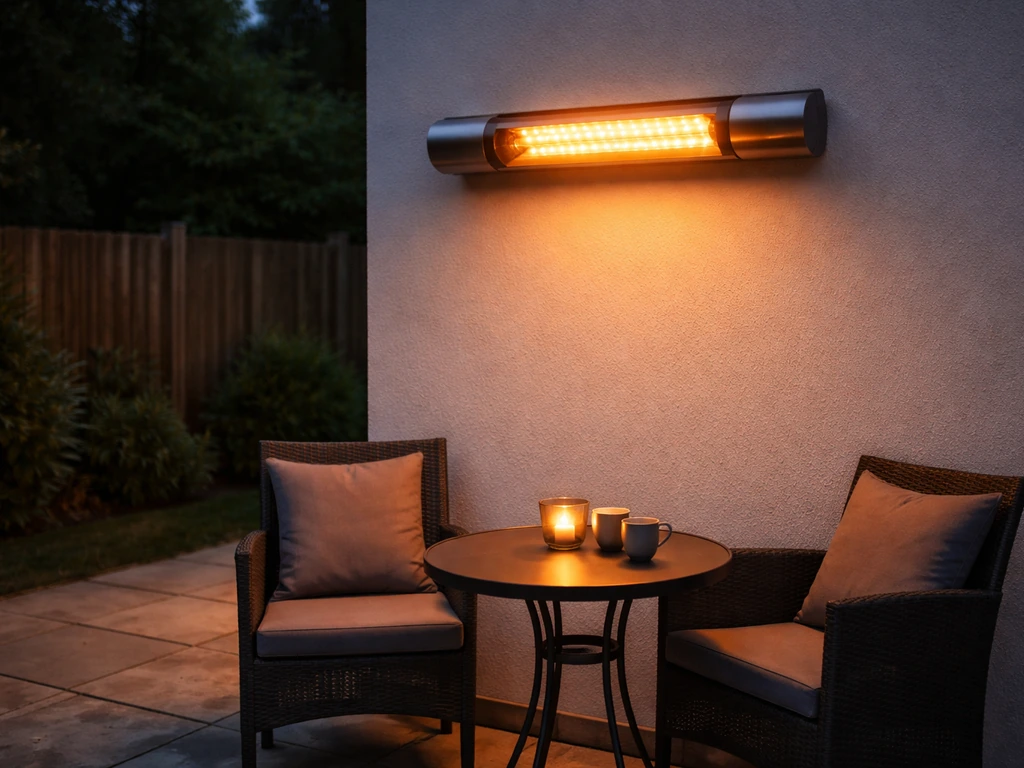
Best Wall Mounted Patio Heaters UK: Electric vs Infrared Guide
UK guide to the best wall mounted patio heaters: electric vs infrared, coverage, costs, placement, and safety checks.
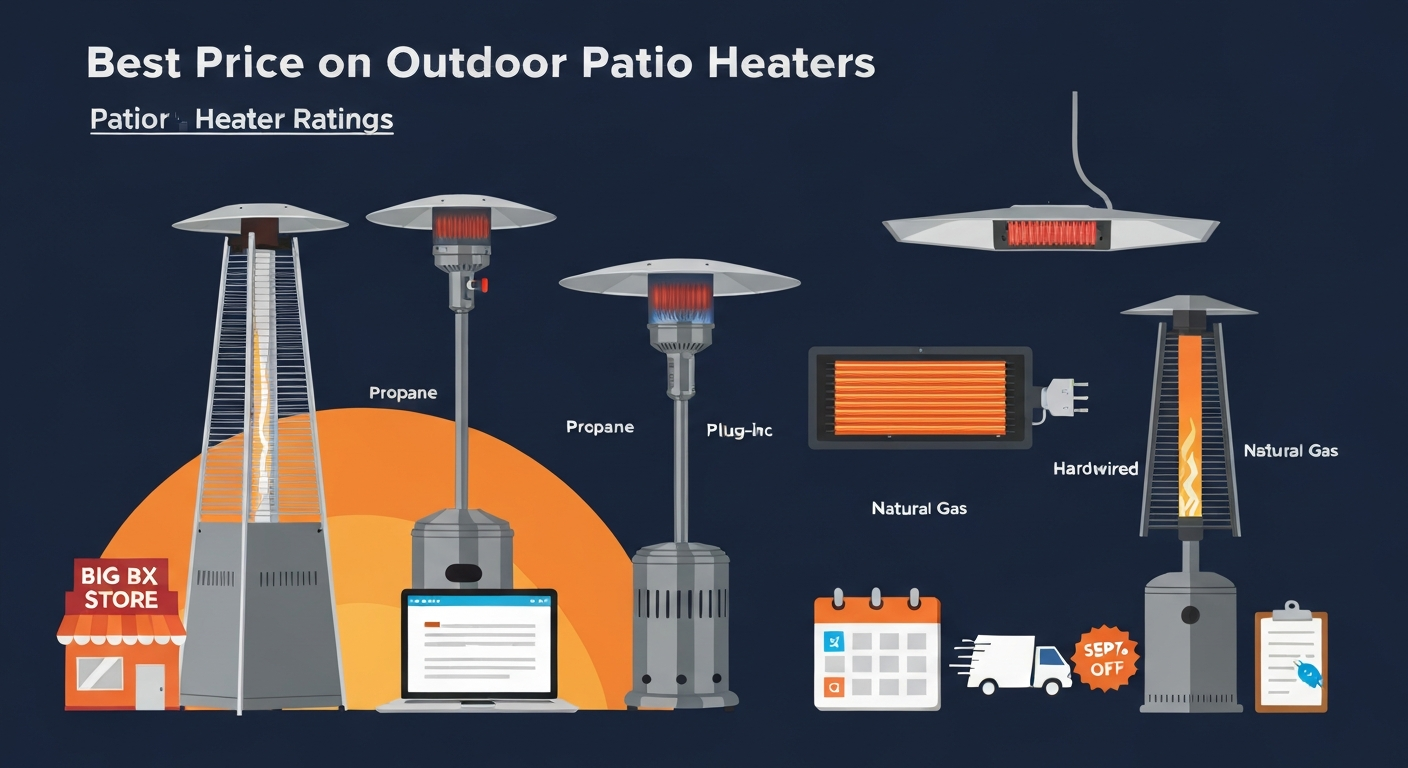
Best Price on Outdoor Patio Heaters: Compare Costs & Deals
Score the best price on outdoor patio heaters, price ranges, top picks, deal tactics, total-cost & safety checklist.
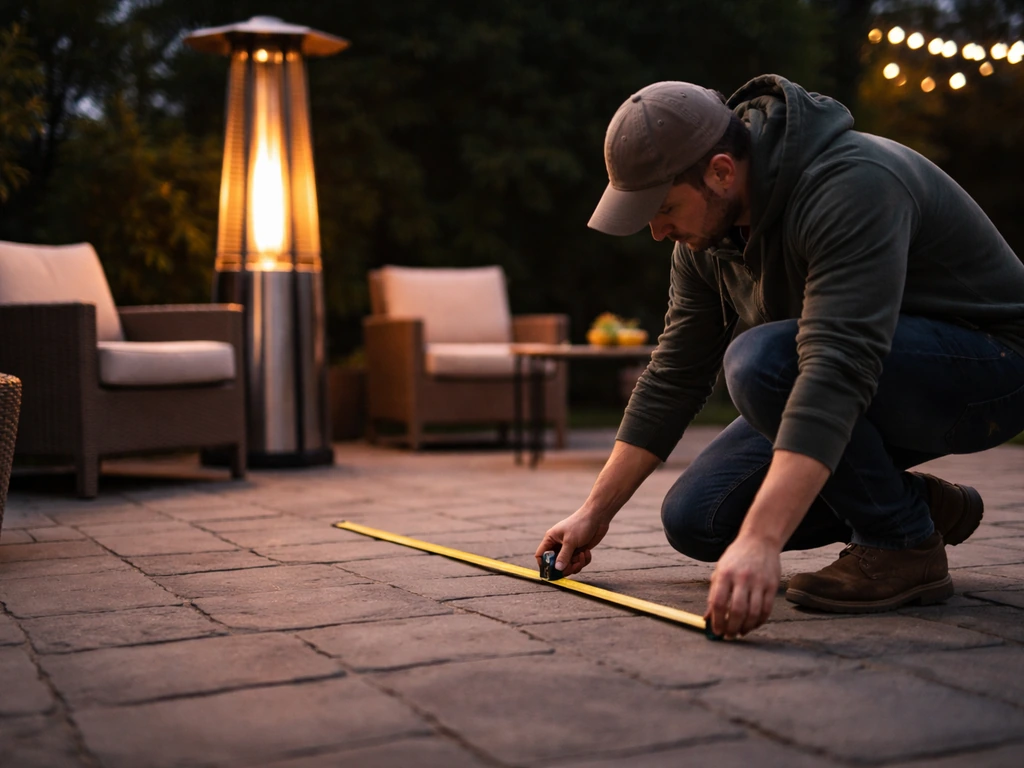
Where Can I Rent Patio Heaters Near Me Today
Find where to rent patio heaters near you today, choose the right fuel type, compare costs, and book safely.