
You can find the best price on outdoor patio heaters by shopping big-box stores like Home Depot and Lowe's for consumer propane and electric models (typically $120–$400), buying direct from manufacturer sites for mid-range and premium units, and timing your purchase around end-of-season clearance sales in September and October. For specialty brands like Bromic or Infratech, an authorized dealer is the only way to get valid warranty coverage. If you only need heaters for a short run of events, renting from a company like Sunbelt Rentals almost always beats buying outright. The right channel depends on your heater type, budget, and how often you'll actually use it, this guide breaks all of it down.
Best Price on Outdoor Patio Heaters: Compare Costs & Deals

Caleb Vale
18 Jul 2026
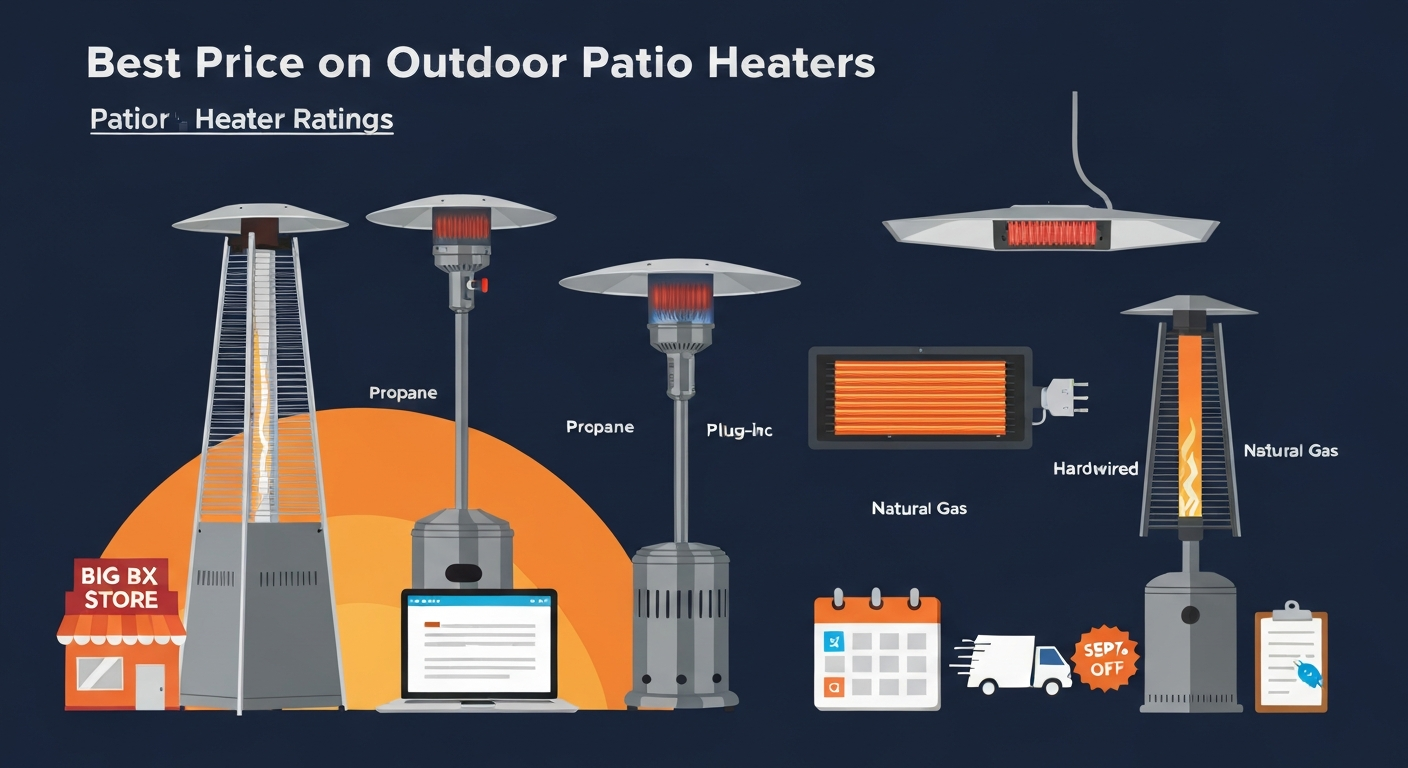
How the main heater types compare on price and practicality
Before you start comparing prices, it's worth understanding what you're actually comparing. Propane, electric, natural gas, infrared, and pellet heaters aren't just stylistic choices, they have fundamentally different upfront costs, running costs, installation requirements, and performance profiles. A propane tower that looks like a deal at $150 can end up costing more per season than a $400 hardwired infrared panel, depending on your usage.
| Heater Type | Typical Heat Output | Upfront Cost Range | Ongoing Fuel/Power Cost | Installation Complexity | Best For |
|---|---|---|---|---|---|
| Propane freestanding/pyramid | 40,000–48,000 BTU | $120–$1,800 | Moderate (propane ~$3–$5/lb) | Plug-and-go (no install) | Decks, patios, portability |
| Electric plug-in infrared/panel | 1,200–3,000 W (4,000–10,000 BTU equiv.) | $70–$600 | Low-moderate (grid electric) | Minimal (outlet required) | Small patios, covered areas |
| Hardwired electric infrared | 2,000–6,000 W | $400–$3,000+ | Low-moderate (grid electric) | Moderate (dedicated circuit) | Permanent installs, commercial |
| Natural gas overhead | 25,000–100,000+ BTU | $600–$3,200+ | Low per BTU (gas line required) | High (gas line, permit) | Restaurants, permanent outdoor areas |
| Infrared (gas or electric) | Varies by fuel/wattage | $150–$3,000+ | Low-moderate | Low to high (depends on fuel) | Targeted, efficient spot heating |
| Pellet | 15,000–30,000 BTU | $300–$1,200 | Moderate (pellet bags ~$6–$10) | Low (freestanding) | Ambiance + heat, off-grid use |
Propane towers dominate the consumer market for a reason: no installation, immediate heat, and you can move them wherever you need them. The AZ Patio Heaters HLDS01, a well-known 40,000–48,000 BTU glass-tube pyramid model with a 1-year limited warranty, sits right in the middle of that mainstream $140–$400 range. At the portable end, the Mr. Heater Big Buddy (MH18B) runs at 4,000, 9,000, or 18,000 BTU with a 3-year limited warranty and comes in well under $150, one of the better warranties in its class. Natural gas and hardwired electric systems cost more upfront and require professional installation, but their per-hour operating costs are meaningfully lower once you're up and running.
Upfront costs vs. what you'll actually spend over time
The sticker price is the least important number for most buyers. What matters is total cost of ownership: fuel or electricity, installation, maintenance, and the occasional replacement part. Here's how those numbers break down realistically.
Fuel and electricity costs
One gallon of propane contains approximately 91,500 BTU of energy. A standard 40,000 BTU propane tower running at full output burns roughly 0.44 gallons per hour. At $3.50–$4.50 per gallon (typical retail exchange prices in 2026), that's about $1.55–$2.00 per hour of use at full blast. Run it four hours on a Friday evening and you're spending $6–$8 in fuel. Over a full season of, say, 50 hours of use, expect to spend $75–$100 in propane alone for a single unit. Natural gas is cheaper per BTU (roughly $0.01–$0.015 per 1,000 BTU at typical residential rates), so a 40,000 BTU gas overhead heater running four hours costs under $2 in fuel. That gap adds up fast for restaurant or bar owners running heaters every night.
Installation costs
Propane freestanding heaters: zero installation cost. You buy it, fill the tank, and turn it on. Electric plug-in panels need nothing more than a nearby GFCI-protected outlet. Hardwired electric infrared heaters require a dedicated circuit, electrician labor typically runs $50–$150 per hour, and most outdoor hardwire jobs are completed in two to four hours, putting labor in the $100–$600 range depending on complexity and your local market. Natural gas lines are the biggest installation investment: running a new gas line to an outdoor area typically costs $600–$2,200 for a residential job, depending on the run length (commonly cited at $15–$35 per linear foot for straightforward exterior runs). Gas Line Installation Cost Calculator, 2026 Appliance Hookup & Per‑LF | UseCalcPro reports typical residential gas‑line installs average $600–$2,200 (commonly cited $15–$35 per linear foot for straightforward exterior runs) Gas Line Installation Cost Calculator — 2026 Appliance Hookup & Per‑LF | UseCalcPro. Add permits and minor site work, anchoring hardware, concrete footings, mounting, and you could add another $50–$500 to any installation.
Shipping and delivery
Patio heaters are often treated as oversized freight items by online retailers. Many big-box stores offer free in-store pickup and free standard shipping on qualifying orders, which is worth using when possible. White-glove or room-of-choice delivery on large items through retailers like Wayfair typically adds $49–$199 or more depending on your zip code and the item's weight. If you're ordering a heavy commercial overhead unit, factor that in. Buying in-store at a Home Depot or Lowe's and renting a truck for an hour is often cheaper than paying freight on a single large unit.
Maintenance
Routine maintenance on propane towers is minimal: clean the burner tip, check the regulator hose for cracking each season, and cover the unit when not in use. Budget $0–$30 per year for cleaning supplies and any small replacement parts. Electric infrared panels have almost no moving parts and maintenance is typically just wiping down the reflector and checking mounting hardware. Natural gas systems need annual burner inspections, ideally by a licensed technician, factor in $75–$150 per year if you're running a commercial setup. Pellet heaters require the most routine attention: regular ash removal and occasional auger cleaning.
Price ranges by heater type: what to expect from entry-level to commercial
These benchmarks are based on current retail listings across major US channels as of mid-2026. Prices fluctuate seasonally, with the best deals typically appearing in late summer and fall.
| Heater Type | Entry-Level | Mid-Range | Premium/Commercial |
|---|---|---|---|
| Propane freestanding tower/pyramid | $120–$200 | $200–$500 | $500–$1,800+ |
| Tabletop propane/electric portable | $70–$120 | $120–$200 | $200–$400 |
| Plug-in electric infrared/panel | $70–$150 | $150–$300 | $300–$600 |
| Hardwired electric infrared (e.g., Infratech, Bromic) | $400–$700 | $700–$1,500 | $1,500–$3,000+ |
| Natural gas overhead (consumer) | $300–$600 | $600–$1,200 | $1,200–$3,200+ |
| Pellet patio heater | $300–$500 | $500–$800 | $800–$1,200+ |
At the premium end, Bromic's Tungsten Smart-Heat Electric series (2 kW–6 kW options, ETL/Intertek approved, 2-year heater warranty) and Infratech's W/WD/C series hardwired units are spec-sheet products priced and sold through architectural and specialty dealer channels. These aren't products you'll find discounted at a big-box store, and you shouldn't want them to be, the value is in precision installation sizing, warranty support, and long-term reliability, not the sticker price.
Total cost of ownership: sample scenarios and a practical checklist
Here are three realistic buyer scenarios with rough 3-year total costs so you can compare apples to apples.
Scenario 1: Homeowner with a covered deck, moderate use (40 hours/season)
A $250 propane tower from Lowe's, 3 seasons of propane at roughly $75/season, and a $30 cover: total 3-year cost around $405. Compare that to a $350 plug-in electric infrared wall panel, zero installation cost if you have an outdoor outlet, and roughly $25–$40/season in electricity at average US rates: total 3-year cost around $425–$470. The electric panel wins on convenience and eliminates propane refills; the propane tower wins on portability and raw heat output in open or windy areas.
Scenario 2: Restaurant patio, heavy use (400 hours/season, 4 heaters)
Four propane towers at $300 each ($1,200 upfront) plus roughly $300/season in propane per heater ($1,200/season total, $3,600 over 3 seasons): total approximately $4,800. Four natural gas overhead units at $800 each plus $1,500 in gas-line installation: $4,700 upfront, then roughly $200/season total in gas ($600 over 3 seasons): total approximately $5,300. In year four, the natural gas setup pulls ahead and keeps saving. For any business running heaters more than 200 hours per season, the math almost always favors a permanent gas or hardwired electric installation despite the higher upfront cost.
Scenario 3: Small business, seasonal and uncertain usage
If you're not sure whether your patio setup will stick around or your season is short, renting or starting with inexpensive propane towers and upgrading later is a smarter move than committing to a $2,000+ permanent installation. Two $150 propane towers give you $300 in and out the door, and if you end up needing more, you can upgrade with real usage data behind your decision.
Total cost of ownership checklist
- Heater purchase price (including tax and any shipping or delivery fees)
- Installation costs: gas line, electrical circuit, permits, anchoring/mounting hardware
- Annual fuel or electricity cost (calculate at your actual expected hours of use)
- Cover, accessories, and weatherproofing hardware
- Annual maintenance: cleaning supplies, burner inspections, part replacements
- Warranty length and what it actually covers (parts, labor, elements separately?)
- Estimated usable lifespan of the unit before replacement
- Resale or rental value if circumstances change
Where to buy: channels, pros, and cons
Where you buy matters as much as what you buy. For more details on retailers, dealer locators, and channel pros/cons, see our guide on where to buy a patio heater. Each channel has genuine trade-offs on price, selection, support, and warranty validity. For a quick comparison of options and current deals, see the best place to buy patio heaters for authorized sellers and channel-specific pros and cons.
| Channel | Best For | Price Advantage | Watch Out For |
|---|---|---|---|
| Home Depot / Lowe's (in-store or online) | Consumer propane and electric units, immediate pickup | Competitive on mainstream models; seasonal clearance | Limited selection of premium/commercial brands |
| Walmart / Wayfair (online) | Entry-level and budget units, tabletop/portable models | Lowest prices on budget tier; frequent rollbacks | Shipping costs on large items; limited after-sale support |
| Manufacturer websites (AZ Patio, Mr. Heater, Fire Sense, Bromic, Infratech) | Full model range, accurate specs, authorized warranty | Sometimes price-matched to retail; bundle deals | Usually no price advantage over authorized dealers |
| Specialty outdoor/patio dealers | Premium and commercial units (Bromic, Infratech, Sunpak) | Expert sizing guidance; authorized warranty coverage | Higher prices; fewer impulse deals |
| Amazon (third-party sellers) | Consumer and mid-range units with fast shipping | Price competition; frequent coupons | Verify seller is authorized; warranty risk on gray-market units |
| Local HVAC/gas contractors | Natural gas and hardwired electric systems | Bundled supply + installation pricing | Markup on product; less selection |
| Used/refurbished (Facebook Marketplace, Craigslist) | Propane towers and portable units on a tight budget | Lowest possible upfront cost | No warranty; unknown service history; safety inspection required |
Timing your purchase to get the lowest price
The single most reliable way to save money on a patio heater is to buy it off-season. Retailers start marking down patio heaters aggressively in August and September as they clear floor space for holiday inventory. By October, it's common to see 30–50% off on propane towers at Home Depot and Lowe's. Spring sales (Memorial Day, Labor Day) are also worth watching, though discounts are shallower, typically 15–25%. Wayfair's seasonal sales events have historically offered meaningful cuts on electric and mid-range propane units. Price-match policies at Home Depot and Lowe's can also be used against each other if you find the same SKU cheaper at a competitor.
Where to buy specific brands, including Fire Sense
Not every brand sells through every channel, and buying a premium product from an unauthorized reseller can void your warranty entirely. Here's where to find the most commonly searched patio heater brands.
- Fire Sense: Sold widely at Home Depot, Walmart, Wayfair, Amazon, and through the Fire Sense website. Because it's a mass-market brand, you'll find the widest price competition across these channels. Check the Fire Sense website directly to confirm authorized dealers and current MAP (minimum advertised price) models, since third-party sellers occasionally undercut in ways that affect warranty eligibility.
- AZ Patio Heaters: Available at Home Depot, Walmart, Wayfair, and Amazon. Authorized dealers are listed on the AZ Patio Heaters website. The HLDS01 pyramid model is one of the most widely stocked SKUs across all major channels.
- Mr. Heater (Big Buddy and related portables): Home Depot, Lowe's, Walmart, Amazon, and Tractor Supply. Mr. Heater products are broadly distributed and warranty claims are handled directly through the manufacturer regardless of purchase channel.
- Bromic Heating (Tungsten, Platinum series): Only sold through authorized Bromic dealers — find them via the dealer locator on the Bromic website. Do not buy Bromic products from unauthorized third-party Amazon or eBay sellers; the 2-year warranty requires authorized purchase.
- Infratech: Sold exclusively through specialty outdoor living and architectural dealers. Use the dealer locator on the Infratech website. These are spec-driven products that require professional sizing; buying without dealer support is a mistake.
- Sunpak / Sunpak Two-Stage commercial gas: Available through commercial kitchen/outdoor equipment dealers and some specialty patio retailers. Not a mass-market channel product.
- Napoleon, Dimplex, and similar mid-tier brands: Available at Home Depot, Lowe's, and specialty outdoor retailers. Authorized dealer lists are on each brand's website.
If you're looking for a specific brand in your area, searching the manufacturer's dealer locator is almost always faster and more reliable than calling big-box stores. To locate nearby sellers and dealers quickly, search 'who sells patio heaters near me' to pull up local retailers, authorized dealers, and rental options. Authorized local dealers for premium brands often provide installation quotes bundled with the product purchase, which can simplify the natural gas or hardwired electric process significantly.
When renting patio heaters makes more sense than buying
Renting is a seriously underused option for homeowners and small businesses that only need heaters for occasional events. If you're running a handful of outdoor events per year rather than a nightly restaurant patio, renting almost always delivers better value than buying, maintaining, and storing multiple propane units.
Where to find rental heaters
Sunbelt Rentals is one of the most widely available national options, they rent 40,000 BTU radiant patio heaters by the day, with fuel consumption specs of approximately 1. Sunbelt Rentals lists 40,000 BTU radiant patio heaters for event rental with fuel consumption ≈1.9 lb/hr and run time ≈10.5 hours. 9 lb/hr and roughly 10.5 hours of run time per tank. Pricing varies by location but daily rates for a single unit are typically in the $35–$75 range before fuel and delivery. United Rentals, another national chain, also carries propane patio heaters at many locations. For events specifically, local event rental and party supply companies often carry patio heaters alongside tents and tables; searching 'event heater rental [your city]' will surface these quickly. Local party rental companies sometimes offer per-unit rates as low as $25–$40/day for simple propane towers, plus a delivery and pickup fee.
What to know before you rent
- Fuel is usually not included: most rental companies provide the heater unit only; you source and pay for propane separately, or pay the rental company's refill rate (often higher than retail exchange prices).
- Delivery and pickup fees apply: expect $50–$150 or more for delivery and pickup depending on distance and quantity.
- Insurance and damage waivers: rental companies typically offer a damage waiver (often 10–15% of the rental cost) that limits your liability if the unit is accidentally damaged. Review whether your event insurance or homeowner's policy covers rented equipment before declining the waiver.
- Minimum rental periods: most companies require a 1-day minimum; multi-day discounts are common for 3+ day rentals.
- Quantity discounts: if you need five or more heaters, always ask for a volume rate — rental companies regularly offer 10–20% off on bulk event orders.
- Reservation lead time: for peak dates (late September through November, New Year's Eve, spring graduation season), book rental heaters at least 2–4 weeks in advance. Inventory gets tight fast.
Buy vs. rent: when each makes sense
| Situation | Better Choice | Why |
|---|---|---|
| Restaurant patio open 5+ nights/week | Buy (propane or gas) | Cost per hour of renting is too high over a season |
| 1–4 private events per year | Rent | Avoids storage, maintenance, and upfront investment |
| Small business testing a new patio space | Rent first, then buy | Real usage data makes a smarter purchase decision |
| Wedding or large event, 50+ guests outdoors | Rent (event supplier) | Event companies can deliver, set up, and retrieve multiple units |
| Year-round outdoor dining in mild climate | Buy (permanent gas or hardwired electric) | Long-term operating cost advantage is significant |
| Homeowner wanting occasional backyard use | Buy (1–2 propane towers) | Low enough volume that ownership is practical and portable units are versatile |
Safety and warranty: what actually affects the value equation
A heater priced $50 less with no safety certifications and a 90-day warranty is not a deal. Look for CSA, ETL, or UL certification on any heater you buy, these are the marks that confirm the unit has been tested to North American safety standards. Bromic's Tungsten Electric series carries ETL/Intertek approval, Infratech units are UL Listed, and most Fire Sense and AZ Patio products carry CSA or ETL marks. For propane heaters specifically, check that the regulator is CSA-approved and that the unit has a tip-over safety shutoff and a low-oxygen/overheat shutoff, both are standard on quality consumer units but sometimes absent on the cheapest off-brand imports.
Warranty terms vary more than most buyers realize. The Mr. Heater Big Buddy's 3-year limited warranty is genuinely better coverage than the 1-year warranty on many comparably priced propane towers. Bromic's 2-year warranty covers the heater body and extends separately to the heating element, that matters because elements are the most common failure point on infrared units. When comparing two units at similar prices, a longer or broader warranty is a meaningful differentiator, not just a marketing claim. Always confirm the warranty is backed by the brand itself and not just the seller, and check whether it covers both parts and labor or parts only.
Final recommendations by budget and use case
For most homeowners buying their first patio heater, a mid-range 40,000–48,000 BTU propane tower in the $150–$300 range from Home Depot, Lowe's, or a manufacturer's authorized channel is the right starting point: no installation required, good heat output for an open patio, and easy to move. If you want something more permanent and your patio is covered, a hardwired electric infrared panel in the $300–$700 range delivers better targeted heat, lower long-term operating costs, and a cleaner install. For restaurants and outdoor hospitality businesses with high usage, invest in permanent natural gas or hardwired electric from a specialty dealer, the installation cost pays back within one to two seasons. And if you're not sure yet how much you'll use it, rent first. Sunbelt Rentals and local event suppliers make it easy to test the experience before committing hundreds or thousands of dollars to a permanent setup.
FAQ
What price ranges should I expect for different types of outdoor patio heaters?
Typical retail price bands (US homeowner market): - Propane freestanding/tower/pyramid: ~$120–$1,800 (most consumer 40–48k BTU towers commonly $140–$400). - Portable tabletop/compact propane or electric: ~$70–$200. - Plug‑in electric infrared/panel (residential): ~$70–$600 (1,200–3,000 W consumer units often $70–$300). - Hardwired/commercial electric infrared and premium gas overhead: ~$400–$3,000+ per fixture depending on kW/BTU and controls. - Pellet and specialty units: variable; often in mid‑hundreds to thousands depending on capacity. These bands reflect live retailer pricing at big‑box and specialty sellers.
How do I compare total cost of ownership (upfront + ongoing) between heater types?
Compare these components: 1) Upfront cost: unit price, shipping/white‑glove. 2) Installation: electrician for hardwired electric, plumber/gas fitter for natural‑gas lines, concrete footings/anchoring. 3) Operating costs: fuel (propane gallons) or electricity (kW), using energy conversions (propane ~91,500 BTU/gal) to estimate runtime and cost. 4) Maintenance/warranty: expected part replacements and warranty length. 5) Permits and site prep. Rough pattern: portable electric has low upfront/install cost but higher electrical draw per useful heat; propane towers have moderate upfront and predictable fuel costs; hardwired commercial infrared has high upfront and install cost but lower operating cost per useful outdoor comfort area and longer service life. Use a two‑year or five‑year horizon to estimate payback.
What are typical operating‑cost examples for propane vs. electric?
Example method: convert unit output to fuel use, then multiply by local fuel/electric rates. Quick guidance: - A 40,000 BTU propane tower running at full output uses ~0.44 gal/hr (40,000/91,500). At $3.50/gal that’s ≈$1.54/hr. - A 1,500 W electric heater uses 1.5 kW; at $0.15/kWh that’s $0.225/hr. Note: electric wattage listed is full‑output; real outdoor effectiveness varies—infrared/direct‑radiant heaters warm people efficiently, so runtime and required power differ. Always calculate using your local energy prices and expected duty cycle (hours/week).
Where can I get the best price — buy, rent, or used/refurbished?
Best options by need: - Buy new (lowest long‑term cost for permanent setups): shop big‑box (Home Depot, Lowe’s), mass marketplaces (Walmart, Wayfair) for entry/mid models; manufacturer/specialty dealers for premium hardwired systems. - Buy refurbished/used: marketplaces and certified refurbishers—good for budget buys but check warranty/condition. - Rent: event or short‑term needs (Sunbelt, local rental firms) — cost‑effective for occasional use. Tactics: compare cross‑retailer pricing, watch for seasonal clearance (late winter/early spring), use promo codes, and consider floor models or open‑box at local stores.
What timing and tactics reliably find the best deals?
Deal tactics: - Buy off‑season (late winter/early spring) clearance and pre‑season sales. - Watch holiday sales (Memorial Day, Black Friday/President’s Day for seasonal rollbacks). - Use price matching at big‑box stores and aggregator alerts (Google Shopping, deal newsletters). - Consider refurbished or open‑box units from reputable resellers. - Factor white‑glove/freight fees into comparisons. - Negotiate delivery/installation credits for high‑ticket or multi‑unit purchases for small businesses.
Which heater types deliver the best value for specific use cases?
Recommendations by use case: - Small residential patio, occasional use, tight budget: portable electric 1,200–1,500 W or small tabletop propane ($70–$200). - Year‑round backyard entertaining, moderate budget: consumer propane freestanding tower (40k–48k BTU; $140–$400) — good balance of upfront cost and effective radiant heat. - Covered patio or pergola, frequent use: hardwired electric infrared panels (Infratech type) — higher install cost but efficient radiative comfort and lower ongoing fuel expense. - Commercial/restaurant: premium gas/electric overhead infrared (Bromic, Infratech) sized per spec sheets — high upfront/install cost but best coverage, durability and safety compliance. - Events/one‑off: rental of 40k BTU units — cost‑effective short‑term solution.
Next Articles
Where Can I Rent Patio Heaters Near Me Today
Find where to rent patio heaters near you today, choose the right fuel type, compare costs, and book safely.
Where to Buy a Patio Heater: Best Places and Types
Where to buy a patio heater now, plus electric vs gas vs propane tips, safety checks, and size/BTU buying checklist.
Best Ceiling Heaters for Outdoor Patio: Buy Guide & Picks
Compare propane, electric, gas and IR ceiling patio heaters with picks, specs, installation steps and safety checklist.