
Austin's mild winters fool a lot of people. December through February, nighttime temps regularly drop into the low 40s°F, and a north wind can make an open patio feel closer to freezing. The venues and homeowners who get this right use either overhead infrared or high-output propane mushroom heaters, positioned for coverage rather than aesthetics. Below you'll find a curated list of Austin spots with reliably heated outdoor spaces, followed by a practical guide for anyone equipping their own patio with heaters, including sizing rules, installation requirements, and Austin-specific permitting tips.
Best Heated Patios in Austin: Top Spots and Buying Guide

Caleb Vale
21 Jul 2026
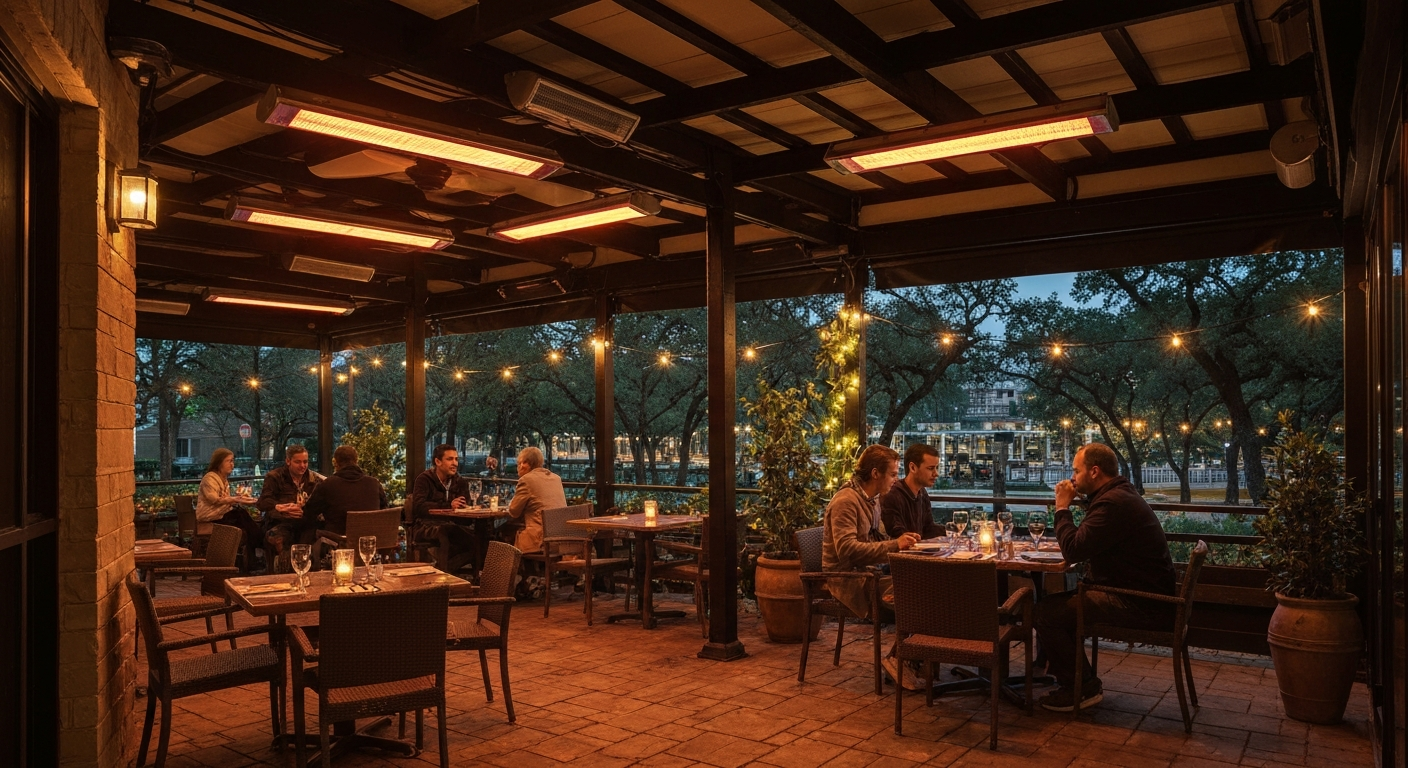
Best Heated Patios in Austin: Quick Roundup
This list was assembled from cross-referencing Eater Austin and The Infatuation's patio guides, community threads on r/austinfood, Google Business Profile photos, and direct venue verification. Heating type and a short note on coverage quality are included for each entry. Venues were excluded if heater presence could not be corroborated by at least two independent signals (recent photos, guest reviews mentioning warmth, or direct staff confirmation). See our best heated patios guide for full listings and heater details.
| Venue | Neighborhood | Heater Type | Notes |
|---|---|---|---|
| Uchi | South Lamar | Electric infrared (ceiling-mounted) | Covered patio with overhead Bromic-style strip heaters; consistently warm even on 40°F nights |
| Contigo | Mueller | Propane mushroom (freestanding) | Large open lawn with multiple 46,000–50,000 BTU propane towers; works best at tables closest to units |
| El Chile Cafe & Cantina | Manor Road / East Austin | Propane freestanding | OpenTable profile flags heated patio; mid-range propane heaters distributed across covered section |
| Loro | South Lamar | Electric infrared (wall/ceiling) | Semi-enclosed indoor-outdoor space with commercial infrared strips; one of the most uniform heat distributions on this list |
| Justine's Brasserie | East Austin | Propane mushroom (freestanding) | String-lit courtyard with several propane towers; coverage is adequate for the intimate footprint |
| Odd Duck | South Lamar | Propane freestanding | Partially covered deck; propane units supplemented by the structure's thermal mass on cooler nights |
| Lenoir | South Congress | Natural gas (built-in) | Permanent gas-fed heaters on a covered back patio; most consistent runtime since no tank swaps needed |
| Launderette | East Austin | Electric infrared (overhead) | Covered patio with ceiling-mounted infrared; quiet and efficient, no open flame in tight quarters |
A few notes on this list: freestanding propane mushroom heaters work adequately on calm nights but lose significant effective range once wind exceeds 10 mph. Austin averages roughly 9–11 mph winds at street level in winter, so venues with open, unshielded layouts will always underperform covered or semi-enclosed spaces regardless of heater brand. If you're planning a visit specifically for cold-weather comfort, the covered/semi-enclosed spots (Uchi, Loro, Lenoir, Launderette) will give you the most reliable experience.
How These Venues Were Evaluated
Selecting venues for a heated-patio list sounds straightforward, but 'we have patio heaters' and 'our patio is genuinely warm' are two very different things. Here's exactly what I looked for.
- Heater presence confirmed by at least two independent sources: recent Google Business Profile or Yelp photos showing installed heaters, plus either a staff-confirmed report, reservation platform notes, or dated guest reviews specifically mentioning warmth
- Heater type and placement: overhead infrared or natural gas scores higher than freestanding propane in open layouts, because coverage is more predictable and less wind-dependent
- Coverage quality: guest reviews from November through February that mention comfort (or discomfort) at specific tables or zones, cross-checked with the venue's physical footprint from Street View
- Operational reliability: venues known to seasonally store heaters or only deploy them on request were noted or excluded; heaters need to be running by default on cool evenings to make this list
- Customer feedback patterns: consistent complaints about cold patios in winter Yelp or Google reviews were a disqualifier even if heaters were visually confirmed
- Recency: venue photo evidence and review dates needed to be from 2024 or 2025 to confirm heaters are still in active use rather than removed or replaced
Austin's Climate and Why Outdoor Heating Actually Matters Here
Austin sits in USDA hardiness zone 8b, and the NOAA 30-year climate normals for Austin-Bergstrom International Airport tell a useful story. Average December low is around 42°F; January is the coldest month, averaging a low of 40°F. Freeze events (below 32°F) happen roughly 25–30 nights per year, clustered between late November and early March. That's a meaningful chunk of prime dining and entertaining season.
Wind is the other factor that gets underestimated. Austin's prevailing winter winds come from the north and northwest, with average speeds of 9–11 mph. A 45°F evening with a 10 mph wind produces a wind chill closer to 38°F, which turns an unheated patio from chilly to genuinely uncomfortable within 20 minutes. Covered structures and strategic windbreaks make a bigger difference than heater output alone, which is why patio layout matters so much in equipment selection.
Austin's outdoor dining culture runs year-round, not just in spring and fall. Locals expect to use patios in January and February, especially for weekend brunch, evening dining, and late-night bar seating. Businesses that fail to heat adequately lose covers to competitors who do. For homeowners, the practical heating window runs from mid-October through early April, roughly six months of partial or full heater use depending on the year.
Heater Types Explained for Austin Conditions
There are five heater categories you'll encounter in Austin patios, each with real trade-offs for the local climate and common patio configurations.
Propane (Freestanding and Portable)
The mushroom-style propane tower is the default choice for restaurants and homeowners who want flexibility. Common models from brands like Fire Sense, Hiland, and Dyna-Glo put out 40,000–50,000 BTUs and cover roughly 100–150 square feet at optimal conditions. A standard 20 lb tank runs about 8–10 hours at full output. The appeal is obvious: no installation required, portable between zones, and relatively cheap upfront (typically $150–$350 for consumer-grade units). The downside in Austin's wind conditions is real: output drops significantly above 10 mph wind, and tall freestanding heaters are exposed to tipping risk. For open-air commercial patios, this means needing more units than you'd initially estimate.
Natural Gas (Permanent Installation)
Natural gas heaters require a gas line run to the patio, which means a licensed plumber and a city permit in Austin, but the operational advantage is significant for businesses: no tank management, consistent pressure, and lower per-BTU fuel cost than propane. Commercial-grade post-mounted or wall-mounted natural gas heaters typically output 40,000–60,000 BTUs. For venues like Lenoir that run heaters four to five nights a week through winter, natural gas makes financial sense within two to three seasons compared to recurring propane costs.
Electric Infrared
Electric infrared is my top recommendation for covered patios and any space with a ceiling or overhead mounting point. Brands like Bromic (Tungsten and Platinum Smart-Heat lines) and Infratech (C-Series, W-Series) deliver 1,500W to 6,000W output, with manufacturer-published coverage areas of 100–250 square feet per unit depending on mounting height. Bromic's Tungsten Smart-Heat 2000W unit, for example, is rated for 210 sq ft coverage at a 7.2 ft mounting height. Infrared heats objects and people directly rather than the air, so it's far less affected by breezes than convective gas heaters. The trade-off is that electric infrared requires a dedicated electrical circuit (typically 240V for commercial-grade units) and a licensed electrician for installation. Operating cost in Austin, at roughly $0.12–$0.13/kWh (current Austin Energy rates), runs about $0.18–$0.78/hour depending on wattage, which is competitive with propane once you factor in tank exchange costs.
Pellet Heaters
Pellet heaters are an emerging option in residential outdoor settings and some rustic-style commercial patios. They burn compressed wood pellets, produce a visible flame aesthetic, and can output 10,000–50,000 BTUs depending on the model. They're not common in Austin's commercial dining scene due to fuel-handling logistics (pellets must be stored dry and replenished frequently) and stricter open-flame regulations in commercial settings. For residential patios where the fire-feature aesthetic is part of the draw, they're worth considering. Expect ash cleanup and more active management than gas or electric alternatives.
HEATSTRIP-Style Radiant Strip Heaters
Strip-format electric radiant heaters (HEATSTRIP is a well-known brand in this category) are particularly useful for pergolas, covered walkways, and timber-frame structures where a sleek, low-profile heater is preferred. They mount directly to beams or ceilings, have published IP (ingress protection) ratings for outdoor use, and many commercial models carry 10-year warranties. HEATSTRIP's Classic and Extreme lines range from 1,500W to 5,000W and include models rated for wet locations (IP44 or higher), which matters for Austin's occasional heavy rain during shoulder seasons. HEATSTRIP®, Official product pages and downloads (spec sheets & installation guidance) provides downloadable datasheets with IP ratings, mounting clearances, wattages, and warranty details for the Classic and Extreme radiant strip heater lines HEATSTRIP® — Official product pages and downloads (spec sheets & installation guidance).
Which Heater Type Works Best for Each Austin Patio Layout
| Patio Layout | Best Heater Type | Why It Works | What to Avoid |
|---|---|---|---|
| Covered (pergola, solid roof) | Electric infrared (ceiling-mounted) | Direct radiant heat retained by overhead structure; no wind loss; cleaner install | Freestanding propane (height limited by ceiling; tip hazard) |
| Open air (no cover) | High-output propane freestanding or natural gas post mount | Portability and BTU volume compensate for some wind loss; can cluster units | Low-wattage electric (ineffective in open wind) |
| Semi-enclosed (partial walls, open top) | Natural gas wall-mount or electric infrared | Wall mounting keeps units out of foot traffic; semi-enclosure reduces wind loss | Pellet heaters (smoke accumulation in partially enclosed spaces) |
| Rooftop | Electric infrared (flush or wall-mount) or propane freestanding with wind guards | Electric avoids fuel logistics on rooftop; wind guards protect propane flame | Tall mushroom heaters without anti-tilt bases at elevation |
| Sidewalk / parklet | Propane freestanding (portable) or natural gas post-mount if utility access exists | Propane flexibility matches shifting seating configurations; easy to reposition | Permanent electric install (trenching to sidewalk is expensive and requires ROW permit) |
If you're comparing Austin's setup needs to other cities with harsher winters, the math shifts somewhat. For a comparison of how other U.S. cities handle outdoor heating, see our guide to the best heated patios in NYC. Chicago and Denver patios, for example, often need heaters rated for sub-20°F operation and higher sustained BTU output than Austin's milder 38–45°F winter evenings typically demand. For a comparison of how other U.S. cities handle outdoor heating, see our guide to the best heated patios DC. Austin's shorter, milder heating season also changes the payback calculation on permanent gas line installations, though for high-traffic commercial spaces the math still favors natural gas over propane within a few seasons. For a city-by-city comparison and specific recommendations, see our best heated patio chicago guide for heater choices and permitting notes tailored to Windy City conditions.
Sizing and BTU Rules of Thumb
The standard industry rule of thumb for outdoor heating is 25–35 BTUs per square foot for a partially sheltered space in a mild climate like Austin. For open, exposed patios or when you need to handle nights below 35°F, push that to 40–50 BTUs per square foot. For electric infrared, the equivalent is roughly 10 watts per square foot as a starting point, adjusting upward for open or windy conditions.
Heat loss factors you need to account for in Austin specifically include wind exposure (discussed above), ceiling or roof presence (a solid roof reduces required BTU load by 20–30%), and patio orientation. North-facing patios that catch winter winds from the prevailing direction will need meaningfully more coverage than south-facing, sheltered spaces.
| Patio Size (sq ft) | Mild Night (45°F) | Cold Night (35°F) | Number of 46,000 BTU Propane Units Needed | Number of 2,000W Infrared Units Needed (covered) |
|---|---|---|---|---|
| 100 | 2,500–3,500 BTU | 4,000–5,000 BTU | 1 unit (shared coverage) | 1 unit |
| 200 | 5,000–7,000 BTU | 8,000–10,000 BTU | 1 unit | 1–2 units |
| 400 | 10,000–14,000 BTU | 16,000–20,000 BTU | 1–2 units | 2–3 units |
| 800 | 20,000–28,000 BTU | 32,000–40,000 BTU | 2–3 units | 4–5 units |
| 1,500 | 37,500–52,500 BTU | 60,000–75,000 BTU | 3–4 units | 7–9 units |
Spacing matters as much as total BTU count. With propane mushroom heaters, a common mistake is clustering all units in one zone and leaving the rest of the patio cold. A single 50,000 BTU unit effectively covers a roughly 15-foot diameter circle on a calm night. For a 400 sq ft rectangular patio (20 x 20), that means one central unit won't adequately cover the corners. Two units positioned on opposite diagonals, or a central unit paired with a wall-mounted infrared at the perimeter, gives much better distribution.
Installation Basics for Austin Homeowners and Businesses
Propane: What You Actually Need
Freestanding propane heaters are legally plug-and-play in most residential and commercial settings, no permit required for portable units. That said, the Austin Fire Department enforces NFPA 1 clearance requirements: a minimum 3-foot horizontal clearance from combustibles and a minimum vertical clearance that varies by unit (manufacturer spec sheets list this, typically 2–3 feet of overhead clearance minimum). Propane storage on a commercial patio is subject to quantity limits under NFPA 58; more than one spare 20 lb cylinder on a restaurant patio triggers additional requirements, so most commercial venues store spares in a ventilated exterior enclosure away from the dining area.
Natural Gas: Permitting Is Not Optional
Running natural gas to a patio requires a licensed master plumber in Texas, a gas piping permit from the City of Austin Development Services Department, and inspection before the line is covered or connected. The Austin Energy code for exterior gas work references the International Fuel Gas Code (IFGC) as adopted by Texas, and the inspector will check pipe sizing, bonding, shutoff valve placement, and connection to the appliance. Budget $800–$2,500 for a residential gas line extension to an adjacent patio depending on run length; commercial projects with longer runs or trenching through hardscape will cost more.
Electric Infrared: Circuit and Mounting Requirements
Most commercial-grade infrared heaters (2,000W and above) require a dedicated 240V/20A or 240V/30A circuit. In Austin, electrical work for permanently installed outdoor equipment requires an electrical permit from the City of Austin Development Services Department. The installation must meet the 2020 NEC as adopted by Texas, including GFCI protection for all outdoor circuits and proper weatherproof enclosures for junction boxes. A licensed electrician in Austin typically charges $75–$125/hour; a dedicated outdoor circuit installation runs $400–$900 all-in for a residential project. Wall and ceiling mounting of infrared heaters also requires structural consideration: manufacturer specs for commercial infrared heaters like Bromic's Tungsten Smart-Heat specify minimum mounting heights (as low as 6.5 ft for 2,000W, up to 8 ft for higher-output models) and minimum clearances from walls and combustibles (typically 18–24 inches to the side, 5 feet from any combustible overhead).
Residential vs. Commercial: Key Differences
- Commercial projects in Austin typically require a Certificate of Occupancy amendment if the heated patio is a new or expanded dining area, not just heater-equipment permits
- Restaurants adding permanent heaters to an existing patio may trigger a fire sprinkler review if the covered area exceeds thresholds under Austin's local fire code amendments
- Residential homeowners installing freestanding propane heaters need no permit; permanent gas or electric infrastructure always requires permits in both residential and commercial contexts
- HOA covenants in Austin subdivisions (particularly newer master-planned communities in the suburbs) may restrict visible propane tank storage or require approval for permanent outdoor structures supporting heater mounts — check before installing
Austin Permitting and Code: What You Need Before You Install
Austin's Development Services Department (DSD) handles building, electrical, mechanical, and plumbing permits. Their online portal (Austin Build + Connect, or AB+C) is where both residential and commercial permit applications are submitted. For patio heater projects, the relevant permit types are: Residential Electrical Permit (for homeowners adding outdoor circuits), Commercial Electrical Permit (for businesses), Plumbing/Gas Permit (for any natural gas line extension), and potentially a Building Permit if structural modifications (like a new pergola or mounting structure) are involved.
The City of Austin has adopted the 2021 International Building Code (IBC), the 2020 National Electrical Code (NEC), and the 2021 International Fuel Gas Code (IFGC), all with local amendments. You can access the adopted codes and local amendments through the Austin DSD's Code Resources page. For fire code compliance, the Austin Fire Department enforces a locally amended version of NFPA 1, which includes specific sections on portable and permanent outdoor heating equipment: minimum clearances from combustibles, requirements for automatic tip-over shutoffs on freestanding units, and fuel storage limits for commercial properties.
For natural gas heaters on commercial patios, Austin Fire Department review is typically triggered as part of the building permit process. They'll check that shutoff valves are accessible, that gas lines are properly bonded, and that heater placement meets clearance requirements. For restaurants expanding heated outdoor seating in a historic district (think South Congress or 6th Street corridors), the Historic Preservation Office may also have input on visible structural changes, though the heaters themselves rarely trigger historic review unless they require new structural penetrations.
Compliance Checklist for Austin Patio Heater Projects
- Determine heater type and whether installation is portable (no permit) or permanent (permit required)
- For gas line extensions: hire a licensed master plumber, pull a gas/plumbing permit through Austin DSD's AB+C portal before work begins
- For permanent electric installations: hire a licensed electrician, pull a residential or commercial electrical permit through AB+C
- Confirm heater model meets NFPA 1 clearance requirements and carries an ETL or UL listing (required for most commercial occupancies)
- If adding a new covered structure to support ceiling-mounted heaters, determine whether a building permit is required (generally yes if the structure is attached or exceeds 200 sq ft in residential, lower thresholds in commercial)
- For commercial restaurants: check whether the expanded covered patio area triggers a sprinkler review or change of occupancy classification with Austin DSD
- Schedule inspections before covering any rough-in gas or electrical work
- Verify Austin Energy's current outdoor circuit requirements if connecting to the utility grid for high-wattage infrared
Running Costs and Fuel Efficiency Compared
Fuel cost is where many buyers underestimate long-term expense. Here's a straightforward comparison based on current Austin-area rates and standard unit outputs.
| Heater Type | Typical Output | Fuel/Energy Cost (Austin rates) | Estimated Cost Per Hour | Annual Cost (6-month season, 4 hrs/week) |
|---|---|---|---|---|
| Propane freestanding | 46,000 BTU | ~$4.50–$5.50 per gallon (exchange) | ~$0.55–$0.85/hr | ~$70–$108 |
| Natural gas post-mount | 50,000 BTU | ~$1.20–$1.50 per therm (Austin Energy) | ~$0.18–$0.22/hr | ~$23–$28 |
| Electric infrared 2,000W | 6,824 BTU equivalent | ~$0.12–$0.13/kWh (Austin Energy) | ~$0.24–$0.26/hr | ~$30–$33 |
| Electric infrared 4,000W | 13,648 BTU equivalent | ~$0.12–$0.13/kWh | ~$0.48–$0.52/hr | ~$61–$66 |
| Pellet heater (mid-size) | 30,000–40,000 BTU | ~$5–$8 per 40 lb bag (local retail) | ~$0.50–$0.80/hr | ~$64–$102 |
The takeaway here is clear: natural gas and low-to-mid wattage electric infrared are the cheapest to operate in Austin. Propane is 2–4x more expensive per hour of heat output. For a restaurant running three heaters five nights a week from November through March, the difference between propane and natural gas can easily be $800–$1,500 per season, which pays for a gas line extension within two to three seasons.
Safety, Maintenance, and Seasonal Tips
Patio heaters in commercial settings in Austin take more abuse than most people anticipate: humidity from spring storms, UV degradation from intense summer sun even when heaters are stored, and the occasional hard freeze that can stress regulators and valves. A simple maintenance routine prevents most failures and keeps compliance status intact.
- Propane heaters: inspect the regulator and burner assembly at the start of each heating season; replace O-rings and regulator every two to three years regardless of visible condition; always use the anti-tilt base or base weight ring on freestanding units, especially on concrete or pavers where leveling is uneven
- Natural gas heaters: have a licensed plumber inspect the flex connection and shutoff valve annually; check for corrosion at the burner head and clean the igniter with a soft brush before first use each fall
- Electric infrared: clean the quartz element cover and reflector with a dry cloth at the start of season; inspect mounting hardware for corrosion, especially after Austin's summer humidity; verify GFCI circuit is functional before first use
- All heaters: store freestanding units indoors or under waterproof covers during the off-season (April through October in Austin); UV and ozone exposure accelerates plastic and rubber component degradation even on stainless-steel units
- Fire clearances: never rearrange patio furniture without re-checking that clearances to heaters are maintained; NFPA 1 requires 3 feet minimum horizontal clearance from combustibles for most propane and gas heaters
- Commercial operators: keep inspection and permit documentation on file; Austin Fire Department inspectors can and do check portable heater tip-over mechanisms during routine commercial inspections
Recommended Models by Heater Type and Budget
These recommendations reflect performance testing data, customer feedback patterns, and independent reviews from outlets like Consumer Reports and Tom's Guide, cross-referenced with manufacturer specs. Austin's mild-winter context means you don't necessarily need the highest-output commercial units unless you're running a large open patio or a high-volume restaurant.
| Category | Model | Output | Price Range | Best For |
|---|---|---|---|---|
| Budget propane freestanding | Fire Sense Pro Series 50,000 BTU (stainless) | 50,000 BTU | $180–$250 | Residential patios, occasional use, small commercial with tight budget |
| Mid-range propane freestanding | Hiland HLDS01-WCBT (46,000 BTU with table) | 46,000 BTU | $200–$280 | Homeowners wanting portability plus stability; table base reduces tip risk |
| Commercial electric infrared | Bromic Tungsten Smart-Heat 2000W | 2,000W / ~6,800 BTU eq. | $500–$700 | Covered residential or commercial patios; ceiling or wall mount |
| Commercial electric infrared (high output) | Infratech C-Series 4,000W | 4,000W / ~13,600 BTU eq. | $600–$850 | Larger covered commercial patios; restaurant-grade build quality |
| Strip / pergola heater | HEATSTRIP Classic 2,400W | 2,400W / ~8,200 BTU eq. | $350–$480 | Pergola-mounted residential; IP44 rated for Austin's rain exposure |
| Natural gas post-mount | Bromic Platinum Smart-Heat Gas 500 | 57,000 BTU | $1,000–$1,400 | High-traffic commercial patios with existing gas infrastructure |
| Budget natural gas | Fire Sense Commercial Patio Heater (NG) | 46,000 BTU | $300–$450 | Residential patios with existing gas stub-out; lower upfront cost |
For in-depth performance breakdowns, heat-distribution test data, and customer rating summaries on the Bromic, Infratech, and Fire Sense lines, the model-specific review pages on this site cover each category in detail with comparative ratings and setup notes. If you're also evaluating heated patio setups for properties in Dallas or San Antonio with similar climates, the Dallas heated patios guide on this site covers the same heater-type logic with DFW-specific permitting notes.
Austin Buying and Installation Checklist
Use this as a quick reference whether you're a homeowner outfitting a backyard deck or a restaurant owner upgrading a commercial patio for the fall and winter season.
- Measure your patio: total square footage, overhead clearance, and whether the space is open, covered, or semi-enclosed
- Identify your fuel source: existing gas line, available electrical circuits, or propane-only if no infrastructure exists
- Calculate BTU/wattage needed: use 25–35 BTU/sq ft for covered Austin patios, 40–50 BTU/sq ft for open-air spaces; 10W/sq ft as the electric equivalent starting point
- Select heater type based on patio layout: electric infrared for covered, propane or natural gas for open or sidewalk setups
- Confirm model carries UL or ETL listing, appropriate IP rating for outdoor use, and NFPA 1-compliant auto tip-off (for freestanding units)
- For permanent installations (gas or electric): contact Austin DSD to determine required permits before purchasing equipment or hiring contractors
- Get at least two quotes from licensed Austin-area plumbers (gas) or electricians (electric infrared) before committing to installation
- Check clearances against manufacturer spec sheet AND NFPA 1 before finalizing mounting location
- For commercial spaces: confirm with Austin Fire Department whether your project requires fire inspection or affects your Certificate of Occupancy
- Plan for off-season storage or weatherproof covers before summer; UV and heat exposure degrades components even on quality units
Local Resources: Austin Retailers, Installers, and Code Links
For equipment, Austin-area Home Depot and Lowe's locations stock consumer-grade propane heaters (Fire Sense, Hiland, Dyna-Glo) seasonally starting in October. For commercial-grade electric infrared and natural gas units (Bromic, Infratech, HEATSTRIP), you'll typically need to order through a specialty outdoor lighting and heating dealer or directly from manufacturer-authorized distributors. Several Austin-area hearth and patio specialty shops carry commercial lines and can provide installation referrals.
- Austin Development Services Department (DSD) permit portal: Austin Build + Connect (AB+C) at austintexas.gov/permits — submit residential and commercial permits online
- Austin Fire Department (AFD) fire code resources: austintexas.gov/department/fire-prevention — NFPA 1 local amendments and commercial inspection contact
- Texas State Board of Plumbing Examiners: verify licensed master plumbers for gas line work at tsbpe.texas.gov
- Texas Department of Licensing and Regulation (TDLR): verify licensed electricians for outdoor circuit work at tdlr.texas.gov
- Austin Energy rate schedule and outdoor electrical service details: austinenergy.com — confirm current residential and commercial rate tiers before modeling operating costs
FAQ
What core datasets are required to compile an accurate, city‑specific roundup of Austin heated patios?
1) Curated venue list: seed from Eater Austin, The Infatuation, Austin360, CultureMap, Visit Austin. 2) Direct venue data: confirmation of heater presence, heater type, heater location, hours of heated operation, photo evidence, and staff contact/source statement. 3) Climate data: NOAA/NCEI 30‑year normals and wind statistics for Austin (ABIA station) to assess typical temperature/wind loads. 4) Equipment specs: manufacturer spec sheets (wattage, BTU, coverage, mounting height, IP rating, clearances) from Bromic, Infratech, Heatstrip, major brands and big‑box listings. 5) Independent performance tests & reviews: lab/field tests or published reviews (Consumer Reports, Popular Mechanics, Tom’s Guide, Patio Heater Ratings) that include measured heat output, coverage, and safety results. 6) Operational & cost data: fuel prices, runtime tests, electrical load and estimated monthly operating costs (from installers, utilities, or vendor calculators). 7) Regulatory & safety: NFPA codes, Austin municipal code, permit requirements, and AHJ contact info. 8) Local installer/retailer data: quotes, install lead times, permitting experience from local HVAC/plumbing/electrical contractors and outdoor‑living retailers.
Which source types should be prioritized and why?
1) Tier‑1 / authoritative: manufacturer spec sheets, NFPA standards, NOAA climate normals, official Austin municipal code — use for technical, safety and regulatory facts. 2) Independent test labs & reputable editorial reviews (Consumer Reports, Popular Mechanics, Tom’s Guide): use for unbiased performance comparisons. 3) Trusted local journalism (Eater, The Infatuation, Austin360) for initial venue candidates and context. 4) Primary confirmation: direct venue contact (email/phone) and timestamped imagery (Google Business photos, Street View) — these are required to confirm current heater status. 5) Community signals (Yelp, Reddit) and reservation listings (OpenTable/Resy) are useful secondary corroboration but must be verified with primary sources. 6) Installer quotes and trade guides for real‑world costs and installation practices.
What verification steps are required to confirm a venue’s patio is reliably heated?
1) Contact the venue directly (manager/operations) and log date, respondent name, and exact statement about heater type and when they operate. 2) Request photos or video showing the installed heater(s) in operation if available. 3) Cross‑check with recent user‑uploaded photos on Google Business Profile, Yelp, and social media (check timestamps). 4) Inspect Google Street View and any 360 photos for permanent heater installations or fixed gas lines. 5) If conflicting evidence, note the conflict and re‑contact the venue for clarification. 6) For commercial claims (e.g., “always heated”), verify via multiple recent datapoints (staff confirmation + photo within last 12 months + at least two patron reports).
What performance measurements should be collected or cited for heater evaluation?
1) Rated output: watts and/or BTU per hour from manufacturer specs. 2) Coverage area: manufacturer recommended square‑foot coverage and mounting heights. 3) Measured radiant temperature/comfort: third‑party or lab measurements of operative temperature at seating height under representative conditions (if available). 4) Wind tolerance: documented performance or test results at different wind speeds (important for Austin breezes). 5) Run time and fuel consumption: measured runtime for propane tanks, or kWh use per hour for electric units. 6) Safety features and failure modes: tip‑over, flame failure, IP rating, clearances. 7) Sound level (if relevant) and maintenance intervals. Cite independent tests (Consumer Reports, other labs) where on‑device measurements exist.
How should heater sizing and BTU/coverage rules of thumb be determined for Austin patios?
1) Use manufacturer coverage guidance (wattage/BTU ↔ sq ft) as baseline. 2) Adjust for Austin climate and layout: for partially covered patios or wind exposure increase sizing by 15–35%; fully enclosed/commercial spaces may require lower upsize. 3) Example rules: electric infrared — 1,500–3,000 W per 100–200 sq ft depending on exposure; propane standing heaters — 40,000–50,000 BTU per 100–140 sq ft of close seating; mounted gas/infrarred overhead — 10,000–25,000 BTU or 1,500–4,500 W per 50–150 sq ft. 4) Use NOAA wind and temperature percentiles to size for typical cold nights rather than extreme lows. 5) Recommend on‑site installer heat‑load check for commercial patios and HVAC/plumbing trade for gas line sizing.
What city‑specific permitting and installation considerations apply in Austin?
1) Consult Austin Development Services and the Austin Fire Department for permits: permanent natural‑gas or hard‑wired electric patio heaters typically require building/electrical/plumbing permits and possible inspection. 2) Portable propane heaters used temporarily may avoid some permits but are subject to fire code clearances and fuel‑storage rules. 3) NFPA and Austin Fire Code provisions on clearances, venting and fuel storage apply; AHJ (Authority Having Jurisdiction) interpretations vary—get a written pre‑approval when possible. 4) Commercial venues should document installed permanent heaters on their Certificate of Occupancy or lease amendments as required. 5) Retain licensed plumbers for natural gas lines and licensed electricians for hard‑wired electric heaters; get written scope and permit numbers for records.
Next Articles
Best Heated Patios NYC: How to Choose the Right Heater
Compare electric, propane, natural gas, infrared and pellet heaters for NYC patios. Pick the right BTU, coverage, and sa
Best Price on Outdoor Patio Heaters: Compare Costs & Deals
Score the best price on outdoor patio heaters, price ranges, top picks, deal tactics, total-cost & safety checklist.
Where Can I Rent Patio Heaters Near Me Today
Find where to rent patio heaters near you today, choose the right fuel type, compare costs, and book safely.