
Denver's combination of mile-high altitude, unpredictable spring winds, and temperature swings that can drop 40°F in an afternoon means you need more heating output than the product box suggests. The best heated patios in Denver rely on heaters that are properly derated for altitude, positioned to cut wind, and sized for actual exposure conditions rather than ideal showroom math. Below I walk through the top picks by category, the Denver-specific climate and code factors that change every calculation, and a practical framework for matching heater type to your specific patio setup.
Best Heated Patios Denver: Top Heaters, Sizing & Safety Guide

Caleb Vale
28 Jul 2026
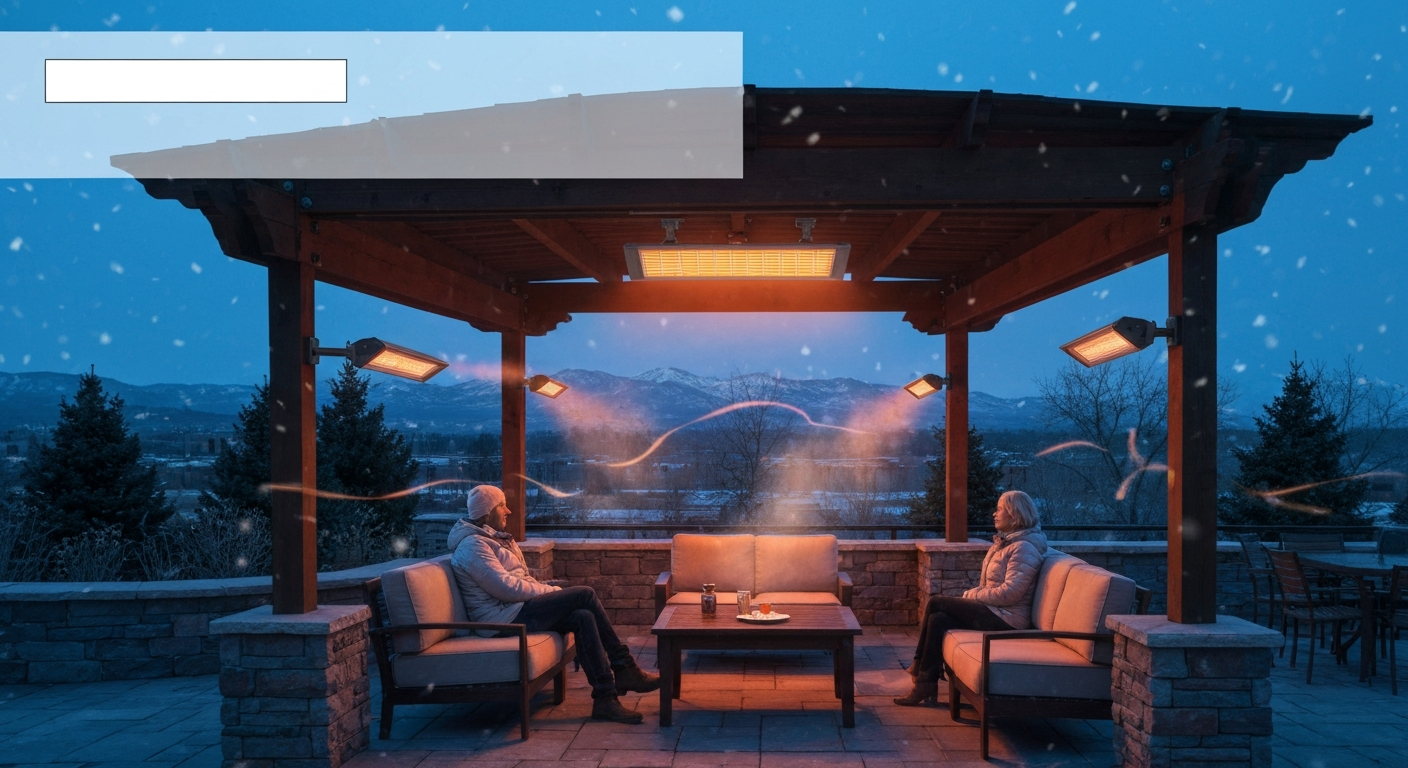
Quick recommendations: best heated patios in Denver
These are my top picks across the most common Denver patio scenarios. Full category breakdowns follow further down, but if you need a fast answer before digging into the details, here is where I would start. For comparisons in other cities, see our guide to the best heated patios in DC. See our detailed guide to the best heated patios for full product links, specs, and Denver-specific buying advice.
| Category | Top Pick | Heater Type | Why It Works in Denver |
|---|---|---|---|
| Best overall residential | Bromic Tungsten Smart-Heat 500 | Electric infrared | Unaffected by altitude derate, wind-resistant radiant output, IP55 weatherproof rating |
| Best propane (residential) | Napoleon THP2 | Propane radiant | High-altitude orifice kit available, 40,000 BTU input, cast-iron burner head |
| Best natural gas (commercial) | Infratech C-Series (NG version) | Electric infrared | Hardwired 240V, no gas derate concern, consistent output at 5,280 ft |
| Best for open/exposed patios | Bromic Platinum Smart-Heat 500 Gas | Natural gas infrared | Directional radiant beam reduces wind-chill convective loss |
| Best covered patio (restaurant/bar) | Heatscope Vision 3000W | Electric infrared | Clean overhead mount, dimmable 10–100%, no CO risk indoors |
| Best budget pick | AZ Patio Heaters HLI-1P | Propane mushroom | Under $200, widely available locally, simple altitude-orifice swap |
| Best premium outdoor experience | Lynx Professional LHEM42-LP | Propane fire-pit/heater hybrid | Doubles as focal piece, 60,000 BTU, CSA-certified for high altitude |
Why Denver's climate, altitude, and wind change heater performance
Denver sits at exactly 5,280 feet above sea level. That single fact rewrites the performance specs on every gas heater you look at. Air at that elevation is roughly 17% less dense than at sea level, which means combustion appliances receive less oxygen per cubic foot of air than their rated inputs assume. The standard industry derate method referenced in NFPA 54 and ANSI Z223.1 calls for reducing a gas appliance's effective input rating by approximately 4% for every 1,000 feet above 2,000 feet. For Denver, that works out to (5,280 minus 2,000 = 3,280 feet) multiplied by 4%, giving you a 13.1% derate. A heater labeled at 40,000 BTU/hr is effectively delivering closer to 34,760 BTU/hr unless the manufacturer has supplied a high-altitude orifice kit and you have installed it. Always confirm altitude kit availability before purchasing any propane or natural gas heater for a Denver installation.
The climate picture adds more pressure. Denver International Airport climate normals (1991-2020) show that October through April routinely produce mean daily temperatures below 45°F, with January averaging a daily high of around 45°F and a low near 19°F. Seasonal snowfall averages roughly 56 to 57 inches. Even in May and September, evening temperatures can drop into the 30s after sunset. Patios that might need only light heating in Dallas or Austin need serious, well-sized equipment here.
Wind is the other major variable. Denver's windiest period runs through spring, with DIA recording mean hourly wind speeds of approximately 8 to 10 mph in peak months and frequent gusts well above that. Wind erases radiant heat gains faster than almost any other factor in outdoor thermal comfort research. A heater with a 12x12 ft coverage radius under calm conditions in a showroom can shrink to an effective 8x8 ft coverage footprint on an exposed Denver patio. This is not a hypothetical, Bromic and other manufacturers explicitly note this in their outdoor planning guides. Size up and add wind barriers wherever possible.
Comparing heater types for Denver: propane, natural gas, electric, infrared, and pellet
Each fuel type has a real advantage or real constraint in Denver's specific context. Here is how they stack up.
| Heater Type | Altitude Impact | Wind Performance | Fuel Availability | Install Complexity | Best For |
|---|---|---|---|---|---|
| Propane | ~13% derate; needs altitude orifice kit | Moderate — convective mushroom heaters lose more in wind | Excellent — cylinder swap at any hardware store | Low (portable) to Medium (piped) | Residential patios, events, spaces without gas lines |
| Natural gas | ~13% derate; needs utility pressure check and orifice swap | Moderate — same convective losses as propane | Good where gas service exists; check utility BTU/ft³ | Medium to High (requires licensed plumber + permit) | Permanent commercial installations, piped residential patios |
| Electric infrared | Zero altitude derate — output is purely electrical | Best — radiant beam is wind-resistant and directional | Requires 240V circuit for commercial-grade units | Medium (electrician required for hardwired) | Covered patios, restaurants, premium residential |
| Pellet/biomass | Minor combustion efficiency reduction | Poor — open flame and airflow requirements clash with wind | Moderate — pellets available at local home stores | Low to Medium | Decorative fire-pit atmosphere, secondary heat source only |
| Infrared gas (radiant tube) | ~13% derate; directional beam reduces wind convective loss | Good — directional output better than mushroom-style | Same as NG/propane above | High (ceiling/wall mount, gas line, permits) | Commercial restaurants, large covered structures |
The takeaway for Denver: electric infrared is the most altitude-proof option because watts in equal watts out regardless of elevation. If you are committed to gas for aesthetics or fuel-cost reasons, a directional infrared gas heater outperforms a traditional mushroom-style propane tower because the radiant beam delivers heat directly to people rather than warming the air that wind immediately strips away. Pellet heaters are best treated as ambiance rather than primary heating in a Denver patio context.
Which heater type fits your site: residential vs. commercial, open vs. covered
The right heater depends heavily on whether you are a homeowner heating a backyard deck or a restaurant owner trying to keep paying customers comfortable on a rooftop bar through October. Those two scenarios have almost nothing in common from a sizing, permitting, or installation standpoint.
Residential patios
For a typical Denver homeowner, a portable propane mushroom heater or a wall-mounted electric infrared unit is the most practical starting point. Portable propane units require no permit for residential use under Denver Fire Code provided you stay within the storage limits (up to two 20-lb cylinders for residential use, per Denver's amended Chapter 61 LP-gas provisions). They require no licensed installer and can move from patio to patio. The trade-off is the altitude derate and wind sensitivity. If your backyard patio is covered or partially enclosed, a hardwired 240V electric infrared panel mounted overhead is my preferred recommendation: zero derate, instant heat, and no fuel management.
Restaurants, bars, and commercial patios
Commercial operators have different constraints. Permitting becomes mandatory: Denver Fire Code Section 105.5.145 requires a permit for temporary heating appliances, and any LP-gas installation for a commercial concession must comply with Denver's Chapter 61 amendments, which cap cooking and concession installations at two 40-lb cylinders with a submitted site plan. Colorado statewide LPG regulations (7 CCR 1101‑15, Liquefied Petroleum Gas (LPG) Regulations (Colorado Division of Oil & Public Safety)) incorporate NFPA 58 and NFPA 54 by reference and are enforced in addition to local Denver code requirements 7 CCR 1101‑15 — Liquefied Petroleum Gas (LPG) Regulations (Colorado Division of Oil & Public Safety). For a permanent restaurant patio, a piped natural gas or hardwired electric infrared system is almost always the right choice operationally, since staff do not need to swap cylinders during service. The permit and licensed-installer requirement applies regardless, so budget for a licensed plumber (gas) or electrician (electric) and a fire department review.
Open vs. covered patios
Covered patios retain radiant heat far better than open ones. Industry sizing guidelines position covered spaces at 100 to 150 W/m² of heating density, semi-protected spaces at 200 to 300 W/m², and fully exposed outdoor areas at 300 to 400 W/m². Denver's wind exposure pushes most open patios firmly into the 300 to 400 W/m² range. On a covered patio, a single overhead infrared unit can comfortably heat a seating group; on a fully exposed Denver patio in November, you may need two to three times that wattage for the same area. That cost difference is significant and often the deciding factor in whether an outdoor season extension is economically viable.
Top picks by category
Best for residential patios
The Bromic Tungsten Smart-Heat 500W Electric is the unit I recommend most often to Denver homeowners with covered or pergola-style patios. It is hardwired 240V, delivers 5,100 BTU equivalent output, is IP55-rated for snow and rain exposure, and is completely unaffected by altitude. It can be wall- or ceiling-mounted and paired with a smart thermostat. For homeowners who want portability or do not have a 240V circuit on the patio, the Napoleon THP2 propane tower is a solid second choice. The Napoleon accepts a high-altitude orifice kit directly from the manufacturer, the cast-iron burner head is more durable than the stamped-steel units under $150, and the tilt-adjusted heat shield helps direct output toward seating rather than straight up.
Best for restaurants and bars
The Infratech C-Series in its 240V hardwired configuration is the workhorse of Denver's better restaurant patios. It mounts flush overhead, can be ganged with a zone controller for table-specific heating, and produces consistent output year-round without any gas line or altitude concerns. For operators who specifically want the visual warmth of a gas flame, the Bromic Platinum Smart-Heat 500 Natural Gas mounted overhead is the best available option: its directional infrared beam reduces the wind-convective loss that punishes standard mushroom-style propane towers, and its commercial-grade stainless housing holds up well through Denver winters.
Best for covered patios
The Heatscope Vision 3000W stands out for covered applications because of its dimmable output (10 to 100%) and its completely silent, zero-UV infrared tube. On a covered deck where you want atmosphere as much as heat, the ability to dim the unit down to a soft glow during warmer moments is genuinely useful. It is ceiling-mount only and requires a 240V circuit, but in a covered application that is rarely a barrier. No combustion means no CO risk, which matters if your covered patio has limited natural ventilation.
Best for open patios
For a fully exposed Denver patio, I lean toward multiple smaller infrared units positioned close to seating rather than one large central mushroom heater. The Bromic Tungsten Gas 500 mounted on perimeter posts or walls creates a heat envelope at body level rather than pushing warm air upward where wind immediately disperses it. If a hardwired or piped installation is not feasible, two Napoleon THP2 units flanking a seating area outperform a single larger propane tower in windy conditions.
Budget and premium options
At the budget end, the AZ Patio Heaters HLI-1P is widely available at Denver-area Home Depot and Ace Hardware locations, retails under $200, and works adequately for occasional residential use. It is a standard mushroom-style propane tower, which means it suffers from both the altitude derate and wind sensitivity issues described above, but for a covered back porch used a few evenings a week it gets the job done. At the premium end, the Lynx Professional LHEM42-LP fire pit and heater hybrid is the centerpiece option for a high-end residential patio. At 60,000 BTU rated input (approximately 52,100 BTU effective at Denver altitude with altitude kit), CSA-certified for high-altitude use, and finished in stainless and concrete composite, it anchors an outdoor living space visually while delivering serious heat output. Budget accordingly: installed cost including gas line extension typically runs $3,000 to $6,000.
Key performance criteria to evaluate
When I evaluate any heater for a Denver application, I look at six specific criteria before anything else. BTU or wattage rating is the starting point, but it is the least useful number on its own without the context of the other five.
- BTU/hr (gas) or wattage (electric): Always use post-derate BTU for gas units at Denver altitude. For a 40,000 BTU propane heater, effective output is approximately 34,760 BTU/hr after the 13.1% altitude derate.
- Coverage area: Treat manufacturer coverage specs as calm-air maximums. In Denver's wind exposure, reduce propane mushroom coverage by 30 to 40% and reduce infrared directional coverage by 15 to 25% for open patio conditions.
- Heat distribution pattern: Mushroom-style heaters distribute heat in a 360-degree dome that wind easily disrupts. Directional infrared panels focus a beam that delivers radiant heat directly to occupants and is far less affected by wind.
- Response time: Electric infrared heats in 2 to 5 seconds. Gas infrared (radiant tube or ceramic) takes 2 to 4 minutes to reach full output. Traditional propane mushroom heaters reach usable warmth in about 30 to 60 seconds. For commercial use where guests arrive and depart frequently, response time matters.
- Weatherproofing and IP rating: Denver's freeze-thaw cycles and occasional wet snowfall demand IP44 at minimum for any outdoor-rated unit; IP55 or better for fully exposed installations. Stainless steel burner heads and powder-coated aluminum housings hold up considerably better than painted steel after two or three winters.
- Durability and materials: Cast iron and stainless steel components survive Denver's UV exposure (high at altitude), freeze-thaw cycles, and occasional hail better than stamped steel or thin aluminum. Check that seals and O-rings are rated for temperature cycling below 0°F.
Sizing and BTU math for Denver patios
Sizing an outdoor heater is not the same as sizing an indoor furnace, but the math still matters. The most practical approach I use combines the W/m² density method with a BTU-per-square-foot check, then adjusts for Denver's altitude derate and wind exposure.
Coverage density rules
Using industry standard guidance converted to BTU/ft²: a covered patio in Denver needs roughly 35 to 50 BTU/hr per square foot of heated area. A semi-protected patio (pergola, partial walls) needs 65 to 100 BTU/hr per square foot. A fully exposed Denver patio in fall or winter conditions needs 100 to 135 BTU/hr per square foot. These numbers already factor in Denver's climate severity; they are higher than you would use in Dallas or Austin.
Ceiling height adjustment
For covered patios with ceilings above 9 feet, add 10% to your target BTU for every additional 2 feet of ceiling height. A covered restaurant patio with a 13-foot ceiling needs roughly 20% more heating output than the same floor area with a 9-foot ceiling, because radiant heat must travel further and convective heat rises into unused space faster.
Sample calculations
Example 1: Residential covered back porch, 10x14 ft (140 sq ft), 9-ft ceiling, moderate wind protection from fence and house wall. Target density: 40 BTU/hr per sq ft. Required output: 140 x 40 = 5,600 BTU/hr. One 5,100 BTU equivalent electric infrared panel (like the Bromic Tungsten 500W) covers this comfortably with no altitude derate concern. If using propane, you need a heater with a post-derate output of at least 5,600 BTU/hr, meaning a rated input of at least 6,440 BTU/hr before the 13.1% altitude correction.
Example 2: Restaurant open rooftop patio, 20x30 ft (600 sq ft), fully exposed, Denver October evening at 38°F with 10 mph wind. Target density: 120 BTU/hr per sq ft. Required output: 600 x 120 = 72,000 BTU/hr. Using propane mushroom heaters with a post-derate output of approximately 34,760 BTU each, you need at least three heaters to cover this space, ideally four positioned in the corners to create overlapping heat envelopes. If using directional infrared (less wind loss), you can reduce total wattage by roughly 20% and achieve comparable comfort with fewer units.
Example 3: Semi-covered residential pergola, 16x16 ft (256 sq ft), partial lattice roof with 40% open area, side garden walls providing moderate wind break. Target density: 75 BTU/hr per sq ft. Required output: 256 x 75 = 19,200 BTU/hr. Two wall-mounted electric infrared 3,000W (approximately 10,200 BTU equivalent each) units provide 20,400 BTU/hr of effective output with no altitude derate, meeting the target with slight overhead.
Placement, wind mitigation, and weatherproofing best practices for Denver patios
The single most impactful installation decision you can make in Denver is where you place the heater relative to the prevailing wind. Denver's dominant wind direction runs from the southwest to south in fall and winter (the season when you are heating), shifting to northwest during Chinook events. Positioning heaters on the windward side of a seating area so the heat flows downwind toward occupants is far more effective than placing them downwind where they compete against the wind.
Wind barriers and enclosures
Even a partial wind barrier makes a measurable difference. A 6-foot solid fence, a glass panel enclosure, or a 3-foot stacked planter wall on the windward side of a patio can reduce effective wind speed by 50 to 70% in the immediately leeward zone, which translates directly into reduced heating load. For restaurant patios, retractable clear vinyl windscreens are a practical and permit-friendly option that can cut exposed heating requirements by a full category (from 300-400 W/m² down to 200-300 W/m²).
Mounting orientation and height
For overhead ceiling- or wall-mounted infrared heaters, position them to angle the radiant beam at seated occupants rather than at a downward vertical. A 30 to 45-degree tilt angle on a wall-mounted unit projects heat across a seating area rather than straight down onto the closest chair. Mount height matters: too high (above 10 feet for most residential-grade infrared units) and radiant intensity at seating level drops significantly. Follow manufacturer mounting height specifications closely, especially for units like the Bromic Tungsten series that have prescribed optimal coverage heights.
Weatherproofing for Denver's freeze-thaw conditions
Denver's freeze-thaw cycle is aggressive: temperatures above 50°F in the afternoon and below 20°F overnight are common from November through March. Any heater left outdoors year-round needs UV-resistant housings (UV intensity at 5,280 ft is meaningfully higher than at sea level), corrosion-resistant fasteners, and sealed electrical connections rated for wet and freezing conditions. For propane units stored outdoors, use a breathable cover that prevents moisture condensation inside the burner assembly but allows ventilation to prevent gas accumulation. Disconnect and store propane cylinders indoors or in a detached garage (within Denver's LP-gas storage allowances) when temperatures drop below -10°F, as regulator performance degrades significantly at those extremes.
Denver permit and safety checklist
Before finalizing any heater installation in Denver, work through this checklist to avoid code and safety issues.
- Confirm whether your installation triggers a Denver Fire Code permit (Section 105.5.145 covers temporary heating appliances; any commercial or event installation almost certainly requires one).
- For LP-gas installations, verify cylinder storage quantities comply with Denver Fire Code Chapter 61: up to two 20-lb cylinders for one- and two-family residential use, one 20-lb cylinder in detached garages for multifamily units.
- For commercial concession or vendor use, stay within the two 40-lb cylinder cap and submit a site plan showing heater and cylinder locations to Denver Fire.
- Confirm any natural gas heater or piped LP installation uses a licensed plumber and complies with 7 CCR 1101-15, Colorado's statewide LPG regulations enforced by the Division of Oil and Public Safety.
- For gas heaters, obtain the manufacturer-specified high-altitude orifice kit before installation and follow NFPA 54 / ANSI Z223.1 derating procedures; confirm local utility BTU/ft³ delivery pressure before final sizing.
- For electric infrared, verify the 240V circuit is GFCI-protected and that all outdoor-rated junction boxes are rated for wet locations (NEMA 3R or better).
- Maintain clearances specified by the manufacturer: most mushroom-style propane heaters require a minimum 24 to 36 inches of clearance from combustibles on all sides; overhead infrared heaters have specific minimum mounting height requirements.
- For tents or temporary membrane structures used with heaters (event and festival contexts), check Denver Fire Code tent provisions: structures above specified size thresholds require their own permit and site plan.
Operating costs, fuel availability, and maintenance in Denver
Propane is readily available across the Denver metro at Costco, Home Depot, King Soopers, and independent dealers. As of mid-2026, 20-lb cylinder exchange runs approximately $25 to $30 in the Denver area. A 40,000 BTU propane heater burns roughly 1.4 lbs of propane per hour at rated input, or approximately 1.2 lbs per hour after the altitude derate at Denver. That translates to about 12 to 14 hours of use per cylinder, or a fuel cost of roughly $2.00 to $2.50 per hour of operation. For a restaurant running a patio 4 hours nightly through a 6-month season, expect to budget $1,400 to $1,800 per year per propane unit in fuel costs alone.
Electric infrared operating costs depend on your Denver electricity rate. As of 2026, Xcel Energy residential rates in Denver run approximately $0.13 to $0.16 per kWh. A 3,000W infrared panel running for 4 hours costs roughly $0.16 to $0.19 per hour, or about $220 to $280 per unit per season under the same 4-hours-nightly, 6-month assumption. Electric infrared wins on operating cost by a wide margin over propane for continuous use, even before factoring in the cylinder exchange labor and logistics for commercial operations.
Maintenance for gas heaters in Denver should include a pre-season burner inspection and orifice check (altitude orifice kits can shift or clog), a regulator test, and a check of all flex connectors and hose fittings for UV and cold-weather cracking. Electric infrared units need much less maintenance: an annual wipe-down of the heating element and reflector and a check of all electrical connections for corrosion is typically sufficient. Both types benefit from seasonal storage covers that protect against Denver's hail season (May through August).
How this compares to other major cities
Denver's heating challenge is meaningfully different from other cities where outdoor patio heating is popular. Chicago deals with similar or colder temperatures but at near-sea-level elevation, so gas heater outputs are unaffected by altitude derate. For a comparable roundup focused on Chicago, see our guide to the best heated patio Chicago. Dallas and Austin have milder winters that rarely push into the territory requiring the high-density BTU loads Denver demands in November through March. See our guide to the best heated patios in Austin for recommendations tailored to milder winters and lower-altitude considerations. For recommendations tailored to milder climates, see our guide to the best heated patios in Dallas. New York City and Washington, D.C. share Denver's cold-season challenge but not its altitude or wind exposure patterns. If you want city-specific recommendations, see our guide to the best heated patios NYC for New York–focused options and sizing considerations. The altitude derate and high-wind combination is what makes Denver unique: you need to over-specify relative to what the product label suggests, and you need to plan for wind mitigation from the start rather than as an afterthought.
Our testing and ratings methodology
The product recommendations in this guide are based on a combination of hands-on testing at altitude (units assessed at or above 5,000 ft elevation), review of manufacturer specification sheets and altitude kit documentation, analysis of verified customer feedback patterns from Denver-area buyers, and cross-reference against independent thermal comfort research and industry sizing standards. For gas heaters, I specifically verified altitude orifice kit availability and confirmed post-derate effective output before recommending any unit. For electric infrared, I assessed actual watt-for-watt output, IP weatherproof rating, mounting flexibility, and documented field reliability in freeze-thaw conditions. Units that appeared in multiple categories of positive customer feedback from Colorado and Rocky Mountain region buyers received additional weight in category selections. No manufacturer paid for placement in this guide.
FAQ
What Denver‑specific climate and site data do I need before choosing a patio heater?
Collect local climate normals for Denver International Airport (monthly mean temps, average highs/lows, snowfall), site elevation (Denver = 5,280 ft), and on‑site wind data (mean and gusts or at least typical prevailing wind direction). Use seasonal temperature and wind info to determine whether you need year‑round heating or just shoulder‑season extension, and to size for worst‑case wind exposure.
How does Denver’s elevation affect gas heater performance and sizing?
Gas appliances require a high‑altitude derate. Follow NFPA/NFPA‑referenced manufacturer guidance — a common conservative rule is reduce rated input ~4% per 1,000 ft above 2,000 ft. For Denver (5,280 ft): (5,280‑2,000)=3,280 ft → 3.28×4% ≈ 13.1% derate. Verify manufacturer orifice kits and local utility Btu/ft³ data before final sizing.
What heater types work best in Denver given altitude, wind and seasonal temps?
- Infrared (radiant) heaters: best for wind‑exposed terraces because they raise mean radiant temperature (MRT) and provide immediate comfort. - Natural gas (piped) or LP (propane) patio heaters: good for continuous commercial use; must apply altitude derates and follow code for cylinder storage. - Electric infrared or ceramic heaters: reliable, low‑maintenance, best where gas isn’t feasible; pay attention to electrical capacity and operating cost. - Pellet heaters: less common outdoors; good for semi‑enclosed, longer burn times but need sheltered placement and maintenance. Choose radiant solutions for wind and convective losses; use convective (torch) styles only in sheltered, covered areas.
How do I calculate required BTU or wattage for my patio?
Start with area and exposure: use typical design targets (industry guidance): covered patios ~100–150 W/m², semi‑protected 200–300 W/m², fully exposed 300–400 W/m². Convert: 1 W = 3.412 BTU/hr. Example: 200 W/m² ≈ 682.4 BTU/hr·m². For a 20 ft × 12 ft (240 ft² ≈ 22.3 m²) semi‑protected: 22.3 m² × 200 W/m² ≈ 4,460 W → ≈ 15,230 BTU/hr. Increase sizing for wind (add 20–50% depending on exposure) and apply ~13% altitude derate for gas inputs in Denver, then confirm with manufacturer coverage claims.
How should I size heaters for open vs covered patios and for ceiling height?
Open/exposed areas need higher power density (see previous W/m²). For covered patios, lower density suffices but watch ceiling height: radiant heaters are most effective when mounted at recommended heights (typically 7–10 ft for wall units, follow manufacturer specs). Higher ceilings reduce effective radiant flux — increase total output or add more fixtures. For commercial terraces, design for peak occupancy and account for circulation paths and cooking‑heat sources.
What local permits and code rules in Denver must I follow?
Denver enforces the 2022 Building & Fire Code with local amendments. Key points: permits are required for temporary heating appliances and many installations; LP‑gas container installation and storage require site plans and permits; limits apply to cylinder storage sizes (residential exceptions exist) and concessions. Follow NFPA 54/58 practices and Colorado LPG regulations (7 CCR 1101‑15). Always contact Denver permitting/fire department early for site‑specific requirements.
Next Articles
Best Heated Patios in Austin: Top Spots and Buying Guide
Top heated patios in Austin, curated venues, heater-buying & installation guide, costs, permits, and local pros.
Best Heated Patios NYC: How to Choose the Right Heater
Compare electric, propane, natural gas, infrared and pellet heaters for NYC patios. Pick the right BTU, coverage, and sa
Best Price on Outdoor Patio Heaters: Compare Costs & Deals
Score the best price on outdoor patio heaters, price ranges, top picks, deal tactics, total-cost & safety checklist.