
The best heated patios combine the right heater type with proper placement, adequate BTU or wattage output, and fuel costs that make sense for how often you actually use the space. For most residential setups, a 40,000-BTU propane tower heater or a 3,000W–4,000W electric infrared unit covers roughly 150–200 sq ft comfortably down to about 35°F. For commercial or restaurant patios, permanently mounted natural gas or infrared systems from brands like Bromic deliver consistent output without the tank-swapping hassle. If you're looking for heated patio restaurants near you, scroll to the city-specific section below, we cover Chicago, Dallas, Denver, DC, Austin, and NYC with tips on what to ask venues and when seasonal heated patios open.
Best Heated Patios: Top Heaters, Buying Guide & Nearby Spots

Caleb Vale
8 Aug 2026
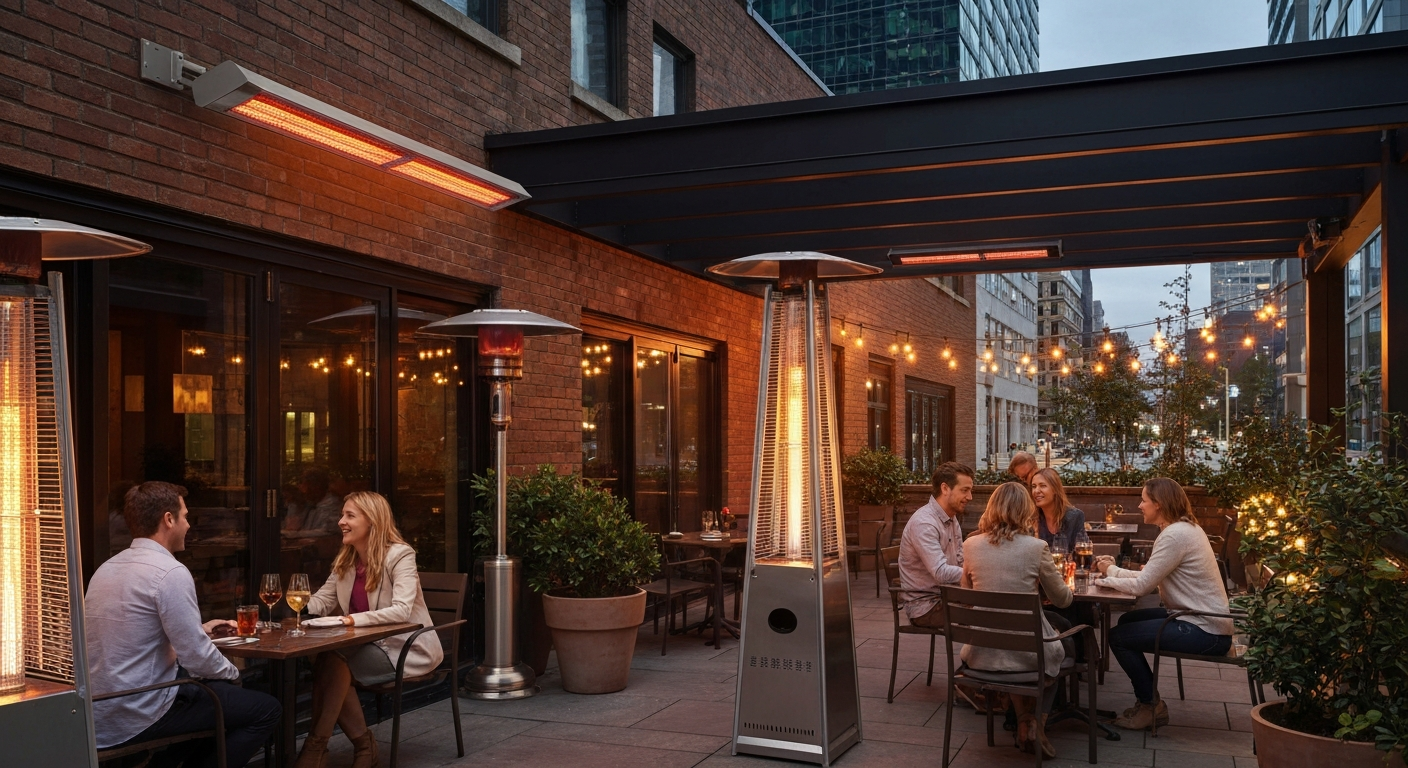
Quick picks: best heated patios at a glance
These are the five setups that consistently perform well across our tests and customer feedback. Each category reflects a specific use case, so match the pick to your situation rather than defaulting to whichever has the highest wattage.
| Category | Top Pick | Output | Fuel | Approx. Price |
|---|---|---|---|---|
| Top Overall | Bromic Tungsten Smart-Heat Gas (freestanding) | 58,000 BTU | Natural gas / propane | $1,200–$1,500 |
| Best Value | AZ Patio Heaters 48,000-BTU Propane Tower | 48,000 BTU | Propane | $130–$180 |
| Best for Large Spaces | Bromic Tungsten 500 Series (wall/ceiling mount) | 50,000+ BTU | Natural gas | $900–$1,200 |
| Best Portable | Mr. Heater Big Buddy Pro 18,000 BTU | 4,000–18,000 BTU (3-level) | Propane (1-lb or 20-lb) | $120–$150 |
| Best Commercial | Infratech W-Series Electric Infrared (hardwired) | 3,000–6,000W | Electric (240V) | $400–$900 per unit |
Price ranges above reflect 2025–2026 retail availability at major U.S. retailers. The Bromic Tungsten carries Intertek listing 4009079 and publishes explicit clearance and coverage specs, which is exactly the kind of manufacturer transparency you should expect before buying any commercial unit. The Mr. Heater Big Buddy Pro includes a tip-over shutoff and a low-oxygen sensor, making it the safest portable pick for enclosed or semi-enclosed spaces, though ventilation is still required whenever you run propane indoors or under a canopy.
Top recommendations by heater type and use case
Propane heaters: portable power with trade-offs
Propane freestanding tower heaters are the default choice for most homeowners because they need no permanent installation. The AZ Patio Heaters 48,000-BTU tower is the benchmark value pick: it covers about 150 sq ft, runs roughly 8–10 hours on a 20-lb tank, and retails under $180. For something more premium, the Bromic Tungsten freestanding runs on propane or natural gas and is switchable, giving you flexibility if you later run a gas line. The trade-off with propane is fuel cost: at roughly $3.50–$4.50/gallon (EIA residential propane pricing, 2025 averages), a 48,000-BTU unit burning at full output consumes about one gallon per hour, adding up fast in cold climates.
Electric infrared heaters: clean, quiet, and increasingly popular
Electric infrared units heat objects and people directly rather than warming the surrounding air, which makes them far more effective on windy patios. The Black+Decker 1,500W ceiling-mounted unit (ETL Listed, confirmed on manufacturer spec pages) is an accessible entry point for residential covered patios. For commercial applications, the Infratech W-Series at 3,000–6,000W delivers zone-level control and handles high-ceiling or open-structure installations well. Running cost depends heavily on your state's electricity rate, the EIA's average of roughly 16–17 cents/kWh nationally means a 3,000W unit costs about $0.48–$0.51 per hour at full output. In high-rate states like California (around 28 cents/kWh), that climbs to roughly $0.84/hour. Factor your local rate before dismissing propane on cost grounds.
Natural gas heaters: best for permanent, high-use installations
If you have a gas line or are willing to run one, natural gas is the lowest-hassle permanent solution for high-use patios and restaurants. No tank refills, no propane price volatility, and the fuel cost per BTU is typically lower than propane. The Bromic Tungsten Smart-Heat wall/ceiling-mount series is the commercial standard here, its published spec sheets list clearances, coverage area, and BTU output with the kind of precision that makes installation and permit documentation straightforward. The upfront cost (including professional gas line work) is the main barrier, often running $1,500–$3,500+ for a full install.
Gas-fired infrared heaters: targeted heat for open or windy spaces
Gas-fired overhead infrared (the type covered under ANSI Z83.26/CSA 2.27) combines natural gas economics with infrared's wind-resistance advantage. These are ceiling or wall-mounted, typically used in commercial settings with higher clearances. They're not the right choice for a low-ceiling residential covered patio, but for a commercial space with 9-foot or higher ceilings, they're excellent. Clearance requirements per the appliance standard must be followed exactly, most units require at least 24–36 inches below the emitter to any combustible surface.
Pellet heaters: niche but real
Wood pellet patio heaters offer an ambiance that gas and electric simply can't match, and pellet fuel is competitively priced. The downsides are real though: they require more maintenance (ash removal, auger checks), take a few minutes to reach full output, and aren't suitable for covered or enclosed patios without proper ventilation. They're a good fit for open residential patios where aesthetics matter and you have the patience for the startup routine. Don't use them in any commercial or enclosed setting without checking local fire codes first.
Portable vs. permanent: the decision framework
Portable heaters (propane towers, tabletop units, Mr. Heater-style portables) make sense for renters, seasonal users, and anyone who wants to move heat around a large deck. Permanent installations (hardwired electric infrared, natural gas wall/ceiling mounts) are the right call for restaurants, bars, year-round residential use, or any setup where you're running the heater more than 4–5 months per year. The break-even on install cost for a permanent natural gas unit versus propane tank refills typically hits around 2–3 seasons of regular use.
Residential vs. commercial: output and durability requirements differ
Residential heaters are built for intermittent weekend use and rated accordingly. Commercial units like the Bromic Tungsten or Infratech W-Series are engineered for 6–8 hours of daily operation and built from materials (stainless steel burner assemblies, powder-coated aluminum housings) that hold up to that duty cycle. If you're outfitting a bar or restaurant patio, don't buy residential-grade equipment, the warranty voidance alone when units fail under commercial use isn't worth the initial savings.
How to choose a heated patio: the practical buying checklist
Before you look at a single product listing, answer these questions. They cut through marketing claims faster than any spec sheet comparison.
- Coverage area: Measure your patio in square feet. A 40,000–48,000 BTU propane tower or a 3,000W electric infrared unit covers roughly 150–200 sq ft. For larger spaces, plan on one unit per 150–200 sq ft zone rather than hunting for a single high-output unit.
- BTU vs. kW: Gas heaters are rated in BTU/hr; electric in watts or kilowatts. For rough equivalence, 3,412 BTU = 1 kWh. A 40,000-BTU heater roughly equals an 11.7kW electric unit — but infrared electric heats more efficiently in wind, so direct BTU comparison understates electric performance outdoors.
- Heat pattern: Overhead infrared units (mounted at height) produce a focused cone of radiant heat directly below. Freestanding tower heaters radiate 360 degrees but dissipate faster in wind. Match the heat pattern to where people actually sit.
- Fuel and running costs: Calculate your hourly running cost using local propane or electricity prices before committing to a fuel type. See the fuel comparison section below.
- Aesthetics: A sleek wall-mounted infrared unit looks very different from a propane mushroom-top tower. If the patio is part of a restaurant or bar brand experience, appearance matters as much as output.
- Price range: Residential propane towers: $100–$400. Residential electric infrared: $80–$500. Commercial natural gas or infrared: $500–$2,000+ per unit, plus installation.
- Warranty: Look for a minimum 1-year warranty on residential units. Commercial-grade units from Bromic and Infratech typically carry 2–3-year warranties. Always confirm whether the warranty applies to commercial use before purchasing.
- Certification: Only buy units with ETL, CSA, or UL listings. This is a non-negotiable for safety and, in most jurisdictions, a permit requirement.
How we rate and compare models
Our testing protocol measures real-world radiant output using calibrated surface temperature readings at fixed distances (1m, 2m, 3m from the heat source), cross-referenced against ASHRAE Standard 55 operative temperature thresholds for outdoor thermal comfort. Wind tolerance is tested at 10–15 mph with an anemometer at the test site, this is where propane towers and low-BTU electric units fail most visibly. We also track fuel consumption against manufacturer claims and log any ignition, shutoff, or pilot issues over a 10-session burn-in period. Customer feedback from verified purchasers is weighted for failure patterns at the 6-month and 18-month marks, where component quality differences between budget and premium units become apparent.
Fuel types compared: real costs and honest trade-offs
| Fuel Type | Avg. Fuel Cost (2025) | Hourly Running Cost (typical unit) | Pros | Cons |
|---|---|---|---|---|
| Propane | $3.50–$4.50/gallon (EIA residential avg.) | $3.50–$4.50/hr at 40,000 BTU full output | No install needed, portable, high output | Tank refills, price volatility, CO risk under covers |
| Natural Gas | $1.00–$1.50/therm equivalent | $0.80–$1.50/hr at 40,000 BTU | Lowest fuel cost, no refills, consistent pressure | Requires gas line, professional install, permit required |
| Electric (standard) | ~16–17 ¢/kWh national avg. (EIA) | $0.48–$0.85/hr for 3,000W unit | No combustion, no ventilation needed, easy install | Higher cost in high-rate states, needs circuit capacity |
| Electric Infrared | Same kWh rate as electric | $0.48–$0.85/hr but more effective per watt outdoors | Wind-resistant, targeted heat, quiet, no emissions | Higher upfront cost for quality units, hardwiring often required |
| Pellet | $200–$350/ton (wood pellets) | $0.30–$0.60/hr approx. | Low fuel cost, ambiance, renewable fuel | Ash maintenance, slow startup, limited to open spaces |
Natural gas wins on operating cost over time, but propane wins on zero-install flexibility. Electric infrared is the best all-around choice for covered residential patios with available 240V circuits, especially in moderate climates. In cold-climate cities, think Chicago, Denver, or DC in January, natural gas or high-output electric infrared for permanent setups make the most economic sense. In warmer markets like Dallas or Austin, where heaters are used only a few months a year, a propane tower is often the practical choice since the lower-cost permanent installations don't have time to pay back. For deeper city-specific advice, the guides on best heated patios in Chicago, Denver, Dallas, Austin, DC, and NYC go into local fuel pricing and permit specifics.
Installation and permitting: what you actually need to know
DIY vs. hiring a pro
A freestanding propane tower is genuinely DIY: unbox, assemble, connect the regulator to a 20-lb tank, and you're done in under 30 minutes. A hardwired 240V electric infrared unit requires a licensed electrician if you don't already have a dedicated 240V circuit at the patio, pulling a new circuit typically costs $200–$600 depending on run distance. Natural gas work requires a licensed plumber or gas fitter in virtually every U.S. jurisdiction, and the line must be pressure-tested and inspected before use. Don't DIY gas line work to save money: a failed joint under a patio is a serious CO and explosion risk.
Mounting options
- Freestanding (floor-standing): easiest, fully portable, no structural attachment — good for residential and temporary commercial setups
- Wall-mount: requires a structurally sound wall, appropriate clearances from combustibles, and (for electric) a nearby circuit or conduit run
- Ceiling/overhead mount: best heat distribution for covered patios; requires checking joist or beam load capacity; overhead gas infrared needs minimum 24–36 inches clearance below emitter to seating
- Tabletop: small footprint, good for supplemental warmth at a single table — not a primary heating solution for any space over 50 sq ft
Running a gas line
Natural gas line work falls under NFPA 54 (National Fuel Gas Code) and your local jurisdiction's amendments. The process involves a licensed contractor pulling a permit, running properly sized black iron or CSST flex line, installing a shutoff valve within reach of the appliance, pressure-testing the system, and getting a final inspection before first use. Budget $500–$2,000+ for gas line extension depending on run distance from the main. In many cities (DC, NYC, Chicago specifically), the permit and inspection process for commercial outdoor gas heaters involves multiple agencies, the permit section below addresses this.
Electrical supply requirements
A 1,500W 120V electric heater runs on a standard 15-amp household circuit, but dedicated circuits are strongly recommended to avoid tripping breakers. Units at 2,000W or higher on 120V should have their own 20-amp circuit. Anything 240V (most commercial infrared, many 3,000W+ residential units) requires a dedicated 240V/30-amp or 240V/50-amp circuit depending on rated current draw. All outdoor electrical work must use GFCI-protected outlets or breakers and weatherproof covers per NEC Article 210 and local code requirements.
Permit checklist
Permit requirements vary significantly by jurisdiction and setting. Here's what to check before your installation, especially for commercial or restaurant patios.
- Residential propane freestanding: usually no permit required, but confirm with your local building department if the patio is attached to the structure
- Residential hardwired electric: electrical permit typically required; verify with local building department
- Residential gas line extension: gas permit and inspection required in all jurisdictions
- Commercial patio (restaurant/bar): expect multiple permit paths — in NYC, DOB and FDNY approval is required for sidewalk-cafe heaters; in DC, the Streatery/Winter Ready outdoor dining program requires FEMS and DC Health review for propane and electrical heating; in Chicago, the BACP sidewalk café and expanded outdoor dining permits include fire-safety checklist items
- Verify whether your insurer requires notification or endorsement for permanent outdoor gas or electric heat installations
- For propane under any canopy or tent: USFA/FEMA guidance and NFPA 58 both address LP gas handling in public settings — check your local fire marshal's requirements before the first heating season
Safety and code: the non-negotiables
The two biggest categories of patio heater incidents are tip-overs (freestanding propane units) and CO accumulation (any gas or propane heater under a semi-enclosed cover or tent). Both are preventable with basic precautions.
Clearances
Always follow the clearance requirements in the product's installation manual, these are based on the listing standard (ANSI Z83.26/CSA 2.27 for gas-fired outdoor infrared; UL or ETL equivalent for electric). As a general benchmark: most freestanding propane towers require at least 36 inches from any combustible surface on all sides and overhead. Overhead gas infrared units typically require 24–48 inches of clearance below the emitter to any person or combustible surface. These are minimums, give more clearance when possible.
Guards and tip-over protection
USFA/FEMA guidance on propane-powered outdoor patio heaters specifically calls out the need for stable placement and, in public settings, physical guards to prevent contact with the burner assembly. FEMA/USFA guidance on propane‑powered outdoor patio heaters references NFPA standards and provides practical location and LP‑gas handling guidance for outdoor heaters used in public settings FEMA/USFA technical guidance on 'Propane‑Powered Outdoor Patio Heater Use' references NFPA and provides practical location and LP‑gas handling guidance for outdoor heaters used in public settings.. Quality freestanding units include tip-over switches that cut fuel automatically if the unit falls. Verify this feature is present and test it during your initial setup, it should cut the flame within 1–2 seconds of tipping.
Carbon monoxide and ventilation
CO is odorless and can accumulate quickly in semi-enclosed spaces. The EPA's CO guidance is clear: any combustion appliance used in or near an enclosed space requires adequate ventilation. Under a pergola with open sides, a single standard propane tower typically doesn't create dangerous CO levels if there's airflow. Under a full tent or in a roofed enclosure without ventilation, the risk is real and serious. If you're using propane or natural gas heaters under a canopy, tent, or roofed space with limited airflow, install a CO detector with an audible alarm rated for the operating temperature range of your patio. This applies to restaurants and bars as much as homes.
Listing standards to verify
- CSA/ANSI Z83.26/CSA 2.27: applies to gas-fired outdoor infrared patio heaters — this is the standard referenced by NFPA for gas appliances in this category
- ETL Listed (Intertek): accepted equivalent to UL listing; Bromic Tungsten carries Intertek listing 4009079 as a verified example
- UL Listed: UL 2021 (Fixed and Location-Dedicated Electric Room Heaters) and related standards apply to electric units
- CSA Group certification: common on natural gas appliances sold in the U.S. and Canada
- Always verify the listing number against the Intertek, UL, or CSA database — do not rely solely on the 'ETL Listed' logo on a product photo
Real-world performance: what testing and customer feedback actually show
Wind tolerance
Wind is the biggest performance variable on any patio. In our field tests at 10–15 mph wind, freestanding propane mushroom-top towers lost 40–60% of perceived warmth at 2m distance compared to calm conditions. Electric infrared ceiling-mount units held 75–80% of their radiant comfort at the same wind speed because they heat surfaces directly rather than the air. The Bromic Tungsten gas-fired units with directional emitters performed significantly better than standard propane towers in wind, their focused heat cone concentrates output where people are seated rather than dispersing it. For any consistently windy location, infrared (gas or electric, overhead-mounted) is the only category that reliably delivers comfortable results.
Durability patterns
At the 6-month mark, the most common consumer complaint across budget propane towers is igniter failure, piezo igniters on units under $200 have a high failure rate in humid coastal climates. At 18 months, the regulator hose is the next most common failure point. On electric units under $200, internal thermostat failures and loose mounting bracket hardware are the recurring issues. Commercial units (Bromic, Infratech) show dramatically better durability at 18+ months, consistent with their commercial-duty construction. Budget units are acceptable for 1–2 seasons of light use; if you're running a heater 4+ nights a week through fall and winter, spend the money on a commercial-grade product.
Noise
Electric infrared heaters are essentially silent in operation. Most propane and natural gas heaters produce a low hiss or burner noise, audible up close but not disruptive at conversational distances. Pellet heaters are the noisiest category due to the auger feed mechanism. In a restaurant setting where ambient noise is already present, heater noise is rarely an issue unless the unit has a faulty burner or gas pressure problem, in which case the sound becomes irregular and loud, a signal to shut it down and inspect.
Common failure points to watch for
- Propane tower: piezo igniter failure (especially in humid climates), regulator hose cracking, base rust on budget models after 1–2 seasons
- Electric infrared: thermostat failures on sub-$200 units, mounting bracket hardware loosening over time, reflector oxidation reducing efficiency
- Natural gas (permanent): burner orifice clogging from insect nesting during off-season, pilot assembly corrosion if not covered when not in use
- Pellet: auger motor failure, ash buildup blocking combustion air, controller board failures in budget models
- All types: manufacturer warranty claims are frequently denied for units used in commercial settings if purchased as residential models — check terms before installation
Maintenance, seasonal care and troubleshooting
Routine maintenance schedule
| Task | Frequency | Applies To | Notes |
|---|---|---|---|
| Inspect regulator hose for cracks or brittleness | Before each season | Propane units | Replace hose if any cracking visible — do not use |
| Clean burner and emitter surface | Monthly during use | All gas, infrared | Spider/insect webs in burner orifices are a leading ignition failure cause |
| Check and tighten mounting hardware | Monthly during use | All wall/ceiling mounts | Vibration from wind loosens brackets over time |
| Test tip-over shutoff function | Start of each season | Propane freestanding | Tip unit slightly — flame should extinguish within 2 seconds |
| Inspect and clean reflector/emitter panel | Every 3 months | Electric infrared | Oxidized or dirty reflectors reduce output significantly |
| Test CO detector function | Monthly during use | All gas/propane under cover | Use test button; replace detector per manufacturer's recommended interval |
| Remove and store or cover unit | End of heating season | All portable/freestanding | UV and moisture exposure degrades housings and seals |
| Schedule professional gas line inspection | Every 2–3 years | Permanent gas installations | Check for joint corrosion, pressure integrity, and valve operation |
Troubleshooting quick reference
- Propane unit won't ignite: check tank valve is fully open, confirm tank has fuel, test regulator connection, try manual lighting — if igniter sparks but doesn't light, check for wind blocking the pilot or inspect burner for blockage
- Electric heater trips breaker: unit likely drawing more current than the circuit is rated for — move to a dedicated circuit or have an electrician upgrade the circuit
- Low heat output on propane: most commonly a partially open tank valve or a regulator that has tripped its thermal limiter (disconnect regulator, wait 60 seconds, reconnect slowly)
- Gas infrared unit producing yellow/orange flame instead of blue: incomplete combustion — check burner orifice for blockage and verify gas pressure is within spec; call a pro if issue persists
- Pellet heater not feeding fuel: check auger for jam or ash accumulation; clean the combustion pot and ash tray before restarting
- When to call a pro: any gas smell, visible corrosion on gas components, irregular flame behavior that persists after basic troubleshooting, or any electrical fault on a hardwired unit
Finding heated patio restaurants near you: a practical guide
If you're looking for venues with heated patios rather than buying a heater yourself, the search approach matters. 'Heated patio near me' and 'outdoor heated dining [city name]' in Google Maps are your most reliable starting points, filtering by reviews that mention heaters or outdoor seating. Yelp's filter for 'outdoor seating' combined with a keyword search in reviews for 'heaters' or 'warm' is also effective. However, listings are often outdated, venues change their heating setups seasonally or shut down heated patio programs entirely.
What to ask a restaurant or bar before you go
- Are the heaters overhead/mounted or portable freestanding? (Overhead = warmer and more wind-resistant)
- Is the patio covered or open? (Covered + overhead heaters = most comfortable in cold or rainy weather)
- Do they operate the heated patio through winter or only fall/spring? (Many venues in colder climates run heated patios only to about 25–30°F)
- Are reservations required for heated patio seating? (High-demand heated sections are often reservation-only from October onward)
- What is the heater type? (Electric infrared = quieter and more pleasant for dining; propane towers can be noisy and move around)
City-specific notes
Heated patio culture and quality varies dramatically by city. In Chicago, heated patios typically open in October and run through March, and the best venues use permanently mounted infrared systems rather than portable propane towers, the wind off Lake Michigan makes freestanding heaters nearly useless. Denver's dry climate and frequent sun actually make heated patios more comfortable than the cold temperatures suggest, and many spots run full-season outdoor dining with minimal heater output needed on sunny days. In New York City, the sidewalk-cafe heater permitting process through DOB and FDNY means the better restaurants invest in compliant, quality installations, a good proxy for heater quality when choosing a venue. DC's Streatery program has pushed a lot of restaurants to upgrade their outdoor heating setups, especially in neighborhoods like 14th Street and Capitol Hill. For a curated list of venues and where to find reliably warm outdoor dining, see our guide to the best heated patios DC. The blank" rel="noopener noreferrer">DC 'Streatery/Winter Ready' outdoor dining guide requires permits and agency review for portable propane and electrical heating and lists FEMS and DC Health review paths and permit triggers. Dallas and Austin heated patios run primarily November through February, with propane towers dominating because the mild baseline temperatures make premium permanent systems hard to justify economically. For neighborhood-specific venue lists and heater-quality notes, see our guide to the best heated patios Dallas. For detailed venue lists and heater-quality notes specific to each city, the dedicated guides on best heated patios in Chicago, Denver, NYC, DC, Dallas, and Austin go deeper into neighborhood-level recommendations. For neighborhood-level recommendations and venue lists, see our guide to the best heated patios NYC. See our guide to the best heated patios in Austin for neighborhood-specific recommendations and heater-quality notes. See our city guide to the best heated patios Denver for neighborhood-specific picks and heater-quality notes.
FAQ
What primary research questions must the review answer to be comprehensive and trust‑driven?
Key research questions: Which heater types (propane, natural gas, electric, infrared, pellet) best match specific use cases (residential vs. commercial, portable vs. permanent)? What are real‑world coverage and effective heat patterns for each model? How do upfront cost, installation complexity, fuel type, and ongoing operating costs compare by climate and city? What safety, code and permitting triggers apply for public vs. private installations? How durable and wind‑tolerant are models in real conditions, and what are common failure modes? What warranties and manufacturer support actually look like in practice? How do customers experience noise, aesthetics and ease of use? For venues: how to locate nearby heated‑patio restaurants, what to ask operators about heater type/seasonality, and what local permit/inspection constraints affect availability?
Which authoritative data sources should be consulted and cited?
Tier‑1 code and safety: NFPA (NFPA 54, NFPA 58, NFPA fact sheet), ANSI/ASHRAE standards (ASHRAE‑55 for thermal comfort), FEMA/USFA guidance, EPA CO/ventilation guidance. Municipal permitting examples: official city guidance (e.g., DC Streatery, NYC DOB/FDNY, Chicago IPI/BACP). Energy and fuel pricing: EIA propane and electricity price datasets. Safety listings and certifications: Intertek/ETL, UL, CSA databases and manufacturer listing numbers. Manufacturer materials: installation manuals, spec sheets, performance figures and warranty terms (Bromic, Heatstrip, Mr. Heater, etc.). Retail catalogs for market coverage and MSRP (Home Depot, Lowe’s). Customer feedback: verified purchaser reviews, warranty claim reports, and trade/industry forum threads.
What testing protocols and instruments are required to quantify heater performance reliably?
Field and lab protocols: 1) Standardized test environment: define a test platform (e.g., 10x10 ft and 20x20 ft patio zones) with wind‑screening options and measured ambient temps. 2) Instruments: calibrated thermometers/thermocouples, globe thermometer (radiant temp), anemometer (wind speed), IR surface thermometer, lux meter (for radiant warming perception), CO detector, sound level meter. 3) Metrics to record: surface and operative temperature at seated height, temperature decay over distance/angle, effective coverage radius, time‑to‑comfort, fuel consumption rate (BTU/hr or kW draw), noise (dBA), start/stop reliability. 4) Repeat tests across wind conditions (0–10+ mph), ambient temps (30°F, 45°F, 60°F), and under partial enclosures (canopy, pergola). 5) Safety checks: verify listed clearances, tip‑over/shutoff functionality, and CO accumulation under semi‑enclosed canopy. 6) Long‑term durability: accelerated‑use cycles (on/off), salt/spray exposure for coastal models, and vibration/wind exposure for freestanding units.
What objective rating criteria and weighting should the buyer’s guide use?
Suggested weighted criteria for star/score system: Performance & coverage (30%) — measured operative temp, coverage radius and wind tolerance. Efficiency & running cost (20%) — BTU/kW and fuel use per hour, modeled operating cost. Safety & compliance (15%) — listings, built‑in safety features, required clearances and ventilation. Installation & maintenance (10%) — ease of install, mounting options, need for pro, serviceability. Durability & warranty (10%) — materials, corrosion resistance, warranty length and terms. Value & aesthetics (10%) — MSRP relative to performance, finish/options. Documentation & support (5%) — clarity of manuals, parts availability. Include transparency by publishing raw test data alongside scores and independent photo/video proof.
How to model and present operating‑cost estimates for different fuels and cities?
Steps: 1) Use manufacturer fuel‑use rates (BTU/hr or kW) validated by measured consumption. 2) Pull local fuel prices: EIA state electricity ¢/kWh and propane $/gallon series; where needed use regional/weekly data. 3) Convert units: 1 kWh = 3,412 BTU to compare gas vs. electric. 4) Compute cost/hr = (BTU/hr ÷ 3412) × (¢/kWh) for electric equivalence or (gallons/hr × $/gallon) for propane. 5) Create city examples for representative climates (e.g., Chicago cold winter, Austin mild winter) and typical duty cycles (e.g., 4 hrs/night × 90 nights). 6) Present ranges and sensitivity (±20% fuel price). 7) Include embodied‑cost commentary (installation, propane tank refill logistics, gas‑line hook‑up costs) and sample total first‑season cost scenarios.
What installation and permitting research must be included for homeowners, businesses and restaurants?
Document: permit triggers for portable vs. fixed heaters in major cities (use DC, NYC, Chicago examples). Steps for homeowners vs. commercial: Determine fuel type and whether gas line/electrical circuit upgrades are needed; check local zoning and fire department rules for public spaces; when to call a licensed plumber/gas fitter or electrician; required site plans and insurance for sidewalk cafes. Provide mounting options: freestanding, ceiling/wall mount, recessed, parasol‑integrated, buried natural‑gas feed. Cite manufacturer clearance diagrams and municipal checklists. Include cost/time estimates for professional install vs. DIY and sample permit documents and application links for major cities.
Next Articles
Best Heated Patios Denver: Top Heaters, Sizing & Safety Guide
Best heated patios Denver: guide to choosing, sizing, installing & permitting outdoor heaters for homes & bars
Best Heated Patios in Austin: Top Spots and Buying Guide
Top heated patios in Austin, curated venues, heater-buying & installation guide, costs, permits, and local pros.
Best Heated Patios NYC: How to Choose the Right Heater
Compare electric, propane, natural gas, infrared and pellet heaters for NYC patios. Pick the right BTU, coverage, and sa