
Propane patio heaters work well in mild to cool weather on sheltered patios, delivering a felt temperature boost of roughly 10–15°F within a 10–20 foot diameter circle around the unit. A standard 40,000–47,000 BTU freestanding model can keep a small group comfortable down to around 25–30°F, burns through a 20-lb tank in about 9–10 hours at full output, and costs roughly $1.37 per hour to run at current propane prices. They are not magic in a windstorm or a wide-open yard, but in the right setup they do exactly what they promise.
How Well Do Propane Patio Heaters Work: Real-World Guide

Caleb Vale
5 Aug 2026
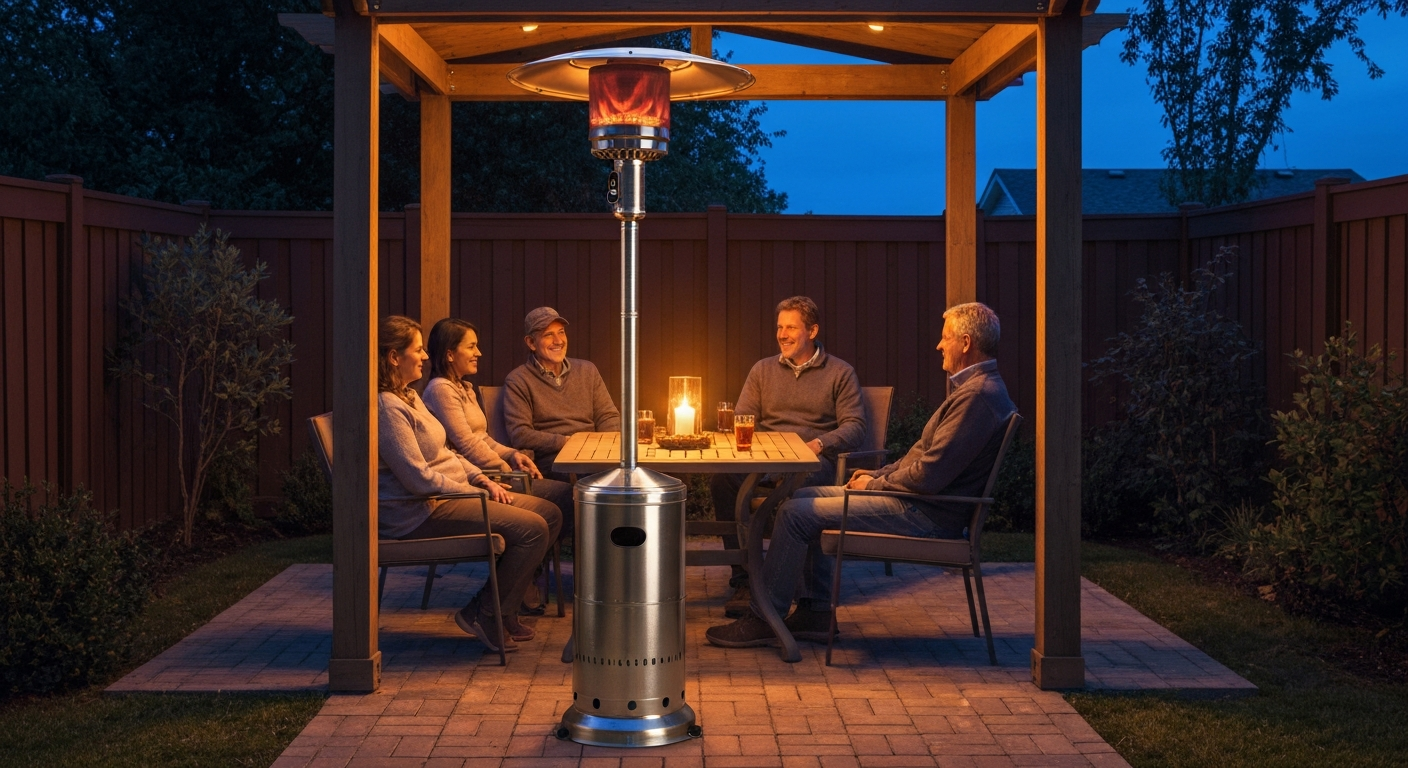
How propane patio heaters actually work
A propane patio heater burns liquefied petroleum gas (LPG) at a burner head, typically positioned beneath a reflective dome or inside a glass tube. The combustion reaction releases energy as heat and light. That heat reaches you through two mechanisms: radiant heat, which travels as infrared electromagnetic waves and warms objects and people directly without heating the air in between, and convective heat, where the hot combustion gases and surrounding air rise and spread warmth through air movement.
For open-flame combustion, only about 10–20% of the energy output is emitted as infrared radiant energy. That fraction is important because radiant heat is what you actually feel on your skin, especially outdoors where convective warmth dissipates quickly in any breeze. The rest of the energy heats the air, which is far less useful outside. This is why the geometry of the heater matters: the reflector dome on a mushroom-style heater is designed to redirect that radiant fraction downward and outward toward the seating area rather than letting it escape straight up.
Radiant vs. convective heating: what you actually feel
Because propane heaters rely on both mechanisms, how warm you feel depends heavily on where you are sitting relative to the unit. Sit within the direct line of sight of the reflector and you get the radiant component hitting your skin and clothing directly. Move to the edge of the coverage zone, or turn your back to the heater, and you lose much of that radiant benefit and are relying more on the convective air warming around you. Outdoors, that convective air warming is easily stolen by even a light breeze.
Dedicated infrared patio heaters, whether propane or electric, are engineered to push a higher fraction of their output into the infrared band. Standard mushroom-style propane heaters are more of a hybrid. If felt warmth from radiant heat is your priority, an infrared-optimized unit will outperform a standard mushroom heater in windy conditions. That said, most homeowners and restaurant patios get solid results from a standard 47,000 BTU freestanding propane unit when the setup is reasonable.
BTUs, coverage area, and warm-up time explained
BTU per hour (BTU/hr) is the single most quoted spec on any patio heater, and it is the right starting point for sizing. Consumer freestanding propane heaters are almost universally sold in the 40,000–50,000 BTU/hr range. A 47,000 BTU/hr unit is the most common configuration and is the benchmark I use for most comparisons on this site.
Manufacturers typically claim a 'circle of warmth' of 10–20 feet in diameter for units in this output range. A 47,000 BTU unit from Backyard Pro, for example, is spec'd at a 20-foot diameter coverage area. Treat those figures as best-case numbers achieved in calm, mild conditions. In practice, a comfortable seating radius of 8–10 feet from the heater base is a more reliable real-world expectation for a group of four to six people.
Warm-up time is short. Propane heaters reach useful output within 30–60 seconds of ignition because the combustion starts immediately. There is no preheating element or mineral warm-up period like you get with some electric infrared models. This makes them genuinely convenient for evening gatherings that start and stop unpredictably.
| Spec | Typical Consumer Propane Heater | What It Means in Practice |
|---|---|---|
| Output | 40,000–50,000 BTU/hr | Enough for a small patio group in mild-to-cool weather |
| Coverage (calm conditions) | 10–20 ft diameter | Reliable comfort zone closer to 8–10 ft radius |
| Warm-up time | 30–60 seconds | Ready almost immediately after ignition |
| Runtime (20-lb tank, full output) | ~9–10 hours | Roughly two to three evening sessions per tank |
| Fuel cost per hour | ~$1.37 at March 2026 propane prices | Lower per-hour cost than equivalent electric output |
Realistic temperature gains and where propane heaters hit their limits
In sheltered conditions, a 47,000 BTU unit typically adds a felt warmth of 10–15°F within the comfortable seating zone. At an ambient temperature of 45–55°F, that puts people in a comfortable range without needing to add layers. Most users find the heater effective down to roughly 25–30°F ambient, though you are working harder to overcome heat loss at those temperatures and comfort is more marginal. Below about 20°F, a single standard mushroom heater struggles to keep a group genuinely warm without additional wind protection.
For below-freezing use, propane heaters have a practical advantage over electric models: propane combustion itself is not affected by cold temperatures the way some electric heating elements can be, and the fuel is available even when power goes out. However, liquid propane pressure in the cylinder does drop as temperatures fall, which can reduce the BTU output slightly on very cold nights. Keeping the tank above 0°F is generally sufficient to avoid meaningful pressure loss. If you are regularly heating in freezing or near-freezing conditions, a larger-output commercial model or a covered, wind-blocked patio structure makes a significant difference.
Wind, open spaces, and site factors that cut effectiveness
Wind is the biggest enemy of any patio heater, propane included. Every major manufacturer manual explicitly warns that coverage area 'will vary based on wind conditions.' Even a 5–10 mph breeze disperses both the convective heat and the rising warm air column, which can reduce effective coverage by 30–50% and make the outer edges of the warmth zone feel barely warmer than ambient. Bromic's commercial Platinum Gas heaters are engineered to tolerate winds exceeding 11 mph on specific models, which is a meaningful spec if your patio is exposed. Most consumer-grade freestanding units have no such spec and are simply not designed for open, windy sites.
Placement on a wide-open lawn or terrace without walls, pergola, or overhead cover means a large portion of the heat output escapes upward and outward before reaching anyone. Overhead or wall-mounted tube heaters can be better solutions for exposed commercial patios because they direct heat straight down into the occupied zone. For homeowners, simply positioning a freestanding heater in a corner with two walls nearby can dramatically improve perceived warmth compared to setting it in the middle of an open patio.
- Wind above 10 mph reduces effective coverage significantly — look for wind-rated commercial models for exposed sites
- Open patios without overhead cover lose convective heat upward; walls or pergolas help retain warmth
- Heater placement at the edge of a seating group, not the center, often improves coverage geometry
- Hard, uneven, or combustible surfaces affect both safety clearances and unit stability — anchor or ballast the base
- Seating height matters: lower seating relative to reflector height reduces the felt radiant component
What buyers and testers actually report
The honest picture from customer feedback and reviewer testing is that satisfaction with propane patio heaters is high when expectations are correctly set and low when they are not. For a concise overview of their real-world performance, see our guide Are patio heaters effective. For a focused discussion on cost versus benefit and whether to buy, see our guide on are patio heaters worth it. The most common complaint in negative reviews is that the heater 'doesn't heat enough' or 'only warms a small area,' which almost always traces back to an open, windy site, a patio that is too large for one unit, or an ambient temperature below 30°F. If readers are asking 'do patio heaters work', see our detailed guide for a straightforward, evidence-based answer and practical setup tips. Buyers who place the heater in a semi-enclosed or sheltered setting and seat people within 8–10 feet consistently rate them positively. For comparisons across models and hands-on testing, see our roundup where we review patio heaters and summarize performance, runtime, and durability findings.
Independent reviewers including Wirecutter note substantial model-to-model variability and emphasize that there are few standardized, publicly available lab tests mapping exact temperature change versus distance for consumer propane heaters. In the absence of independent ΔT contour data, real-world user reports are the best available signal, and those reports consistently show: the heaters work as described in the right conditions, and underperform when site factors are ignored. Assembly quality, ignition reliability, and burner durability are also commonly flagged, premium units with stainless burners and electronic ignition age better than budget models with piezo ignitors and painted-steel burners.
Fuel consumption, runtime, and what a tank really costs you
The math here is straightforward and worth doing before you buy. One gallon of liquid propane contains approximately 91,452 BTU of energy (per EIA conversion factors). A standard 20-lb BBQ cylinder holds about 4.7 gallons, giving you roughly 430,000 BTU total. Common references list a 20‑lb (BBQ) propane cylinder as about 4.7 gallons, roughly 430,000 BTU of usable fuel. At a 47,000 BTU/hr rated output, that heater burns through about 0.514 gallons per hour, which means a 20-lb tank lasts approximately 9.1 hours at full output. This lines up closely with manufacturer claims of 'approximately 10 hours' on a 20-lb tank, since most users do not run the heater at absolute maximum the entire time.
At the most recent published EIA residential propane average of $2.674 per gallon (week ending March 30, 2026), running that 47,000 BTU/hr heater costs approximately $1.37 per hour (0.514 gal × $2.674). A full tank costs about $12.57 in propane to burn through, plus whatever your exchange or refill fee is. For comparison, generating the same heat output electrically at the equivalent of 14.06 kW would cost roughly $2.65 per hour at mid-2026 U.S. average residential electricity rates of about $0.1883 per kWh. Propane is meaningfully cheaper per hour of equivalent heat output at current energy prices.
| Scenario | Propane (47,000 BTU/hr) | Electric Equivalent (14.06 kW) |
|---|---|---|
| Energy cost per hour | $1.37 | $2.65 |
| Runtime per 20-lb tank / equivalent | ~9.1 hours | N/A (grid-connected) |
| Fuel cost per full tank equivalent | ~$12.57 | ~$24.13 for same runtime |
| Warm-up time | 30–60 seconds | Varies (30 sec to 5+ min for some infrared) |
| Works in power outage | Yes | No |
| Safe for enclosed spaces | No — combustion gases | Yes (electric only) |
Propane vs. electric vs. natural gas: picking the right type
Propane is the most flexible option because the tank goes anywhere, no gas line or electrical outlet required. That portability makes it the default choice for most homeowners and for restaurants setting up seasonal patio seating. The trade-off is that you manage tank refills and pay per-unit propane pricing, which varies regionally and seasonally. Natural gas is cheaper per BTU if you already have a gas line and are willing to do a permanent plumbed installation, but you lose portability entirely. Electric patio heaters, particularly infrared electric models, are genuinely useful for smaller covered patios, are safe in more enclosed settings, and require zero fuel management, but they cost more per hour of heat output at current energy prices and depend on a nearby outlet.
If your patio is wind-exposed or you need to heat a very large open area, neither a standard propane mushroom heater nor a standard electric panel will satisfy you. That is when you should be looking at commercial overhead propane tube heaters or high-intensity infrared units mounted above the seating zone, which deliver heat more directionally and are less vulnerable to wind disruption.
Safety, clearances, and installation basics
Propane patio heaters produce combustion byproducts including carbon monoxide, carbon dioxide, and water vapor. They are not safe for use in enclosed indoor spaces, and manufacturer warnings and PERC safety guidelines are unambiguous on this point. 'Covered patio' means a space open on at least two sides with substantial airflow, not a sealed sunroom or garage. If you are uncertain whether your space is sufficiently ventilated, treat it as enclosed and use an electric heater instead.
Consumer freestanding units typically require a minimum clearance of 24 inches from the reflector top to any overhead obstruction, plus specific side clearances noted in the manual. Installations that involve permanent propane lines (rather than portable cylinders) should follow the National Fuel Gas Code (ANSI Z223.1 / NFPA 54) and may require local permits. For commercial installations, verify that the unit carries UL, ETL, or CSA listing marks and meets CSA 5.90 or equivalent North American standards.
Safety and setup checklist
- Confirm the unit carries a UL, ETL, or CSA certification mark before purchasing
- Place the heater on a level, stable, noncombustible surface — use the ballast ring or anchor to prevent tipping
- Maintain at least 24 inches of clearance between the reflector top and any overhead structure
- Never operate in an enclosed or semi-enclosed space without confirmed adequate ventilation
- Inspect the propane hose and regulator before each season for cracks, wear, or gas odor
- Follow the soap-bubble test on the cylinder connection before the first light of the season
- Store spare cylinders upright, outdoors or in ventilated storage — never in a basement or closed garage
- If a permanent gas line is run, use a licensed gas technician and obtain any required permits
How to size and choose the right propane heater for your space
For a standard residential covered or semi-sheltered patio up to about 150 square feet, one 40,000–47,000 BTU freestanding mushroom heater is a reasonable starting point. For patios between 150–300 square feet or open-air restaurant seating, plan on two units positioned to overlap their coverage zones, or step up to a commercial overhead tube heater sized to the seating run. For patios larger than 300 square feet or for consistently windy, exposed sites, a single consumer-grade freestanding unit will leave people on the edges uncomfortable, and a different heater category is the right call.
Climate matters too. If you are in a temperate coastal climate that rarely drops below 40°F, a standard 47,000 BTU propane heater will handle your shoulder seasons well. If you regularly entertain in temperatures below 30°F and want to extend use well into winter, look at higher-output commercial models or plan for supplemental heating and wind screening. The question of whether propane heaters work below freezing is real, and the answer is: yes, but with diminishing returns as temperatures drop and wind picks up. For more detail on seasonal performance and practical tips, see do patio heaters work in winter.
Buying checklist before you purchase
- BTU output: 40,000–47,000 BTU/hr for residential; 50,000+ BTU or commercial tube heaters for larger or windier spaces
- Certifications: UL, ETL, or CSA mark confirmed on the unit — not just 'CE' for North American use
- Ignition type: electronic push-button ignition lasts longer than piezo; pilot-less electronic is best for reliability
- Burner and emitter material: stainless steel burner and emitter screen outlast painted mild steel
- Base stability: weighted base or anchoring kit included, especially for freestanding models in any wind-prone location
- Heat control: variable BTU settings (high/medium/low) extend tank runtime and let you match output to conditions
- Portability needs: confirm wheel kit and tank access if you need to move the unit regularly
- Warranty: look for at least 1 year on parts; commercial-grade units often carry 2–3 year warranties
FAQ
How do propane patio heaters produce heat and how is that heat felt?
Propane heaters burn liquefied petroleum gas (LPG). Combustion produces hot gases and a mix of radiant (infrared) and convective heat. Radiant energy warms people and objects directly; convective heat warms the surrounding air. Consumer freestanding ‘‘mushroom’’ and glass‑tube units typically emit only a fraction of their energy as true infrared; much of the output heats air and the reflector assembly. As a result, ‘‘felt’’ warmth depends on the radiant fraction, the geometry (height, direction, reflectors), and whether the area is wind‑protected.
What size heaters are typical and what area can I expect one to cover?
Common consumer freestanding propane models are rated about 40,000–50,000 Btu/hr. Manufacturers commonly claim a usable ‘‘circle of warmth’’ roughly 10–20 ft in diameter for those units. In practice, effective coverage is highly variable: expect the quoted diameter in mild, wind‑protected conditions with seating arranged radially around the heater; coverage shrinks in wind, with obstructions, or if the heater is mounted too high.
How warm will a propane patio heater make a seating area (real‑world temperature change)?
There are no widely published standardized ΔT maps for consumer models, and measured results vary by model, placement, and wind. Typical experience: directly facing a 40k–50k Btu heater at 3–6 ft will feel several degrees C (several to ~10°F) warmer than ambient; at the edge of the manufacturer’s quoted ‘‘circle’’ the felt gain can drop to a few degrees or less. Wind quickly reduces felt temperature; in breezy conditions the useful radius can shrink by half or more.
Can a propane patio heater keep an outdoor space comfortable below freezing?
Propane heaters will provide local comfort in below‑freezing air for brief seating periods if you are positioned close to the radiant source and sheltered from wind. They do not raise ambient outdoor temperature significantly over large volumes, so they won’t make an entire unprotected patio ‘‘warm’’ in subfreezing weather — expect localized comfort near the heater and diminishing effect with distance and wind.
How long does a propane patio heater run on a common tank?
A typical 20‑lb (BBQ) cylinder contains about 4.7 gallons of propane (~91,452 Btu/gal × 4.7 ≈ 430,000 Btu usable). A 47,000 Btu/hr heater consumes ~0.51 gal/hr, so a full 20‑lb cylinder will run roughly 9–10 hours at full output. Lower setting or intermittent use extends runtime proportionally.
What does it cost to operate a propane patio heater?
Using EIA energy conversions and recent residential propane pricing as an example: a 47,000 Btu/hr heater consumes ≈0.514 gal/hr. At $2.67/gal (example recent U.S. residential price), that’s about $1.37/hr. By contrast, producing the same Btu/hr electrically (≈14 kW) at a U.S. average electricity price could cost roughly $2.50–$3.00/hr. Actual costs depend on local propane and electricity prices and how often you run the heater.
Next Articles
Do Infrared Patio Heaters Work? Verdict, Costs & When to Buy
Do infrared patio heaters work? Evidence-based verdict, costs, coverage, pros/cons and a practical buying checklist.
Are Patio Heaters Worth It? Costs, Coverage, and Best Types
See if patio heaters are worth it: compare electric vs gas costs, coverage, wind impact, safety, and best type for your
Do Patio Heaters Work? How Well They Heat Your Patio
Learn how well patio heaters heat outdoors, what affects coverage, BTUs vs watts, and how to choose safely for your pati