
The best patio heaters for South Africa right now are the Totai Modern Glass Flame (propane/LPG, ~11 kW) for open outdoor use, a wall-mounted infrared panel (1.5–2 kW electric) for semi-enclosed verandas, and a natural-gas mushroom heater for restaurants and cafés on Egoli Gas or a reticulated LPG network. Which one is right for you depends on your patio size, whether you have piped gas, how often load-shedding hits, and what you're willing to spend per hour to run it. This guide cuts through the noise and gives you concrete answers for each scenario. For a broader comparison of models and types, see our guide to the best outdoor patio heaters.
Best Patio Heaters South Africa 2026: Top Picks & Guide

Caleb Vale
26 Jul 2026
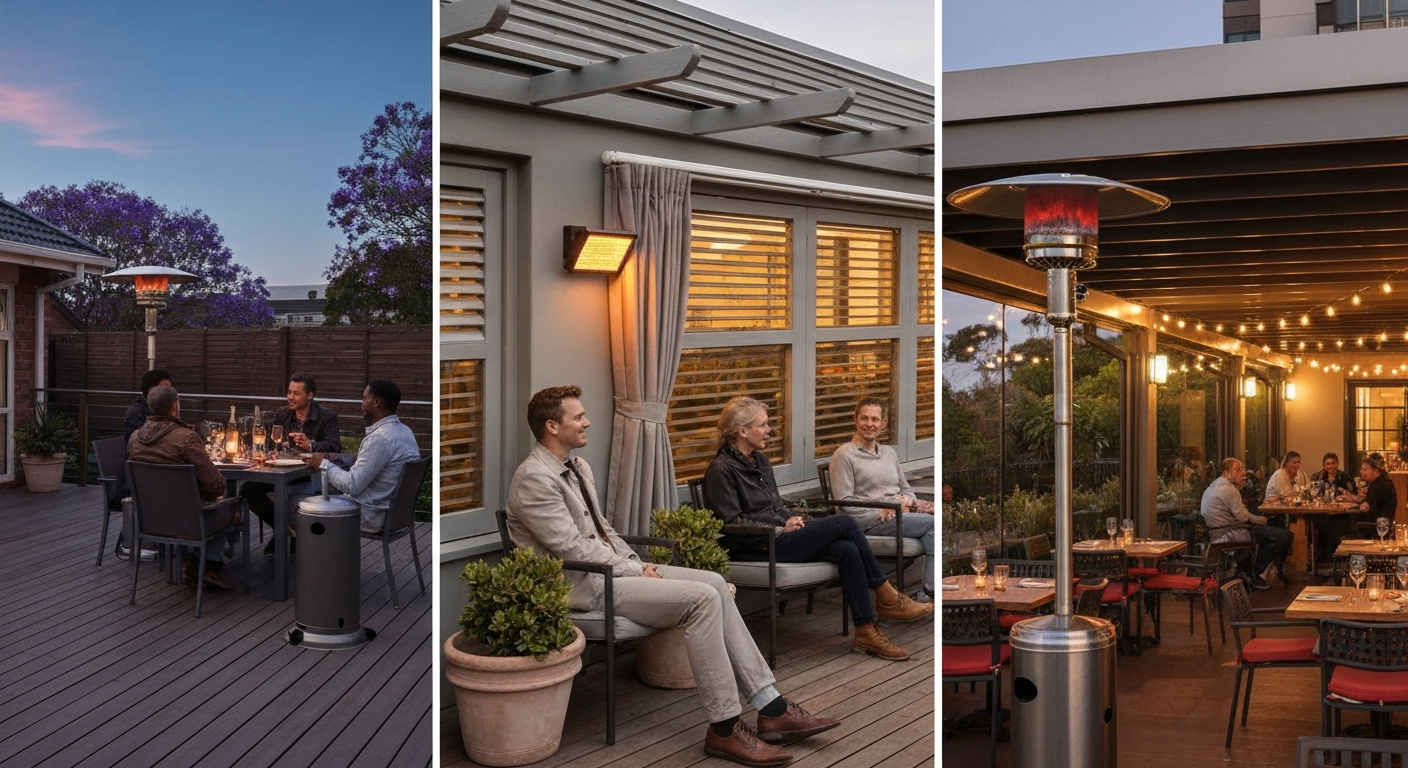
Who this guide is for and how to use it
This guide is written for four main audiences: homeowners who want to extend their evening patio season through the Highveld winter or a Cape Town westerly cold front; landlords and property managers who need a durable, low-maintenance solution for a rental unit or complex communal space; café and restaurant owners who need commercial-grade output, compliance with SANS 10087, and a heater that survives a busy service; and installers or contractors who need a quick technical reference on clearances, regulator specs, and local compliance requirements. Start at the heater-type comparison if you already know your fuel source. Work through the BTU/kW section if you need to size a heater to your specific patio area. Jump to the running-cost section before you commit to electric if you're on a Johannesburg or Cape Town municipal tariff and run a heater more than three hours a night.
How to choose the right patio heater for a South African setting
South Africa's climate varies dramatically between regions, and that variation matters more than people expect when choosing a heater. Johannesburg winters are cold and dry, with temperatures regularly dropping to 2–6 °C overnight, but wind is manageable and humidity is low, a good match for radiant or propane mushroom heaters. Cape Town winters are wet, windy, and often blustery from the south-east or north-west, which rules out freestanding mushroom heaters unless they're sheltered; wall-mounted infrared or under-table heaters work far better here. Durban and coastal KwaZulu-Natal need minimal heating for most of the year, so a portable electric panel is usually enough.
Beyond climate, think about your patio footprint and how enclosed it is. A fully open deck needs a heater with a wide radiant cone, a 10–14 kW propane or gas mushroom covers a roughly 6–9 m² comfort zone at table height. A pergola or semi-enclosed braai room benefits from directional infrared, which heats objects and people rather than air, so wind and draughts have almost no effect on efficiency. A covered restaurant terrace can run a ceiling-mounted infrared strip effectively at 2–4 kW per linear metre of seating. Also factor in power availability: load-shedding stages 4–6 make electric-only setups unreliable for a restaurant during the dinner service, so a gas backup or a gas-primary heater is a sensible hedge.
- Measure your patio area in square metres before choosing heater output — undersizing is the most common mistake.
- Check whether piped natural gas (Egoli Gas in parts of Johannesburg) or reticulated LPG (Indigas and similar) is available at your site before committing to cylinders.
- Coastal and wind-exposed patios: prefer wall-mounted or ceiling-mounted heaters over freestanding models.
- Load-shedding exposure: if your municipality runs Stage 4 or above regularly, gas or pellet heaters offer grid-independent operation.
- Confirm that any LPG appliance you purchase holds an LPGSASA Safe Appliance Scheme verification permit — non-compliant appliances can void insurance and are unlawful to sell in South Africa.
- Check siting clearances: SANS 10087 specifies minimum distances from combustible materials, overhead structures and ventilation requirements for gas appliances.
- For commercial premises (restaurants, hotels), budget for a registered gas installer — the Pressure Equipment Regulations and LPGSASA rules require this.
Top picks by heater type
The table below gives my current top picks for each heater type available in South Africa, along with budget and premium tiers. Prices are indicative mid-2026 retail figures from Makro, Takealot, and Builders Warehouse/Leroy Merlin, always check current listings because stock and pricing change frequently.
| Type | Budget Pick | Approx. Price (ZAR) | Premium Pick | Approx. Price (ZAR) | Best For |
|---|---|---|---|---|---|
| Propane/LPG Freestanding | ALVA Circular Patio Heater | R1,800–R2,500 | Totai Modern Glass Flame | R3,500–R4,500 | Open patios, homeowners, portable use |
| Natural Gas (fixed) | Generic burner/mushroom head on pipe | R2,500 (head only) | Commercial NG mushroom (13–15 kW) | R6,000–R10,000 | Restaurants, piped-gas sites in Joburg |
| Electric Freestanding | Goldair Electric Patio Heater 1.8 kW | R900–R1,400 | G5 Gold Commercial Infrared Stand | R4,000–R6,500 | Covered patios, small areas |
| Infrared Wall/Ceiling Mounted | ALVA or Cadac 1.5 kW panel | R1,200–R1,800 | G5 Gold commercial strip (2–3 kW) | R3,500–R5,500 | Semi-enclosed, wind-exposed, verandas |
| Pellet Heater | Entry pellet fire pit (imported) | R4,500–R7,000 | Premium pellet patio stove | R12,000–R18,000 | Homeowners wanting ambience + heat |
| Wall/Ceiling Mounted Gas Radiant | Compact gas plaque heater | R1,500–R2,500 | Commercial gas radiant strip | R5,000–R8,000 | Covered patios, braai rooms, restaurants |
| Indoor/Semi-Enclosed (electric IR) | Cadac 1.5 kW wall panel | R1,200–R1,600 | G5 Gold 2 kW ceiling strip | R3,500–R4,500 | Enclosed verandas, covered braai rooms |
The Totai Modern Glass Flame is my go-to recommendation for most South African homeowners shopping on Takealot or Makro. For a focused comparison of available options, see our guide to the best outdoor gas patio heater. Its ~11 kW (approximately 37,500 BTU) output on butane/propane/LPG covers a generous outdoor area, it looks good on a deck, and spare parts and local gas refills (9 kg or 19 kg Afrox Handigas cylinders) are easy to source nationally. The ALVA Circular is a credible budget alternative with decent build quality for the price. For restaurants and commercial sites with piped gas in Johannesburg, a fixed natural-gas mushroom at 13–15 kW per unit is the most cost-effective over a three-to-five year lifespan. If you're comparing the South African market to what's available in Australia, be aware that some premium brands common there are harder to source locally, spares availability and after-sales service should factor heavily into any buying decision here. For a direct comparison of models and availability, see our guide to the best outdoor patio heaters Australia (resource 154bd06d-f497-45b8-9f34-a3be45ef5f71).
Indoor and semi-enclosed spaces: what's safe and what isn't
This is where I see the most dangerous mistakes. LPG and natural-gas combustion heaters, mushroom heaters, gas radiant plaques, propane freestanding heaters, must never be used in a fully enclosed indoor space. They produce carbon monoxide (CO) as a byproduct of combustion, and in an enclosed room that CO accumulates to lethal concentrations quickly. SANS 10087 and LPGSASA guidelines are explicit: gas patio heaters are for outdoor or well-ventilated semi-open use only. A 'lapa' or covered braai area with open sides generally qualifies as adequately ventilated; a fully enclosed room with windows closed does not. If you're heating a semi-enclosed space, gas radiant plaque heaters designed for partially ventilated areas are a safer choice than an open-flame mushroom, but even these require permanent ventilation openings as specified in the installation guide and SANS standards.
Electric infrared heaters are the correct choice for genuinely enclosed or semi-enclosed spaces. For recommendations on models suitable for enclosed rooms, see our guide to the best indoor patio heater. A wall-mounted infrared panel or ceiling strip heater produces no combustion products, no CO risk, and no oxygen depletion. Models like the Cadac 1.5 kW wall panel or the G5 Gold 2 kW ceiling-mounted strip are appropriate for an enclosed veranda, a glassed-in restaurant section, or a covered home entertainment room. Mount them according to the manufacturer's clearance specifications, typically a minimum of 0.5–1 m clear of combustible materials and upholstery. Pair with a thermostat and a timer to control running costs, especially given the steep municipal electricity tariffs discussed later in this guide.
- Never use an open-flame LPG or gas heater in a fully enclosed room — CO poisoning risk is serious and rapid.
- Semi-enclosed braai rooms and lapas with open sides: gas radiant plaques are acceptable with adequate permanent ventilation.
- Fully enclosed verandas, conservatories, and glassed-in sections: electric infrared only.
- Install a CO alarm near any gas appliance in a partially enclosed space — they cost under R300 at hardware stores and can save lives.
- Check that gas appliances carry the LPGSASA Safe Appliance Scheme permit before purchase — non-verified appliances are prohibited from sale in South Africa under SANS 1539.
Understanding heat output and coverage: BTU, kW and effective radius
South African product listings mix BTU and kW, sometimes on the same product page. They're measuring the same thing: 1 kW = approximately 3,412 BTU/h. So the Totai Modern Glass Flame's claimed 11 kW equals roughly 37,500 BTU/h. What the spec sheet won't tell you is effective coverage area, which depends on heater height, mounting angle, wind exposure, ambient temperature, and whether you're heating an open or enclosed space. As a practical rule of thumb for South African conditions: allow roughly 1 kW per square metre for a well-sheltered semi-enclosed patio, and 1.5–2 kW per square metre for an exposed outdoor deck in winter. A 10 kW freestanding heater centred on a table setting can comfortably warm 6–8 people within a roughly 3 m radius on a calm night, but that comfort zone shrinks noticeably in a 15 km/h wind.
| Heater Output | Approx. kW | Approx. BTU/h | Effective Comfort Radius (calm) | Effective Comfort Radius (breezy) |
|---|---|---|---|---|
| Small electric panel | 1.5–2 kW | 5,100–6,800 | 1.5–2 m | 1–1.5 m |
| Medium propane/gas mushroom | 8–11 kW | 27,000–37,500 | 2.5–3 m | 1.5–2 m |
| Large propane/gas mushroom | 13–15 kW | 44,000–51,000 | 3–4 m | 2–2.5 m |
| Commercial infrared strip (2 m) | 3–4 kW | 10,000–13,600 | 2 m wide × 2 m below | Directional — minimal wind effect |
| Pellet patio stove | 5–9 kW | 17,000–30,700 | 2–3 m | 1.5–2 m |
Infrared heaters behave differently from convective heaters. They heat surfaces and bodies directly via radiated electromagnetic energy rather than warming the air. This means wind has almost no impact on their felt warmth, which is why directional infrared is the best choice for Cape Town's notorious south-easter or any wind-exposed patio. The trade-off is that infrared heats only in line-of-sight, you need to be within the beam to feel it.
Performance and coverage by heater type
Propane and LPG freestanding heaters
Propane/LPG mushroom heaters are the most widely sold and stocked patio heater category in South Africa. They're portable, readily available (Makro, Takealot, Builders Warehouse, and most hardware stores carry multiple models), and use standard Afrox Handigas cylinders that can be exchanged or refilled at thousands of retail points nationally. A 9 kg cylinder at roughly R360–R520 (depending on region, exchange vs new, and supplier) will run a medium 10 kW heater for approximately 8–10 hours total, though in practice you won't run it flat every night. The main weaknesses are wind sensitivity (the radiant cone disperses quickly in a breeze), cylinder logistics (you need a spare for a long dinner party), and the fact that they're genuinely only suitable for outdoor use. On build quality, local-brand models from ALVA and Totai offer reasonable durability at the price; more expensive imported mushroom heads with stainless reflectors last longer but are harder to service locally.
Natural gas heaters
Fixed natural-gas patio heaters are the best-value-per-hour option if your site is on Egoli Gas's reticulated network (primarily parts of Johannesburg) or has a reticulated LPG supply through a provider like Indigas. Gas tariffs per unit of energy are typically lower than electricity tariffs and far lower than the effective per-kWh cost of LPG from cylinders. The downside is upfront infrastructure cost: a registered installer, gas piping, regulator, and potentially a meter connection. For a restaurant turning over 80+ covers a night, that investment pays back quickly. For a homeowner, the calculation is tighter and depends heavily on whether infrastructure already exists. Natural-gas availability outside Johannesburg is very limited in South Africa, confirm with your local municipality before specifying NG appliances.
Electric patio heaters
Electric heaters are the easiest to install and the safest indoors, but running costs are high and load-shedding makes them unreliable for commercial use without a generator or UPS backup. For focused recommendations and model comparisons, see our guide to the best outdoor electric patio heater for buying advice and local availability. Standard freestanding electric patio heaters draw 1.5–2 kW, which at a Cape Town 2026/27 residential tariff of approximately R2.57/kWh (per the City of Cape Town's 2026/27 budget tariff schedule) costs roughly R3.86–R5.14 per hour to run. That's not dramatic for occasional home use, but it adds up fast in a restaurant context. Electric models shine in enclosed or semi-enclosed settings where gas is unsafe, and their zero-emission, no-flame operation means no SANS 10087 compliance issues for the installation. Available locally: Goldair, ALVA, and Cadac electric models are consistently in stock at major retailers.
Infrared heaters (electric)
Electric infrared, particularly wall-mounted short-wave or medium-wave infrared panels, is my preferred solution for semi-enclosed South African patios and covered restaurant sections. Directional output means wind has no effect on comfort, and wall or ceiling mounting keeps the floor clear. G5 Gold is the most commonly specified commercial infrared brand locally, and their strip heaters are well-regarded by contractors I've spoken to. Residential infrared panels from ALVA and Cadac are solid budget options. Running costs are the same as general electric heaters (tariff × kW draw), so efficiency gains come from the fact that you're heating people directly rather than wasting energy warming air that immediately blows away.
Pellet heaters
Pellet patio stoves are a niche but growing category in South Africa. They burn compressed wood pellets, produce a real flame and genuine warmth at 5–9 kW, and are grid-independent. The main practical problems in South Africa are pellet supply logistics (pellets are not as widely distributed as LPG cylinders, you'll often need to order online or from a specialist outdoor retailer) and the fact that ash management adds a maintenance step that most users underestimate. Pellet heaters work well for homeowners who want ambience, real fire, and independence from both the grid and gas refill logistics, but they're not practical for restaurants due to the ash and smoke. Budget around R4,500–R7,000 for an entry model and factor in pellet cost (typically R3,000–R5,000 per tonne, with consumption of roughly 1–2 kg/h at full output).
Wall and ceiling-mounted gas radiant heaters
Gas radiant plaques and bar heaters mounted on walls or ceilings are widely used in commercial covered terraces and semi-open entertainment areas. They combine the lower fuel cost of gas with the directional benefits of radiant heat. They must be installed by a registered gas installer under SANS 10087 and require adequate ventilation openings, the specific sizing of those openings depends on total gas appliance kW load and is specified in the standard. For a restaurant with a covered terrace, two or three 4–5 kW wall-mounted gas radiant units is often more practical than multiple freestanding mushroom heaters, as they eliminate trip hazards, keep the floor clear, and can be piped to a central LPG manifold or reticulated supply.
How we score heaters and what our performance ratings actually mean
On Patio Heater Ratings, our scores across categories (heat output, efficiency, build quality, value for money, ease of use, and safety) are based on a combination of manufacturer spec verification, real-world testing at representative South African ambient temperatures (typically 5–15 °C for winter testing), and aggregated customer feedback from verified local buyers. We cross-check spec claims, particularly output in kW and heating radius, against observable comfort zones at standardised test conditions: 10 °C ambient, no wind, heater at standard operating height. Where specs are inflated relative to real performance, we note the discrepancy. Running-cost scores are calculated using current South African tariffs (see next section) rather than offshore rates, because the economics differ significantly from the Australian or European context. A heater that rates as cheap to run in the UK may be expensive to operate at South African electricity rates or cheap at South African gas rates, it depends entirely on your fuel source and local tariff.
Running costs for South Africa: the numbers you actually need
South African running costs for patio heaters are driven by three factors: fuel type, local tariff structure, and usage pattern. Here's how to work it out for your specific situation.
Electricity costs
The City of Cape Town's 2026/27 budget documents an indicative residential small-power energy charge of approximately R2.57/kWh (257 c/kWh) for relevant residential categories. Eskom's 2025/26 Schedule of Standard Prices (effective 1 April 2025) sets residential Homepower tariffs at a different rate, and NERSA approved an ~8.76% Eskom tariff increase effective April 2026, so your actual rate depends on whether you are an Eskom direct customer or a municipal customer, and which tariff category you fall under. As a working estimate for mid-2026, a reasonable range for residential customers across major metros is R2.40–R2.80/kWh inclusive of VAT (15% VAT applies per SARS). Time-of-use (TOU) customers on Homeflex or commercial TOU tariffs pay a peak-period premium (evenings are typically peak or standard period) that further increases evening running costs. Always check your current municipal or Eskom bill for the exact rate applied to your account.
LPG cylinder costs
Afrox Handigas cylinders are the dominant LPG supply format in South Africa, available in 4.5, 6, 9, 14, 19, and 48 kg capacities. For a home patio heater, a 9 kg or 19 kg cylinder is most practical. Based on mid-2026 retail examples from AtomGas and Stargas listings, a 9 kg exchange refill costs approximately R360–R520 depending on region and supplier, and a 19 kg exchange refill costs approximately R700–R900. LPG has a calorific value of approximately 12.8 kWh per kg (using propane as the dominant component of Handigas). A 10 kW heater running at full output therefore consumes roughly 0.78 kg/h of LPG, meaning a 9 kg cylinder lasts approximately 11.5 hours at full tilt. At a mid-range 9 kg refill cost of R440, that works out to approximately R38/hour, significantly more expensive per kWh of heat output than mains electricity, but immune to load-shedding and usable anywhere.
Natural gas costs
Piped natural gas tariffs from Egoli Gas and municipal reticulators are negotiated or published by the reticulator and vary by volume tier and customer category. Per-unit natural gas costs are generally lower than equivalent LPG cylinder costs and often lower than peak-rate electricity for high-output heating applications. For accurate modelling, contact Egoli Gas or your local LPG reticulator (e.g. Indigas) for current tariffs applicable to your site. As a rough order of magnitude, commercially supplied natural gas or reticulated LPG in South Africa tends to cost R0.80–R1.40/kWh of heat energy equivalent, significantly below retail electricity rates.
Worked cost examples
| Scenario | Heater Type | Output | Fuel Cost Basis | Approx. Hourly Cost (ZAR) | Monthly Cost (3h/night × 30 nights) |
|---|---|---|---|---|---|
| Home veranda, Cape Town | Electric infrared 1.5 kW | 1.5 kW | R2.57/kWh municipal | R3.86 | ~R347 |
| Home patio, Joburg | LPG mushroom 10 kW (60% load) | 6 kW effective | 9 kg @ R440 / 11.5 h | ~R38 full / ~R23 at 60% | ~R2,070 at 60% load |
| Restaurant terrace, Joburg (piped NG) | Natural gas mushroom 13 kW | 13 kW | NG @ R1.00/kWh equiv. | ~R13 | ~R1,170 |
| Restaurant (electric IR, 2× strips) | 2× infrared 2 kW ceiling | 4 kW total | R2.57/kWh (CoCT est.) | ~R10.28 | ~R926 |
| Home patio, wind-exposed coastal | Wall-mount infrared 2 kW | 2 kW | R2.60/kWh (est. municipal) | ~R5.20 | ~R468 |
These examples use publicly available tariff data and representative mid-2026 fuel prices. They are estimates only, your actual cost will vary based on your specific tariff schedule, load factor, and local fuel prices. Imported heaters also carry a landed-cost premium: SARS applies import VAT using the Added Tax Value (ATV) method (customs value × 1.10 + customs duty, then × 15% VAT), which adds meaningfully to the shelf price of imported models. This is already baked into the retail prices at local stockists, but it's worth understanding if you're comparing South African prices to what the same model costs in Australia or Europe. Note also that NERSA-approved Eskom tariff increases of approximately 8.76% (April 2026) and 8.83% (April 2027) mean electric running costs will continue to rise, factor this into any multi-year cost projection for an electric heater investment.
Installation and safety: what the rules actually require
Gas appliance installation in South Africa is regulated under SANS 10087 (the gas installation code series) and SANS 1539 (safety requirements for LPG appliances). The LPGSASA Safe Appliance Scheme requires that all LPG appliances sold or used commercially hold a valid verification permit, buy from reputable local retailers (Makro, Takealot, Builders Warehouse) and request documentation if in doubt. The Pressure Equipment Regulations under the Occupational Health and Safety Act require that gas installations be carried out by a registered installer; a non-compliant installation can void your insurance and expose you to liability, especially in a commercial context.
- Purchase only LPG appliances that carry an LPGSASA Safe Appliance Scheme verification permit.
- Use only Afrox or similarly certified LPG cylinders, hoses, and regulators — do not mix brands or use uncertified components.
- For fixed gas installations (piped LPG or NG), engage a registered gas installer — required by law for commercial premises and strongly recommended for residential.
- Maintain minimum clearances from combustible materials as specified in the appliance manual and SANS 10087 — typically 0.5–1 m horizontally and manufacturer-specified overhead clearance.
- Ensure adequate permanent ventilation for any gas appliance in a covered or semi-enclosed space — ventilation area is specified relative to total appliance kW input in SANS 10087.
- Install a CO alarm in any semi-enclosed space where a gas heater operates.
- Inspect hoses and connections before each season — LPG hoses should be replaced every 3–5 years or sooner if cracked or kinked.
- For electric infrared heaters: follow manufacturer mounting clearances, use a qualified electrician for hardwired installations, and ensure the circuit is SANS 10142 compliant.
- Never store LPG cylinders indoors, in enclosed garages, or in pits — LPG is heavier than air and will pool in low spaces, creating an explosion risk.
- For commercial premises: ensure your Certificate of Compliance (CoC) covers the gas installation and is current.
Maintenance, durability, and weatherproofing
South African outdoor conditions are tough on patio heaters, UV intensity is high year-round, coastal salt air is corrosive, and Highveld summer thunderstorms are severe. Stainless-steel burner heads and reflectors outlast painted steel significantly in coastal or humid inland conditions; budget models with thin powder-coated steel reflectors typically show rust within two seasons near the coast. For any freestanding heater, a fitted weather cover (available at R150–R400 from most stockists) is essential if the heater stays outdoors between uses. Electric infrared panels with IP55 or higher rated enclosures are appropriate for permanently mounted outdoor use in wet conditions; check the IP rating before installing an electric heater in an unprotected outdoor position.
- Clean LPG burner ports with a soft brush at the start of each heating season — blocked ports cause uneven flame and incomplete combustion.
- Check the thermocouple or flame-failure device annually on gas heaters — replacement parts are available from local gas suppliers and online.
- Store freestanding heaters under a UV-resistant cover when not in use; long-term outdoor UV exposure degrades plastic components and seals.
- For coastal installations, choose marine-grade stainless steel construction or apply a protective wax coating to exposed metal surfaces each year.
- Pellet heaters require ash pan cleaning every 1–2 uses and a full combustion-chamber clean monthly during heavy use.
- Infrared quartz elements have a finite lifespan (typically 5,000–10,000 hours); replacements are available but confirm local stock before buying an obscure brand.
- Annual professional service is recommended for any fixed gas appliance — a registered installer should pressure-test the system and inspect the burner assembly.
Accessories worth buying
A good patio heater setup is more than just the heater. A few accessories make a real difference to safety, comfort, and running costs. A programmable timer or smart plug for electric heaters cuts wasteful runtime, a heater left on after guests leave is pure cost for nothing. A wall-mounted outdoor thermostat (R300–R600) on an electric infrared system lets you set a target ambient temperature and cycle the heater on and off rather than running flat-out all evening. An outdoor thermometer helps guests and staff make informed decisions about whether to turn the heater on at all, a decent wireless outdoor thermometer is useful here. If you need a recommendation, see our guide to the best outdoor patio thermometer for reliable wireless readings and easy installation. A heavy-duty fitted cover for any freestanding heater is a straightforward investment. For gas setups, a spare regulator and a spare certified hose mean a fault doesn't cancel an evening's service. LPG cylinder weight scales (a simple bathroom scale works) let you gauge remaining gas without guesswork.
Finding heaters, spares, and service locally
The easiest way to buy a patio heater in South Africa is through Makro, Takealot, or Builders Warehouse/Leroy Merlin. To check local availability and delivery options, search for the best outdoor patio heater near me to compare stock and prices at nearby retailers. All three carry multiple categories, post specifications and current prices online, and have returns processes. Takealot is often the fastest for delivery to metro areas and posts customer reviews that are useful for quality cross-checking. Takealot, ALVA Circular Patio Heater (product page) shows the ALVA Circular listing with technical fields that include model wattage/kW values, illustrating how local retailers publish power figures for electric/infrared heaters Takealot — ALVA Circular Patio Heater (product page). For commercial or custom installations, specialist gas equipment suppliers and commercial kitchen/catering equipment dealers are a better channel than general retail, they'll carry higher-output commercial units, can arrange certified installation, and hold service contracts. For LPG cylinders and refills, Afrox's national network is the most reliable; Totalgaz and independent resellers (AtomGas, Stargas) are viable alternatives in most metros. If you're looking for a specific model that's out of stock, note that South Africa's import lead times can be significant, popular models that sell out in winter can take 8–12 weeks to restock if they're sourced from Asia or Europe. Buying a cover or backup option makes sense if you're relying on a heater for commercial service.
Quick buying checklist before you commit
- Measure your patio area and calculate required kW output (use 1 kW/m² for sheltered, 1.5–2 kW/m² for exposed).
- Confirm your fuel source: mains electricity, LPG cylinder, piped natural gas, or reticulated LPG — each has different upfront and running costs.
- Check LPGSASA Safe Appliance Scheme permit for any gas appliance you're considering.
- Confirm whether the installation requires a registered gas installer (it always does for fixed piped installations).
- For enclosed or semi-enclosed spaces: electric infrared only — no open-flame gas appliances.
- Check IP rating on any electric heater intended for permanent outdoor exposure — IP55 minimum.
- Factor in load-shedding exposure: if Stage 4+ is common in your area, gas or pellet provides grid-independent backup.
- Calculate running costs using your actual tariff, not a generic estimate — check your current electricity bill for the exact c/kWh rate.
- Budget for a cover, spare hose, and a CO alarm from day one.
- Confirm spares and service availability for the model you choose before buying — especially for less common imported brands.
FAQ
Which types of patio heaters are best for South Africa (propane, natural gas, electric, infrared, pellet, wall/ceiling)?
Each type has clear trade-offs: propane (portable, high output, good for exposed areas; running cost depends on refill prices and cylinder size), natural gas (lowest fuel cost where piped gas is available, good for restaurants and fixed installs), electric resistance (clean, simple to install, best for semi-enclosed/indoor use if power capacity allows; higher energy cost per kW), infrared (efficient at warming people/objects with lower air heating — excellent in windy or semi‑open patios), pellet (lowers fuel cost if bulk wood waste available; needs storage/maintenance; niche use), wall/ceiling (fixed, tidy, best for commercial/covered patios). For South Africa, infrared and propane dominate retail listings, natural gas is ideal where reticulation exists, and electric suits small, semi‑enclosed residential areas.
What are top picks by heater type and recommended models for indoor/semi‑enclosed use and budget vs premium options?
Representative picks (buying guidance rather than exhaustive list): - Propane: Budget — basic 11–13 kW pyramid patio heater from mainstream retailers; Premium — stainless steel 37–44 kW commercial patio heater with glass-flame option. - Natural gas: Fixed commercial 30–40 kW stainless models from certified installers (premium reliability). - Electric (residential/indoor): Budget — 1–2 kW tubular electric patio heaters; Premium — 1.5–2 kW high‑IP infrared electric panels with thermostat/timer. - Infrared (outdoor): Budget — 2‑3 kW short‑wave quartz patio lamps; Premium — commercial medium‑wave ceramic carbon panels (better comfort, longer life). - Pellet: Small pellet-fired patio stove units for covered patios (specialist suppliers). - Wall/ceiling: Budget — wall-mounted electric IR panels; Premium — gas or electric ceiling recessed units for restaurants. For indoor or semi‑enclosed use pick sealed electric or purpose‑rated low‑emission infrared units; avoid unvented gas indoors. Check local retail pages (Takealot, Makro, Builders) for model specs and Patio Heater Ratings for deeper category reviews.
How do BTU, kW and effective heating radius relate — how much heater do I need?
Convert units: 1 kW ≈ 3,412 BTU/hr. Rule‑of‑thumb coverage: - Electric/resistance/infrared panels (1–2 kW): effective for a 1–2 m radius for seated areas (directed heat). - Propane patio heater (11–13 kW or ~37–45k BTU): comfortable for 3–4 m radius in sheltered spaces; high‑output commercial gas (30–40 kW): 4–6 m radius or to cover larger dining areas when multiple units are used. Effective radius is reduced by wind and open sides. Use desired comfort temperature rise, wind exposure and number of occupants to estimate total kW needing—for restaurants, use multiple fixed units spaced to create overlapping zones rather than one large unit.
How should I estimate running costs in South Africa for electric vs gas (propane/natural gas)?
Electric: calculate kW × hours × local R/kWh (use Eskom tariff booklet, municipal tariffs or Conduit for local R/kWh and TOU bands). Include demand/connection charges for commercial sites. Example: a 2 kW heater running 4 hours at R2.50/kWh costs 2×4×2.50 = R20. Gas (propane): estimate cylinder consumption (kW to kg/hr conversion via calorific value), then cost per kg or exchange price. Use local refill/exchange prices (e.g., 9 kg or 19 kg cylinder prices from suppliers like Afrox/AtomGas). For natural gas, use reticulator's R/GJ or c/kWh equivalent and multiply by appliance kW-hours. Include VAT (15%), and for imported heaters add landed‑cost factors (duty, SARS ATV method). For multi‑year projections account for planned tariff hikes (NERSA/Eskom decisions). Patio Heater Ratings’ running cost pages explain step‑by‑step calculators and sample scenarios.
What South Africa‑specific factors should influence my choice?
Key SA considerations: - Electricity cost and load‑shedding risk (Eskom/multiyear tariff changes and TOU rates affect electric heater economics and availability of power). - Local LPG pricing and cylinder availability/exchange networks (regional price variance). - Wind and seasonal weather — windy coastal sites favour infrared/point‑source heaters and windbreaks. - Availability of spare parts, warranty and after‑sales support: prefer brands stocked by Makro/Takealot/Builders or local distributors. - Compliance and safety: SANS 10087/SANS 1539 and LPGSASA Safe Appliance Scheme for gas appliances/installers. - Import VAT/duties raising landed cost for imported premium units.
Can I use propane or natural gas patio heaters indoors or in semi‑enclosed areas?
Only use appliances rated for indoor or semi‑enclosed use. Most consumer propane patio heaters are designed for outdoor use and should not be used indoors due to CO and combustion‑product risks. Natural‑gas fixed heaters specifically certified for semi‑enclosed spaces and installed by accredited installers (SANS compliance) may be acceptable. Always follow manufacturer restrictions, provide adequate ventilation, and consult a qualified gas installer; do not use unvented LPG appliances indoors.
Next Articles
Best Outdoor Electric Patio Heater: Buying Guide by Patio Size
Choose the best outdoor electric patio heater by patio size, coverage, wind, controls, safety, and cost estimates.
Best Outdoor Patio Heaters: Choose Gas, Electric, Infrared
Buying guide for the best outdoor patio heaters: gas, electric, infrared, propane and pellet with cost, coverage and saf
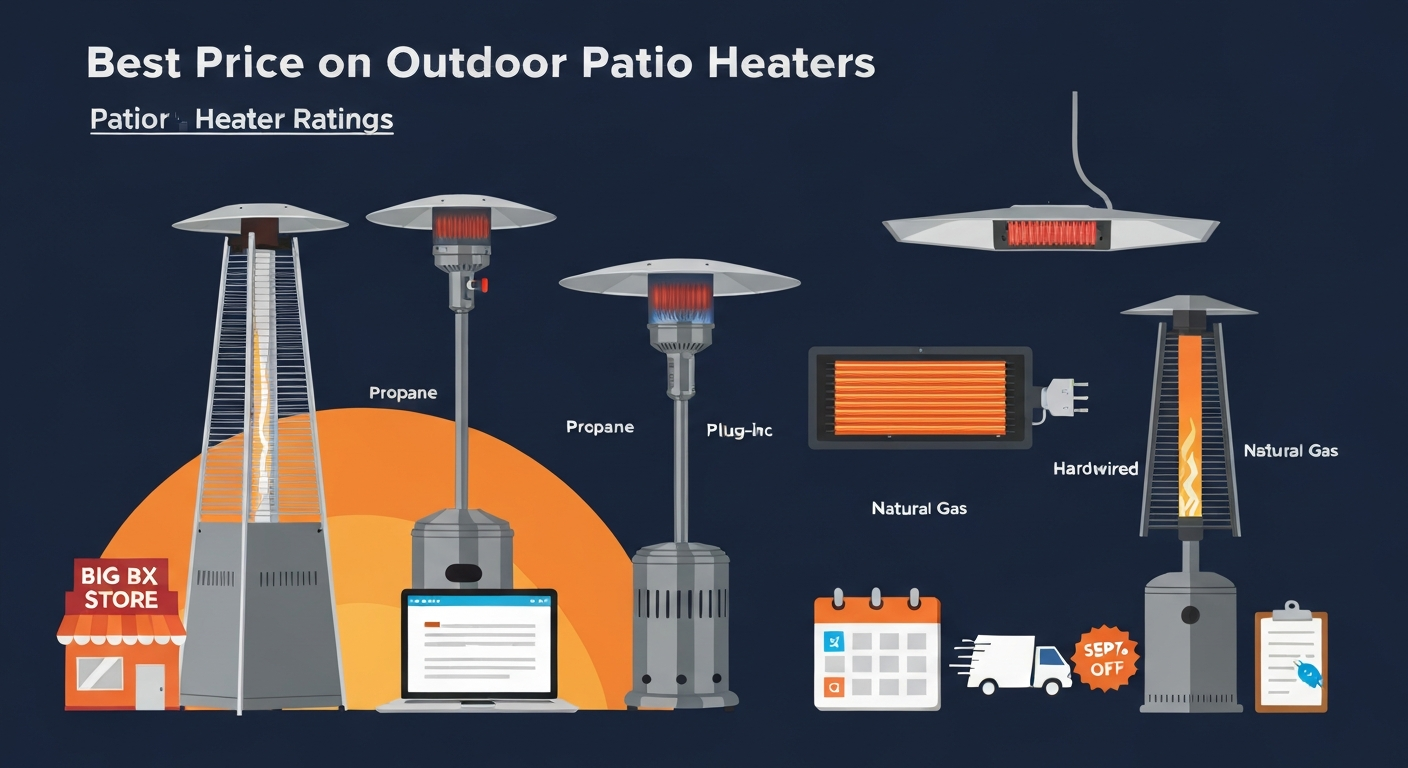
Best Price on Outdoor Patio Heaters: Compare Costs & Deals
Score the best price on outdoor patio heaters, price ranges, top picks, deal tactics, total-cost & safety checklist.