
For most Australian patios, a 2–4 kW infrared electric heater or a 13–15 kW LPG mushroom heater covers the job well, costs between $150 and $600 to buy, and can be running within an hour of delivery. If you have a large undercover area or a commercial venue, step up to a 25–35 kW natural gas radiant heater or a commercial-grade model like the Bromic Tungsten 500 Gas (rated at roughly 17.4 kW / 59,000 BTU/h). The right choice depends on whether your patio is enclosed or open, whether you have a reticulated gas supply, your local climate, and how seriously you want to control running costs.
Best Outdoor Patio Heaters Australia: Top Picks & Buying Guide

Caleb Vale
29 Jul 2026
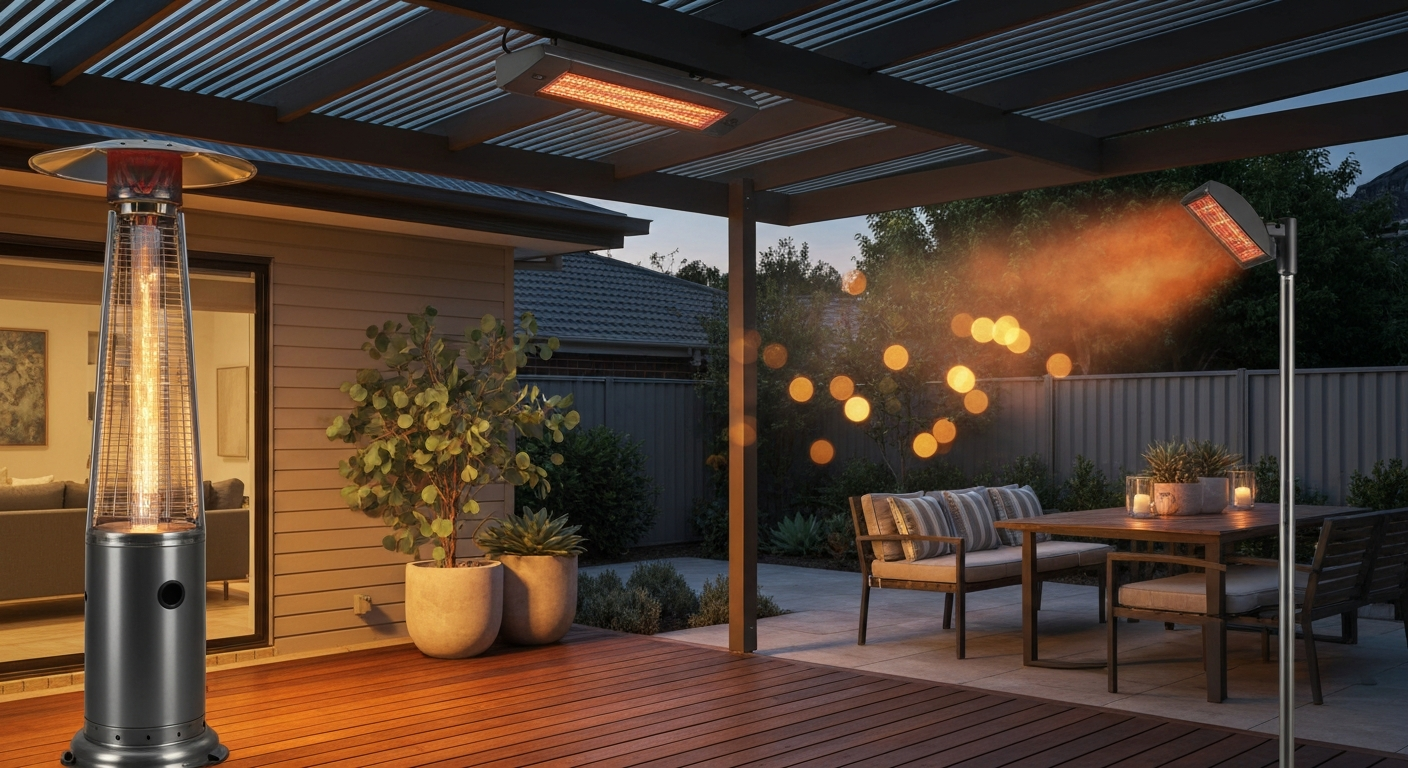
Top picks at a glance
These are the categories we test and review most heavily on this site, matched to the most common Australian patio setups. Use this table as a quick reference before diving into the full recommendations below.
| Use-case | Heater type | Recommended output | Approx. buy price (AUD) | Best for |
|---|---|---|---|---|
| Budget / occasional use | LPG mushroom (propane) | 13 kW (44,000 BTU/h) | $150–$250 | Renters, small decks, anyone wanting portability |
| Small balcony / apartment | Infrared electric (wall/ceiling mount) | 2–3 kW | $200–$450 | Enclosed or semi-enclosed balconies, no gas supply |
| Large undercover patio (home) | Natural gas radiant or LPG radiant | 25–35 kW | $500–$1,200 | Permanent alfresco areas, undercover pergolas |
| Commercial venue / café | Natural gas commercial radiant | 35–50 kW+ (multiple units) | $1,200–$3,500+ | Hospitality, outdoor dining, high-traffic areas |
| Budget electric | Freestanding electric halogen/infrared | 2 kW | $80–$180 | Small covered areas, no gas or plumbing available |
| Pellet (niche) | Wood-pellet outdoor heater | 5–10 kW (variable) | $600–$1,500 | Rural properties, ambience-focused setups, off-grid |
Detailed recommendations by heater type and use-case
LPG / propane mushroom heaters (budget and portable)
The classic tall mushroom heater runs on a standard 9 kg LPG cylinder, outputs around 13 kW, and throws heat in a roughly 3-metre radius. Most mid-range units (Gasmate, Crossray, and unbranded imports from Bunnings or Aldi) sit between $150 and $250 and work well for occasional use on open decks. The main downsides are efficiency in wind (open-flame designs lose a significant amount of heat to convection when there's a breeze) and the ongoing cost of refilling cylinders. A 9 kg cylinder lasts roughly 10–12 hours at full burn, which translates to around $3.50–$4.50/hour at current LPG prices in Australia (approximately $3.00–$3.50 per kg for swap refills as of mid-2026).
- Pros: fully portable, no installation required, wide availability (Bunnings, Mitre 10, BCF), works anywhere with a gas cylinder
- Cons: poor wind performance, ongoing cylinder costs, flame-based heat is less efficient than infrared, not suitable for enclosed spaces
- Best budget pick: Gasmate Party Heater 13 kW (~$179 at Bunnings) — solid build, standard regulator, tilt-safety shutoff
- Step-up pick: Crossray 4-Burner Infrared BBQ/Heater hybrid if you want dual-purpose use
Natural gas radiant heaters (large undercover patios)
If you have a reticulated natural gas supply, a wall- or ceiling-mounted radiant heater is the most cost-effective long-term option for a permanent alfresco area. If you want a top-rated option, see our guide to the best outdoor gas patio heater for full reviews and buying tips. Natural gas in Australia averages around $0.035–$0.055 per MJ depending on your state and retailer (as of mid-2026), so a 25 kW heater running at full output costs roughly $3.15–$4.95/hour, comparable to LPG per hour but far cheaper per unit of heat because you're not paying for cylinder handling. The Bromic Tungsten 500 Gas (approximately 17.4 kW / 59,000 BTU/h rated heat input) is the benchmark commercial-grade unit in Australia and is certified to AS/NZS 5263. AS/NZS 5263.1.4:2017, Gas appliances: Radiant gas heaters (standards store entry) is the appliance-level standard used to certify patio and radiant gas heaters AS/NZS 5263.1.4:2017 — Gas appliances: Radiant gas heaters (standards store entry). 1.4:2017. Installation must be done by a licensed gasfitter in every Australian state and territory.
- Pros: lowest long-term running cost, no cylinder swaps, powerful and consistent output, suits commercial settings
- Cons: requires licensed installation (add $300–$700+ for gasfitting), fixed location, upfront cost is higher, not suitable for fully enclosed or poorly ventilated areas
- Top pick: Bromic Tungsten 500 Gas (~$1,100–$1,400) — IP44 rated, directional radiant heat, wall or ceiling mount, smart-home compatible
- Mid-range pick: Bromic Tungsten 300 Gas (~$700–$900) for smaller undercover patios up to ~6 m²
Electric infrared heaters (balconies and apartments)
Electric infrared heaters are the go-to for apartments, small balconies, and anywhere you cannot run a gas line. The Bromic Tungsten Smart-Heat Electric series runs from 2 kW to 6 kW, is IP55-rated (suitable for covered outdoor use), and can be hardwired by a licensed electrician under AS/NZS 3000:2018. At the 2 kW end you're looking at around $0.70–$0.90/hour to run based on Australian residential electricity rates of approximately $0.35–$0.45/kWh in mid-2026. Short-wave infrared elements heat people and objects directly rather than warming air, which makes them noticeably more effective in partially open or breezy conditions than convection-style or gas mushroom heaters.
- Pros: no emissions, no gas supply needed, safe for covered balconies and enclosed patios, instant heat, precise control
- Cons: higher running cost per hour than gas at commercial outputs, fixed electrical supply required for hardwired models, not suitable for fully open and very windy areas without a windbreak
- Top pick: Bromic Tungsten Smart-Heat Electric 2000 W (~$380–$480) for balconies and small patios
- Large-area pick: Bromic Tungsten Smart-Heat Electric 6000 W (~$750–$900) for big undercover patios where gas isn't available
- Budget electric pick: Goldair or Dimplex 2 kW infrared strip heater (~$120–$200) for occasional use on a covered deck
Infrared heaters (dedicated short-wave and medium-wave)
Infrared deserves its own mention because the technology spans both electric and gas types. Short-wave (near-infrared) elements like quartz or halogen tubes heat instantly and penetrate wind better than convection heaters. Medium-wave (ceramic) elements take 1–3 minutes to reach full output but are gentler and last longer, often 5,000–10,000 hours versus 2,000–5,000 hours for halogen. For covered Australian patios where the heater will run regularly, ceramic medium-wave is the better long-term choice. For a purely occasional-use setup where instant-on matters more than element longevity, short-wave halogen is fine.
Pellet heaters (niche outdoor use)
Pellet heaters are rarely the practical first choice for an Australian suburban patio, but they have a genuine audience: rural properties, hobby farms, and anyone who wants the visual appeal of a fire without burning natural gas or LPG. Outputs typically range from 5–10 kW and fuel costs can be very low if you source compressed wood pellets locally (roughly $0.40–$0.80/hour at current bulk pellet prices). The key limitations are that most pellet heaters are bulky, require ash cleaning every few uses, and are not certified or practical for fully covered or enclosed patios due to combustion byproducts. They're best treated as a feature piece for open, semi-rural entertaining areas.
- Pros: low fuel cost if pellets are locally sourced, atmospheric ambience, off-grid capable
- Cons: bulky, requires regular ash removal, not suitable for enclosed areas, limited retail availability in Australia, no certification path for indoor-adjacent use
- Practical pick: Any CE-certified outdoor pellet fire bowl in the 8–10 kW range from a reputable importer — check that it carries Australian electrical compliance if it includes a fan or igniter
Commercial heaters
For hospitality venues, outdoor dining areas, and function spaces, single-unit residential heaters are usually undersized. Commercial setups typically use multiple natural gas radiant heaters zoned across the space, each rated at 25–50 kW. The Bromic Tungsten 500 Gas is widely used in Australian hospitality for this reason: it's IP44-rated, directional (so you're not wasting heat sideways), and can be controlled via a central smart controller. For venues that can't run gas, high-output electric radiant strips (4–6 kW per unit, multiple units per zone) are the alternative. Budget realistically for professional installation: commercial gas installations typically cost $1,500–$4,000+ depending on the number of units, run length, and whether new gas lines need to be laid.
How we score heaters and what to check before you buy
What our ratings mean
Every heater reviewed on this site is assessed across five weighted criteria: heat output and coverage (30%), running cost and efficiency (25%), build quality and weather resistance (20%), ease of installation and safety compliance (15%), and value for money (10%). A 5-star rating means a heater performs well across all five dimensions for its intended use-case. A 4-star heater typically excels at two or three criteria but has a meaningful trade-off. We do not rate a heater above 3 stars if it lacks any relevant Australian certification (AS/NZS 5263, AS/NZS 3000, or equivalent) or if its safety features (tilt shutoff, overheat protection, IP rating) are absent or unverifiable.
10-point buying checklist
- Measure your patio: note the area in square metres, whether it is open, semi-enclosed, or fully undercover, and your ceiling height if applicable
- Confirm your fuel/power source: reticulated natural gas, LPG cylinder, or 240V electrical supply — this narrows your options immediately
- Check IP rating: outdoor heaters should be rated at minimum IP44 for covered areas; IP55 or higher for exposed locations
- Verify Australian compliance: gas heaters should carry AGA or equivalent certification against AS/NZS 5263.1.4:2017; electric heaters should meet AS/NZS 3000:2018 and carry RCM (regulatory compliance mark)
- Factor in installation costs: gas heaters require a licensed gasfitter in all Australian states; hardwired electric heaters require a licensed electrician — get quotes before you commit to a model
- Calculate running costs: use the kW output and your local electricity or gas tariff to estimate cost per hour (see the running-cost section below)
- Assess wind exposure: open and coastal patios need directional infrared or enclosed-flame designs, not open-flame mushroom heaters
- Confirm clearances: check the manufacturer's minimum clearance distances from combustibles (walls, pergola beams, shade cloth) — most gas radiant heaters need 600 mm–1,500 mm depending on output
- Check safety features: tilt-cutoff (LPG portables), overheat protection, and for gas models, a thermocouple or flame-failure device
- Consider long-term use: if you'll use the heater more than 3–4 months per year, the slightly higher upfront cost of a quality hardwired infrared or natural gas unit almost always pays back within 1–2 seasons
Sizing and heat output: matching kW to your patio
Australian outdoor heating guidelines broadly follow the rule of 1–1.5 kW per square metre for open or partially exposed patios, and 0.5–0.75 kW per square metre for well-enclosed undercover areas. These are conservative starting points, real-world performance depends on ceiling height, insulation, wind exposure, and the ambient temperature you're starting from. For a Sydney or Melbourne winter where temperatures drop to 5–10°C, err toward the higher end of that range on open patios.
| Patio size | Open/exposed (kW needed) | Undercover/enclosed (kW needed) | Equivalent BTU/h (open) | Typical heater type |
|---|---|---|---|---|
| Up to 4 m² | 4–6 kW | 2–3 kW | 13,600–20,500 | LPG mushroom or 2–3 kW electric infrared |
| 4–8 m² | 6–10 kW | 3–5 kW | 20,500–34,100 | LPG mushroom 13 kW or 3 kW electric infrared |
| 8–15 m² | 10–18 kW | 5–9 kW | 34,100–61,400 | Natural gas radiant or Bromic Tungsten 300 Gas |
| 15–25 m² | 18–30 kW | 9–15 kW | 61,400–102,000 | Bromic Tungsten 500 Gas or 2 × LPG radiant |
| 25 m²+ | 30–50 kW+ | 15–25 kW | 102,000–170,000+ | Multiple commercial radiant units, zoned control |
To convert between kW and BTU/h: multiply kW by 3,412 to get BTU/h (so a 13 kW heater = 44,356 BTU/h). In reverse, divide BTU/h by 3,412 to get kW. Most Australian manufacturers publish output in kW, but some imported or US-market products use BTU/h, keep this in mind when comparing models from different markets. Ceiling height matters too: a 3-metre ceiling needs roughly 20–30% more heat input than a 2.4-metre ceiling for the same floor area.
Running costs: what you'll actually pay in Australia
This is where heater choice makes a real financial difference over a season. The numbers below use mid-2026 energy prices for Australian residential customers: electricity at $0.35–$0.45/kWh (varies significantly by state and tariff), natural gas at $0.035–$0.055/MJ, and LPG swap-refill cylinders at approximately $3.00–$3.50/kg (9 kg cylinder for around $27–$32 exchange). A 9 kg cylinder holds approximately 430 MJ of energy; at roughly 60–65% combustion efficiency for an open-flame heater, you get around 260–280 MJ of usable heat.
| Heater type | Rated output | Approx. fuel/energy cost per hour | Cost per 4-hour evening session | Cost over a 90-day winter (3 evenings/week) |
|---|---|---|---|---|
| LPG mushroom (13 kW) | 13 kW | $3.50–$4.50 | $14–$18 | $378–$486 |
| Natural gas radiant (25 kW) | 25 kW | $3.15–$4.95 | $12.60–$19.80 | $340–$535 |
| Electric infrared (2 kW) | 2 kW | $0.70–$0.90 | $2.80–$3.60 | $75–$97 |
| Electric infrared (6 kW) | 6 kW | $2.10–$2.70 | $8.40–$10.80 | $227–$292 |
| LPG radiant (17.4 kW) | 17.4 kW | $4.70–$5.90 | $18.80–$23.60 | $508–$637 |
| Pellet (8 kW avg.) | 8 kW | $0.40–$0.80 | $1.60–$3.20 | $43–$86 |
A few important caveats on these numbers. First, most people don't run heaters at 100% output for the full session, thermostat-controlled or smart-controlled units often run at 50–70% average load, which cuts costs proportionally. Second, natural gas prices vary significantly between states: Victoria and South Australia currently have among the highest residential gas prices in Australia, while WA Alinta customers pay less. Third, the efficiency advantage of infrared electric becomes most obvious in open or breezy conditions where gas heaters lose more heat to ambient air. For a well-enclosed undercover patio, a 25 kW natural gas heater running at half power (12–13 kW effective) can actually be very competitive with a 6 kW electric heater. Run the numbers for your own patio size and local tariffs before deciding.
Installation, compliance and indoor vs outdoor suitability in Australia
Gas installation requirements state by state
No matter which Australian state or territory you're in, connecting a natural gas or LPG heater to a fixed gas supply is gasfitting work that must be done by a licensed gasfitter. The national technical baseline is AS/NZS 5601.1:2022, which governs all gas installations (the 2022 edition superseded the 2013 version and is the current reference). Appliance-level certification for gas patio and radiant heaters sits under AS/NZS 5263.1.4:2017. Portable LPG appliances connected by flexible hose to a portable cylinder have more flexibility, but any fixed piped connection requires a licensed installer. Below is a quick state-by-state reference for who regulates gasfitting work.
| State/Territory | Regulator | Key requirement |
|---|---|---|
| NSW | NSW Fair Trading | Licensed gasfitter required; certificate of compliance issued for each job; gas advisory notes cover balcony heater specifics |
| Victoria | Energy Safe Victoria (ESV) | Gasfitter must follow ESV guidance and AS/NZS standards; open-flued heater restrictions apply in some contexts |
| Queensland | QBCC / Chief Gas Examiner | Gasfitting licence required; contractor obligations under QBCC licensing scheme |
| South Australia | SA Government (energy/safety) | Portable unflued gas heaters under 18 MJ/h have more flexibility; fixed installations require licensed installer |
| Western Australia | DMIRS (Dept. Mines, Industry Regulation and Safety) | Gasfitting authorisation required; WA licensing categories apply |
| Tasmania | Gas Safety Regulations 2021 (TAS) | Permit and installation obligations under the 2021 regulations; references AS/NZS standards |
| ACT | Access Canberra | Construction occupation licence / gas appliance worker registration required for all fixed gas work |
| NT | NT WorkSafe | Licensed gasfitter and registration required; competency certificate obligations apply |
Electrical installation requirements
Fixed hardwired electric patio heaters (anything that connects directly to the house wiring rather than plugging into a GPO) must be installed by a licensed electrician under AS/NZS 3000:2018, the Australian/New Zealand Wiring Rules. This includes ceiling-mounted and wall-mounted infrared heaters that draw more than 10A or are hardwired. Plug-in models (typically up to 2.4 kW on a standard 10A outlet) can be self-installed. Always confirm the heater carries the RCM (Regulatory Compliance Mark), which indicates it has been assessed against applicable Australian electrical safety standards.
Indoor vs outdoor suitability: where the line is
This is one of the most important safety questions for patio heaters in Australia. Unflued gas heaters (any burner without a flue or exhaust duct to the outside) produce combustion gases including carbon monoxide, nitrogen dioxide, and water vapour. Using a gas patio heater in a fully enclosed space, an enclosed sunroom, a garage with the door closed, or any poorly ventilated indoor room, is genuinely dangerous and has caused fatalities in Australia. The South Australian government guidance notes that portable unflued gas heaters under 18 MJ/h are permitted in some contexts, but this does not mean they are safe for enclosed indoor rooms. As a practical rule: if you cannot feel fresh air moving through the space, a gas heater does not belong there. Electric infrared heaters produce no combustion byproducts and are safe in enclosed balconies and semi-indoor patios, which is one of their key advantages in Australian apartment contexts.
Wind, climate and placement for Australian conditions
Australia's climate diversity means placement strategy varies enormously. A beachside patio in Perth's south-west, a rooftop bar in inner-Sydney, and an undercover alfresco in Melbourne's outer suburbs all have different challenges. Here's how to think through placement for the main scenarios.
Open and coastal patios
Wind is the enemy of open-flame heaters. In coastal areas with regular sea breezes, a standard LPG mushroom heater can lose 30–50% of its effective warmth output to wind convection. For these settings, directional short-wave infrared heaters (wall or post-mounted, aimed at the seating zone) dramatically outperform mushroom designs because they heat bodies directly rather than trying to warm the surrounding air. Position heaters on the windward side of the seating area so the heat is pushed toward your guests, not blown away. If budget allows, adding a glass or polycarbonate windbreak panel on the prevailing-wind side can make any heater significantly more effective.
Undercover and pergola patios
Undercover areas with solid or Laserlite roofing are where natural gas radiant heaters and electric infrared ceiling mounts perform best. Mount the heater so it points down at a slight angle toward the main seating zone, most commercial radiant heaters like the Bromic Tungsten series include adjustable mounting brackets for this reason. For pergolas with open sides, consider placing heaters at the outer edge facing inward so the heat blankets the seating area rather than escaping sideways. Reflector orientation matters: a heater mounted flat against a ceiling sends heat straight down and is most efficient in a fully undercover area. Angling 10–30 degrees increases the horizontal coverage but slightly reduces the direct-downward intensity.
Seasonal use notes for Australian climates
- Southern Australia (Victoria, Tasmania, parts of SA and WA): heaters typically needed May–September; budget for 4–5 months of regular use in sizing and running-cost calculations
- Sydney and ACT: milder winters but still 3–4 cold months; 13–25 kW capacity appropriate for most patios
- Queensland (Brisbane and north): heating season often limited to June–August; lighter-duty 2–4 kW electric or 13 kW LPG usually sufficient
- Perth coastal: prevalent afternoon Fremantle Doctor sea breeze makes directional infrared strongly preferable over open-flame designs year-round
- Alpine and elevated areas (Blue Mountains, Dandenong Ranges, ACT highlands): significantly colder, longer heating season, step up one size from the standard sizing table
- Tropical north (Darwin, Cairns): outdoor heating rarely needed; focus instead on shade and airflow — heaters are essentially unnecessary for most of the year
Maintenance and safety checks
Routine maintenance schedule
Patio heaters in the Australian outdoor environment deal with UV, salt air, insects, dust, and seasonal moisture. A simple maintenance routine extends heater life significantly and, for gas models, is a genuine safety obligation. Follow this schedule as a minimum.
| Frequency | Task | Applies to |
|---|---|---|
| Before each use | Visual check: burner mesh, reflector, housing for debris, spider webs or insect nests | Gas and electric |
| Before each use | Check LPG hose and regulator for cracks, abrasion or smell of gas | LPG portable models |
| Monthly (in-season) | Clean reflector with mild detergent and soft cloth — dirty reflectors reduce heat output by up to 30% | All radiant heaters |
| Monthly (in-season) | Check all fixings, mounting brackets and fasteners for tightness | Wall/ceiling-mounted units |
| Start of season | Full gas leak check: apply soapy water to all hose connections, regulator and valve — bubbling indicates a leak | All gas models |
| Start of season | Test tilt/tip-over safety cutoff by gently tilting the unit (portable LPG models) | Portable LPG mushroom heaters |
| Start of season | Check electric element and lead for damage, corrosion or pest ingress | Electric models |
| Annually | Have a licensed gasfitter inspect and service fixed natural gas or LPG installations | Fixed gas installations |
| Annually | Replace LPG flexible hose if it shows any cracking, stiffness or age over 5 years | All LPG models |
| End of season | Cover or store heater; for LPG portables, disconnect and store cylinder upright in a ventilated outdoor area | All portable heaters |
Gas leak and carbon monoxide awareness
Carbon monoxide (CO) poisoning from unflued gas heaters used in enclosed spaces is a known risk in Australia and has resulted in deaths. CO is colourless and odourless, you will not detect it until symptoms (headache, dizziness, nausea) appear, which can be too late. For any setup where a gas heater is used in a semi-enclosed space (a covered alfresco with drop-down blinds, a sunroom with partial opening), install a battery-operated CO alarm. These are available from Bunnings and hardware stores for $30–$80 and are a straightforward precaution. Property managers and landlords in some Australian states have obligations around gas appliance safety under residential tenancy regulations, check your state's tenancy rules if you are renting out a property with a fixed gas heater.
Emergency actions checklist
- Smell gas outdoors: do not operate any switches or ignition sources; turn off the gas at the cylinder or meter valve; move away from the area; call your gas distributor's emergency line (in Australia: APA Group 1800 427 532, Jemena 131 909, or your local network operator)
- Suspected gas leak indoors or semi-enclosed space: evacuate immediately, leave doors open as you exit, do not use electrical switches, call 000 if you cannot ventilate or if someone is unwell
- CO symptoms (headache, dizziness, confusion) near a gas heater: move everyone outside immediately; call 000; do not re-enter until the space has been fully ventilated and the source identified
- Heater tipping over (LPG mushroom): if the tilt cutoff has activated (flame out), turn off the cylinder valve before righting the heater; do not attempt to relight until you've confirmed no gas smell
- Electric heater sparks or burning smell: switch off at the wall and unplug if accessible; do not use water on an electrical fire; use a dry powder or CO2 extinguisher; call 000 if fire has spread
- Overheating or persistent ignition failure on a gas heater: do not attempt to force-start; turn off the gas supply, allow the unit to cool, and have it inspected by a licensed gasfitter before next use
Rental properties and landlord obligations
If you are a landlord with a fixed gas patio heater on a rental property, you have maintenance and safety obligations under Australian residential tenancy law. Victoria requires gas appliances to be checked by a licensed gasfitter at least every 2 years; other states have similar obligations under their respective tenancy acts. Ensure any fixed gas heater has current service documentation, that the installation certificate of compliance is on file, and that tenants are informed not to use portable gas heaters in enclosed spaces. For commercial venues, Work Health and Safety (WHS) laws apply, outdoor heaters in food service or hospitality areas must be maintained to manufacturer standards and any safety-critical defect addressed before continued use.
Where to buy: retailers, online and near-you options
For most Australians, Bunnings Warehouse is the easiest starting point for budget LPG mushroom heaters and entry-level electric infrared models. Mitre 10 and Total Tools carry a similar range. For mid-range and premium heaters (Bromic, Heatmaster, Crossray), specialist outdoor living or BBQ retailers often stock the full range with knowledgeable staff, search for 'patio heater specialist' plus your suburb, or check the dealer finder on Bromic's website. If you're looking for local sellers or installers, search for best outdoor patio heater near me to find nearby retailers and service providers. Online, Appliances Online, My Deal, and Amazon Australia carry a broader selection with competitive pricing, though you miss the ability to see clearance heights and build quality in person before buying. For South African readers, see our guide to the best patio heaters South Africa for locally available models and compliance advice. For commercial installations, contact a commercial kitchen and hospitality equipment supplier or a licensed gasfitter who works with venue fit-outs, they can often source commercial Bromic or Heatmaster units at trade pricing with installation included.
Cross-market differences: buying internationally or comparing overseas guides
A common mistake is buying a heater recommended by a US, UK, or European review site without checking whether it is available in Australia and whether it meets Australian compliance requirements. US-market gas heaters are often configured for different inlet pressures and gas types (natural gas pressure and LPG regulator settings differ between markets). UK/European electric heaters may carry CE marking rather than RCM, and while CE and RCM requirements overlap substantially, they are not identical, using a CE-only marked heater without Australian compliance assessment creates insurance and safety issues. Our guide on the best outdoor patio heaters covers the global market more broadly, and if you're in South Africa, the best patio heaters for that market addresses different electrical standards and climate conditions there. Always look for the RCM mark on electric heaters and AGA certification or equivalent Australian standards compliance on gas heaters before purchasing any import.
Related buying decisions to consider alongside your heater
Once your heater is sorted, a couple of related purchases are worth thinking about. An outdoor patio thermometer lets you dial in the right heat setting rather than running at full power all evening, a sensor placed at seated head height in the main seating zone gives you a much more accurate read than the ambient temperature app on your phone, especially in covered or semi-enclosed areas. For specific model recommendations and placement tips, see our guide to the best outdoor patio thermometer which covers sensors, mounting height, and the most accurate options for seated head-height readings. If you're choosing between purely electric options or want to compare performance more deeply, the best outdoor electric patio heater and best outdoor gas patio heater guides on this site go deeper into individual model testing results and long-term durability data. And if your use case blurs into covered indoor areas like a converted garage or enclosed sunroom, revisit the indoor vs outdoor safety guidance in the installation section above before finalising your choice, the best indoor patio heater options are a distinct category with different compliance requirements.
FAQ
What primary Australian standards and regulations must be referenced when testing and recommending patio heaters (gas and electric)?
Include AS/NZS 5601.1:2022 for gas installations (general installation requirements); AS/NZS 5263 series (especially AS/NZS 5263.1.4:2017) for gas appliance test methods and radiant gas heater requirements; AS/NZS 2658 and related parts for portable LPG appliances; AS/NZS 3000:2018 (Wiring Rules) for fixed electrical heater installations; and the National Construction Code (NCC) / Building Code of Australia (relevant Part G provisions) for building-level compliance. Also collect state/territory enforcement/guidance pages (NSW Fair Trading, Energy Safe Victoria, QBCC, SA Government, DMIRS WA, NT WorkSafe, Tasmania Gas Safety Regulations, Access Canberra) to document licensing, certification and local installation obligations.
What manufacturer and product documentation should be gathered for each heater model tested?
Manufacturer datasheets and spec sheets (rated power in kW and BTU/h, fuel type, gas inlet pressures and flow rates), installation and user manuals (clearances, mounting options, IP/ingress rating, recommended coverage area), maintenance guides, safety certifications and declared conformity (RTA/AS/NZS references), warranty terms, and any performance/efficiency claims. For Australian models, get Bromic and other local manufacturer technical docs as examples; for imported models, obtain equivalent national/IEC/EN test certificates and local distributor compliance statements.
What objective performance data must be measured in lab and field tests?
Measured heat output (kW and converted BTU/h), radiant flux or surface temperature for infrared units, delivered usable warmth (Δ°C) at defined distances/heights and radial coverage, effective coverage area (m²) at target comfort threshold (e.g., +5°C at chest height), time-to-temperature, fuel consumption (L/h for LPG, m³/h or MJ/h for natural gas, kW·h for electric), electrical current draw and power factor, ignition and re‑ignition reliability, noise levels (dB), and start/stop cycling behavior. Record ambient conditions (temperature, humidity, wind speed/direction). Repeat tests across representative Australian conditions (cool temperate, coastal wind, humid subtropics).
What standardized test methods and setups should be used to ensure reproducibility and comparability?
Use controlled environmental chamber or sheltered outdoor test area with instrumentation to log ambient and operative temperatures, wind speed (anemometer), and radiant heat flux (pyranometer or heat flux sensors) at multiple radial points and heights. Define standardized measurement grid (e.g., points at 0.5, 1.0, 1.5, 2.0 m radial distances and 1.1–1.5 m height). Use steady‑state runs (30–60 min) and short‑duration response tests. Measure fuel/energy consumption over matched periods. For gas appliances, follow AS/NZS appliance test methods where applicable (AS/NZS 5263 series). Calibrate sensors and report measurement uncertainty. Report test conditions with climatic context so readers can scale results to own location.
Which metrics and derived figures should the guide present for buyers?
Present rated and measured heat input (kW / BTU/h), measured delivered heat (Δ°C at standard points), effective coverage area (m² at defined comfort threshold), fuel/energy use per hour and per season (L/h, m³/h, kW·h), estimated running cost examples using Australian fuel/electricity tariffs, installation cost ranges (licensed gasfitter or electrician), noise, IP rating and outdoor suitability, weight/dimensions and mounting/clearance needs, maintenance intervals and expected component lifetimes, and safety features (thermocouples, flame failure devices, tip-over protection). Include uncertainty ranges and test-method footnotes.
How should running costs be calculated and presented for Australian readers?
Use measured consumption figures and apply representative Australian unit prices: LPG (AUD per litre and per GJ), natural gas (AUD per MJ or per m³ based on published network tariffs), and electricity (AUD per kWh including typical retail rates). Provide worked examples for low, medium and high usage scenarios (e.g., 2 hours/night for 3 months; 4 hours/night for 6 months), show cost per hour and seasonal cost, and note peak/off‑peak variations. Cite sources for unit prices (government energy price comparators, AEMO, state retailers) and include sensitivity ranges (+/‑20%) so readers can adapt to local tariffs.
Next Articles
Best Patio Heaters South Africa 2026: Top Picks & Guide
Best patio heaters South Africa: top propane, gas, electric & infrared picks, running costs, safety & local buying tips.
Best Outdoor Electric Patio Heater: Buying Guide by Patio Size
Choose the best outdoor electric patio heater by patio size, coverage, wind, controls, safety, and cost estimates.
Best Outdoor Patio Heaters: Choose Gas, Electric, Infrared
Buying guide for the best outdoor patio heaters: gas, electric, infrared, propane and pellet with cost, coverage and saf