
Halogen patio heaters and infrared patio heaters both heat people radiantly rather than warming the air around them, but they use different parts of the infrared spectrum, run at different surface temperatures, and suit different outdoor situations. If you want the fastest possible warm-up and have a covered or semi-covered patio, a halogen (quartz-tungsten) heater is hard to beat. If you want gentler, more even heat with less visible glare, a dedicated far-infrared or ceramic-element panel is worth the extra cost. This guide gives you the measurable differences, real cost math, and a clear decision path for both homeowners and commercial buyers.
Halogen vs Infrared Patio Heaters: Choose the Right One - 2026 Guide

Caleb Vale
24 Jul 2026
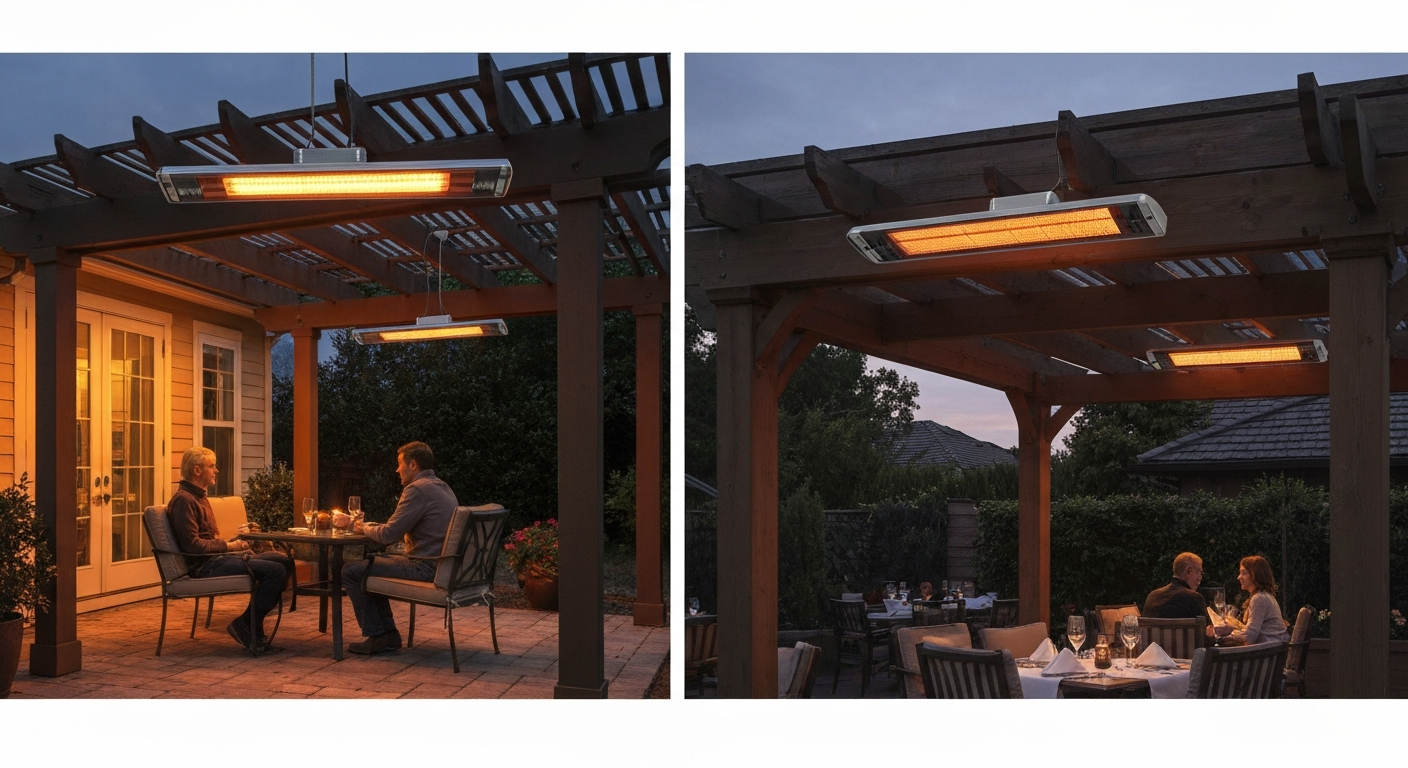
How halogen and infrared heaters actually work
Both technologies are radiant-electric heaters, meaning they warm objects and people directly through electromagnetic radiation rather than circulating warm air. The difference is where each sits on the infrared spectrum.
Halogen (quartz-tungsten) heaters
Halogen heaters use a tungsten filament inside a quartz tube filled with a halogen gas. The filament runs at very high temperatures, producing a peak emission in the near- to short-wave infrared band, roughly 0.9 to 1.4 micrometers (µm). At these wavelengths you get a visible orange glow, almost like a dim lamp. Because near-IR travels in tight, directional beams, the heat feels intense and immediate at exposed skin. The trade-off is the glare: in a dark outdoor dining space, that amber glow can be distracting, and some users report it feeling 'harsh' when seated close to the element.
Ceramic and far-infrared panel heaters
Ceramic and other far-infrared emitters run at lower surface temperatures and emit mainly mid- to far-IR, typically in the 2 to 10 µm range depending on the ceramic composition and operating temperature. At those longer wavelengths there is no visible glow. Heat feels softer and more diffuse because the radiant flux is spread over a broader spectral band that absorbs well into skin and fabric. Peer-reviewed research published in Building and Environment confirms that near-IR produces faster onset warmth at exposed skin, while mid- and far-IR can feel gentler and can provide a stronger pleasant sensation for some distal body segments. In practice, far-IR panels suit spaces where ambient light quality matters, like restaurant terraces or high-end residential pergolas.
Performance compared side by side
When I test patio heaters I track four practical metrics: how the heat feels, effective coverage footprint, warm-up time, and response when you dim or switch off. ASHRAE Standard 55, thermal comfort measurement context discusses mean radiant temperature and measurement methods used in radiant system evaluations, recommending instruments such as black‑globe or mean‑radiant temperature sensors, thermocouples for surface and air temperature, and anemometers for air speed ASHRAE Standard 55 — thermal comfort measurement context (mentions mean radiant temperature and measurement methods used in radiant system evaluations). Here is how the two technologies stack up on each.
| Metric | Halogen (quartz-tungsten) | Far-infrared / ceramic panel |
|---|---|---|
| Heat feel | Intense, directional, fast onset at skin | Softer, more diffuse, gentle onset |
| Coverage (1,500 W) | Approx. 25–36 sq ft at recommended height | Similar footprint, but more even flux distribution |
| Coverage (3,000 W) | Approx. 64 sq ft or more (mfr. spec) | Comparable; some models exceed this with wider beam angles |
| Warm-up time | Seconds to feelable skin warming | 10–60 seconds depending on element mass |
| Cool-down / dimming | Near-instant response | Slower thermal lag on ceramic elements |
| Visible glow | Yes — amber/orange | None |
| Wind tolerance | Loses effectiveness quickly in open/windy areas | Similar limitation; both are radiant, not convective |
Both technologies are similarly vulnerable to wind because radiant heat warms people, not air. A 15 mph gust will strip convective warmth from your skin regardless of which type you choose. For open, exposed patios with regular wind, the radiant-vs-radiant comparison becomes secondary to the question of whether electric heat is the right choice at all, a propane or natural gas heater may deliver higher BTU output that better compensates for wind chill.
Efficiency and what it actually costs to run
Electric patio heaters convert virtually all consumed electricity to heat, there is no flue loss and no combustion inefficiency. The meaningful efficiency question is not conversion rate (both types are close to 100% at the element) but how effectively that heat reaches the people seated under the heater.
The standard wattage-to-BTU conversion is 1 W = 3.412 BTU/hr. So a 3,000 W halogen heater produces roughly 10,236 BTU/hr, and a 1,500 W far-IR panel produces roughly 5,118 BTU/hr. Both figures are honest because there is no exhaust byproduct taking heat away, unlike propane heaters.
Sample cost math you can verify
The formula is simple: cost = (watts / 1,000) × hours × your $/kWh rate. Using the U.S. national average of approximately $0.1388/kWh (EIA, April 2026):
| Heater wattage | BTU/hr output | Cost per hour (@ $0.1388/kWh) | Cost per 3-hour session |
|---|---|---|---|
| 1,500 W | 5,118 BTU/hr | $0.21 | $0.62 |
| 2,000 W | 6,824 BTU/hr | $0.28 | $0.83 |
| 3,000 W | 10,236 BTU/hr | $0.42 | $1.25 |
| 4,000 W | 13,648 BTU/hr | $0.56 | $1.67 |
These numbers will shift based on your local electricity rate. Californians and New Englanders paying $0.25–$0.35/kWh should roughly double the figures above. The math still usually favors electric over propane for short sessions of one to two hours, but propane wins on raw BTU output in very cold or windy conditions. For a full gas-versus-electric cost breakdown, the gas vs. electric patio heater comparison on this site covers that in detail.
Installation and mounting options
Both halogen and far-IR heaters are available in wall-mount, ceiling-mount, and freestanding pedestal configurations. The choice of mounting position matters more than the heater type itself for safe, effective installation.
Wall and ceiling mounting
Most tubular halogen and far-IR heaters are designed to be hard-wired and mounted overhead. Manufacturers typically specify a minimum mounting height of 6 to 8 feet above the floor. Infratech W Series product page, mounting heights and claimed coverage (manufacturer spec example) lists recommended mounting heights and example heating-area claims for its 1,500 W and 3,000 W models Infratech W Series product page — mounting heights and claimed coverage (manufacturer spec example). Clearance requirements vary by model, but as a representative example, Infratech's SL series calls for at least 6 inches behind the element, 18 inches to the sides, and 36 inches in front. Tilt angles are also restricted on quartz-tube models because angling the hot tube beyond the specified limit can cause internal stress fractures in the quartz element. Always follow the specific installation manual for your model, and confirm requirements with your local authority having jurisdiction (AHJ) before hard-wiring.
Freestanding units
Freestanding electric infrared heaters plug into a 120V or 240V outlet and offer flexibility for renters or for spaces where permanent mounting is not practical. They are generally lower wattage (1,500 W is common at 120V) and have narrower coverage. They tip more easily in wind, so freestanding units need additional base weighting in any location that sees regular gusts.
Covered versus open spaces
For covered pergolas, enclosed patios, and under-awning setups, ceiling or overhead wall mounting is the most efficient configuration: heat radiates downward onto seated occupants, and the overhead structure helps retain radiant benefit. In completely open, unroofed patios, overhead mounting is not possible and freestanding units become the default. In that scenario I would seriously consider whether a propane mushroom-style heater with 40,000–46,000 BTU output would serve better than any electric option.
IP weather ratings and what they mean for your patio
The Ingress Protection (IP) rating system (IEC 60529) tells you how well a heater is sealed against solid particles and water. For patio heaters, the water-protection digit is what matters most. Here is a practical translation:
| IP Rating | Water protection level | Best suited for |
|---|---|---|
| IP23 | Protected against rain falling at up to 60° from vertical | Covered patios, pergolas with solid roofs, indoor-outdoor spaces |
| IP44 | Splash-proof from any direction | Semi-exposed patios, under wide eaves, light-rain environments |
| IP55 | Protected against water jets from any direction | More exposed locations, open terraces, coastal climates with salt spray |
Many halogen heaters carry IP23, which means they are fine under a covered pergola but should not be installed in a location where rain can blow horizontally onto the element. If your patio is only partially covered or fully exposed, look for IP44 or IP55. Far-IR panel heaters often achieve IP55 more easily because their sealed panel construction is inherently better at keeping water out than an open quartz tube. Check the product specification sheet for the exact rating, marketing terms like 'weatherproof' or 'outdoor-rated' are not a substitute for a verified IP number.
Safety, maintenance, lifespan, and warranties
Safety certifications to look for
In North America, look for UL or cETL listing marks. Relevant standards for fixed patio heaters include UL 2021 (fixed and location-dedicated electric room heaters) and UL 1278 (movable and portable electric heaters). Some manufacturers also hold CSA certification for Canadian markets. A listing mark means an NRTL (nationally recognized testing laboratory) has independently verified the heater meets the standard, which is what most building departments and AHJs require before they approve installation.
Element lifespan and common failure modes
Quartz halogen elements typically have a published lifespan of around 5,000 hours. At three hours of use per night, that is roughly 4.5 years of daily use before you would expect to replace the element. In practice, elements fail early for two main reasons: mechanical vibration that cracks the quartz tube, and oil contamination from touching the tube with bare hands during installation (the oils cause hot spots). Replacement quartz elements are widely available from manufacturers and usually cost $20–$60 depending on wattage. Ceramic far-IR panels generally have longer quoted element lifespans, some manufacturers claim 10,000 hours or more, because there is no fragile tube and no filament to burn out, though the ceramic substrate can crack from thermal shock if water hits it while at operating temperature.
Routine maintenance checklist
- Inspect the quartz tube or panel surface before each season for cracks, discoloration, or deposits
- Clean reflectors with a damp cloth (heater off and cooled) — oxidized or dirty reflectors cut radiated output noticeably
- Check all wiring connections and junction box covers for corrosion annually
- Verify mounting hardware torque — overhead heaters can work loose from vibration over time
- Test any built-in GFCI protection at the start of each outdoor season
- Never touch the quartz element with bare hands; use clean cotton gloves during any lamp replacement
Warranty norms
Most reputable brands offer one to three years on the complete heater and sometimes a separate shorter warranty on the replaceable element. Commercial-grade units from brands like Infratech, Heatscope, or Schwank often carry longer structural warranties (three to five years) because they are built to run hundreds of hours per season. Consumer-grade heaters sold at big-box retailers typically carry one year. Always register your product and keep your receipt.
Aesthetics, noise, size, and what real users say
Both heater types are quiet (no fan, no combustion noise), which is a genuine advantage over gas heaters with pilot flames or ignition clicks. Where they differ is visually and in terms of perceived ambiance.
Halogen heaters: real-world user feedback
The amber glow of a halogen element divides opinion. Some users specifically want the warm visual effect, especially in evening dining settings. A common complaint in product reviews, measurable enough that multiple manufacturers have addressed it in product updates, is that the glow is too bright at close range in otherwise dark outdoor spaces, causing eye fatigue. Another recurring complaint is that quartz tubes become visually yellowed or clouded after one to two seasons even with proper care, which affects both aesthetics and output. On the positive side, users consistently praise the near-instant heat and the low cost of element replacement.
Far-infrared / ceramic panel heaters: real-world user feedback
Far-IR and ceramic panel users most commonly praise the clean, minimalist appearance and the absence of glare, which is particularly valued for high-end restaurant terraces and residential spaces with lighting design investment. A common criticism is price: good-quality far-IR panels from brands like Heatscope or Bromic cost two to four times more than equivalent-wattage halogen units. Some users also note that the gentler heat onset makes it harder to feel whether the heater is on at low settings, which can lead to higher energy use if people keep turning the output up rather than waiting for steady-state warmth.
Top-rated models and what to look for when buying
Key buying criteria
- Wattage matched to your coverage area: use 10–15 W per sq ft as a starting point for sheltered spaces, 15–20 W per sq ft for semi-exposed areas
- Beam angle: narrower angles (30–60°) concentrate heat for a specific seating zone; wider angles (90–120°) give broader but shallower coverage
- Dimming and controls: 0–100% dimming via rotary switch, wall controller, or smart home integration (Z-Wave, Zigbee, or app-based) adds comfort and saves energy
- IP rating appropriate to your installation location (see table above)
- UL, cETL, or CSA listing confirmation before purchase
- Replacement element availability and cost from the manufacturer
- Mounting hardware included and compatibility with your ceiling or wall structure
Sample models by use case
| Use case | Recommended type | Example models / specs to seek | Why |
|---|---|---|---|
| Small covered patio, 1–2 people | Halogen, 1,500 W | Single-element quartz, IP23, 120V plug-in | Low cost, fast heat, easy installation |
| Mid-size pergola, 4–6 people | Halogen or far-IR, 3,000 W | Dual-element quartz or ceramic panel, IP44, hard-wired with dimmer | Adequate coverage (~64 sq ft), controllable output |
| Restaurant terrace, multiple zones | Far-IR panels, 3,000–4,000 W per zone | Commercial ceramic or carbon-element, IP55, dimming wall controller | No glare, durable, acceptable to hospitality aesthetics |
| Open deck, wind-exposed | Halogen, 4,000 W (or consider propane) | High-wattage quartz array or mushroom-style propane | Electric output may be insufficient; evaluate propane alternative |
| Screened porch or sunroom | Far-IR panel, 1,500–2,000 W | Sealed panel, IP44, smart dimmer | Clean look, gentle heat, no light pollution indoors |
Which technology fits your climate and patio layout
Climate and patio structure are the two variables that should drive most of your decision, more than brand or price point.
- Sheltered pergola or covered terrace (mild to moderate climate): either technology works well here. Choose halogen if budget is tight or you want near-instant heat. Choose far-IR if aesthetics matter and you can spend more upfront.
- Small patio with an awning or overhang (mild climate): a 1,500–2,000 W halogen or far-IR wall-mount heater is typically sufficient. Verify IP44 or better if rain can blow under the awning.
- Commercial restaurant terrace (mild to moderate): far-IR panels at 3,000–4,000 W per zone with smart dimming are the professional standard. The absence of orange glow matters when you have paid for atmospheric lighting.
- Cold-climate patio (sub-freezing temps, heavy use): neither halogen nor far-IR electric heaters are ideal as the sole heat source in temperatures below about 20°F. Consider supplementing with a propane or natural gas heater for raw BTU capacity.
- Windy, exposed outdoor space: both radiant electric types lose effectiveness in sustained wind above 10–15 mph because the convective loss from skin offsets radiant gain. A gas fire pit or high-output propane heater may be a better primary solution in this layout.
Decision checklist and how to choose in 5 steps
- Measure your space: calculate the square footage of the seating area you need to heat, not the whole patio.
- Assess your structure: is the space covered, semi-covered, or fully open? Covered spaces favor mounted electric heaters. Fully open and windy spaces may need gas instead.
- Check your power supply: a 120V outlet supports up to 1,500 W; anything above that needs a 240V circuit and hard-wired installation by a licensed electrician.
- Match wattage and IP rating: use the 10–20 W per sq ft guideline and choose an IP rating appropriate to your rain/wind exposure.
- Decide on aesthetics and controls: if visible glow and orange light are not a concern, halogen saves money. If you want no glare, smart dimming, and a cleaner look, invest in far-IR.
Quick answers to common buyer questions
- Are all 'infrared' patio heaters the same? No. Halogen heaters are a subset of infrared heaters that use near-IR wavelengths (0.9–1.4 µm) with a visible glow. Far-IR and ceramic panels emit at 2–10 µm with no glow.
- Which is cheaper to run? At the same wattage, running costs are identical — both convert electricity to heat at roughly the same rate. The cost difference comes from wattage selection and how long you run them.
- Can I use either type in the rain? Only if the unit's IP rating matches the exposure level. Do not use an IP23-rated heater in a location where rain can hit it directly.
- Which lasts longer? Ceramic/far-IR elements generally have longer quoted lifespans (up to 10,000 hours) versus halogen quartz elements (typically around 5,000 hours). Both can fail earlier if mishandled during installation or maintenance.
- Do I need an electrician? For any hard-wired 240V installation, yes. Most municipalities require a licensed electrician to run the circuit and make the final connection.
When another heater type is the better choice
Halogen and far-IR electric heaters are excellent for covered or semi-covered spaces with access to a suitable electrical circuit, but they are not always the right answer. If you are dealing with any of the following situations, a different heater type deserves serious consideration.
For large, open patios where running a 240V circuit would be expensive or impractical, a propane or natural gas patio heater delivers 40,000–46,000 BTU/hr, which is roughly four times the output of a 3,000 W electric unit. That output gap matters in cold or windy conditions. If you are weighing that choice, the gas vs. electric patio heater comparison on this site walks through total cost of ownership, BTU comparisons, and installation costs for each fuel type. For a straightforward comparison of what's best, gas or electric patio heater, see the gas vs. electric patio heater guide (internal link) what's best—gas or electric patio heater.
If you want radiant heat plus the social and visual appeal of an open flame, a gas fire pit is worth considering. It serves as both a heat source and a focal point for outdoor seating. The patio heater vs. gas fire pit comparison covers where each type excels in terms of heat distribution, safety clearances, and installation complexity. See our detailed patio heater vs gas fire pit comparison for guidance on heat distribution, safety clearances, and installation trade-offs.
Finally, if you are unsure whether you need a dedicated patio heater or a general area heater would suffice for your layout, the area heater vs. patio heater guide covers the key differences in mounting, output, and intended use. See the area heater vs patio heater guide for a direct comparison of mounting, output, and intended use.
Next steps: measure, match, and install
Start with a tape measure, not a product page. Get your seating area dimensions, confirm whether your space is covered or open, check whether you have or can run a 240V circuit, and then use the wattage and IP guidance in this article to build a short list. For most homeowners with a covered patio of 100 sq ft or less, a 3,000 W halogen heater on a 240V circuit hits the sweet spot of cost, performance, and simplicity. For commercial buyers or anyone who has invested in outdoor lighting and ambiance, far-IR panels at the same wattage are worth the additional spend. Once you have the spec in mind, check the broader patio heater comparison section on this site for side-by-side model ratings and tested performance data before you commit to a specific unit.
FAQ
How do halogen (quartz) and ceramic/far‑IR infrared patio heaters work — what wavelengths do they emit and how does that change the heat you feel?
Quartz/halogen (often called 'near‑IR' or short‑wave infrared) uses a hot tungsten filament in a quartz tube; it emits strong near/short‑wave IR with a visible glow and spectral peaks roughly in the ~0.9–1.4 µm band. Ceramic or 'far‑IR' emitters operate at lower surface temperatures and emit mainly mid‑ to far‑infrared (commonly ~2–10 µm depending on material and temperature). Measurable effect: near‑IR gives a faster, more concentrated skin‑surface warming at close range; mid/far‑IR feels gentler and can provide more uniform, comfortable radiant warming at greater distances or for clothed skin (peer‑reviewed thermal perception studies show wavelength affects onset and subjective sensation). (Sources: manufacturer spectral data, ceramic emitter studies, peer‑reviewed thermal perception research.)
What are the key measurable performance differences (heat feel, coverage, warm‑up, response time)?
Heat feel: Near‑IR (quartz/halogen) produces rapid, localized skin warming—noticeable within seconds at close range. Mid/far‑IR feels milder and more enveloping. Coverage and footprint: Manufacturers commonly rate quartz units from ~1,500–4,000 W; claimed effective footprints vary with mounting height (e.g., 1,500 W ≈ 25–36 sq ft, 3,000 W ≈ ~64 sq ft as typical manufacturer examples). Warm‑up/response: Quartz reaches emitting temperature in seconds–minutes (very fast). Ceramic/far‑IR panels take longer to reach steady emissivity (minutes) but remain steady. Measured metrics for rigorous tests use mean radiant temperature (MRT), thermocouples, and IR cameras per ASHRAE practices to report delta‑T and spatial flux.
How do I compare power and convert to BTU/h for cost and sizing calculations?
Electrical power to heating rate: 1 W = 3.412 BTU/hr. So a 1,500 W heater ≈ 5,118 BTU/hr; 3,000 W ≈ 10,236 BTU/hr. Use manufacturer wattage and mounting‑height guidance to estimate coverage rather than BTU alone, because radiant systems heat people and surfaces directly rather than air volume.
What are typical operating cost estimates for electric infrared patio heaters? Can you show a sample calculation?
Operating cost = (Wattage/1000) × hours run × $/kWh. Example using a recent U.S. average retail electricity ≈ $0.1388/kWh: 3,000 W running 3 hours → (3000/1000)×3×$0.1388 ≈ $1.25 per session (≈ $0.417/hr). For 1,500 W the same session ≈ $0.63 (≈ $0.208/hr). Adjust $/kWh for local rates; propane or gas alternatives require fuel‑price conversions and system efficiencies for apples‑to‑apples comparison.
What installation and mounting options exist, and what clearances/mounting heights are typical?
Common mounting options: ceiling/under‑eave, wall/pendant, freestanding (post or stand), and portable. Typical recommended minimum mounting heights for quartz/infrared electric patio heaters are ~6–8 ft above floor (manufacturer‑specific); minimum clearances (examples) can be ~6" behind, 18" to sides/ends, and 36" front for some models. Angle/tilt limits exist—follow the heater’s installation manual and UL label. For exposed outdoors, mount under an eave or use higher‑IP models as appropriate.
What IP/weather ratings should I look for and what do they mean for use in covered vs open spaces?
IP ratings map to outdoor suitability: IP23 = protected against spraying water from above (suitable for covered or partly sheltered use); IP44 = splash‑protected from any direction (suitable under eaves or light exposure); IP55 = dust‑protected and water‑jet resistant (better for more exposed or semi‑exposed locations). Choose at least IP23 for covered patios; use IP44/IP55 for more exposed rooflines or commercial outdoor seating. Always check manufacturer notes and local code/AHJ requirements.
Next Articles
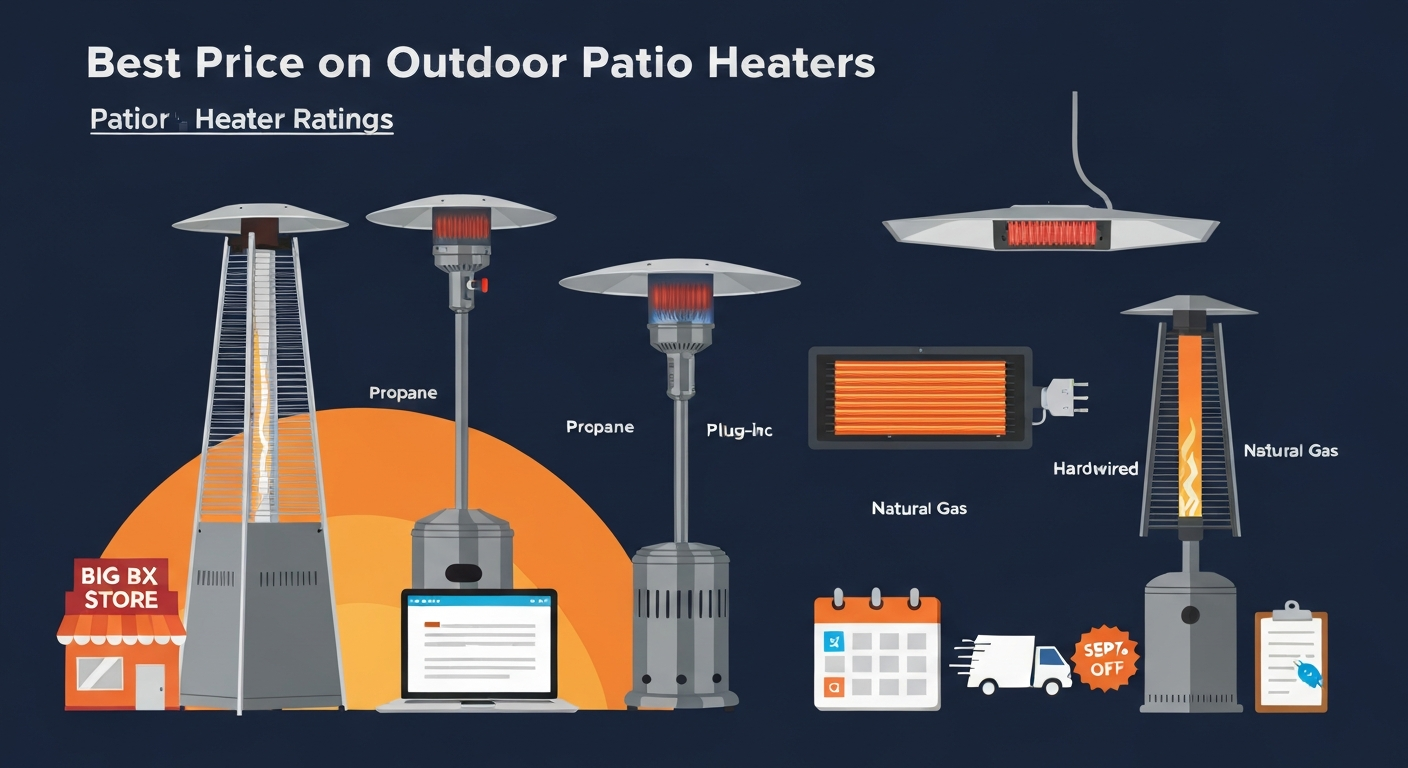
Best Price on Outdoor Patio Heaters: Compare Costs & Deals
Score the best price on outdoor patio heaters, price ranges, top picks, deal tactics, total-cost & safety checklist.
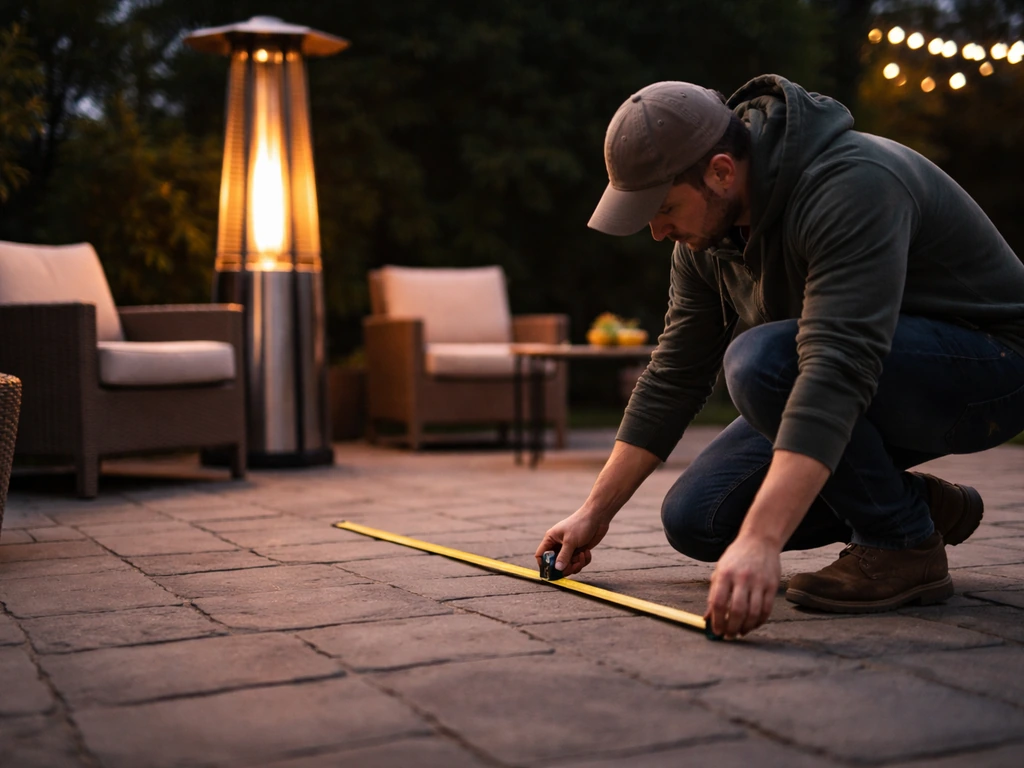
Where Can I Rent Patio Heaters Near Me Today
Find where to rent patio heaters near you today, choose the right fuel type, compare costs, and book safely.
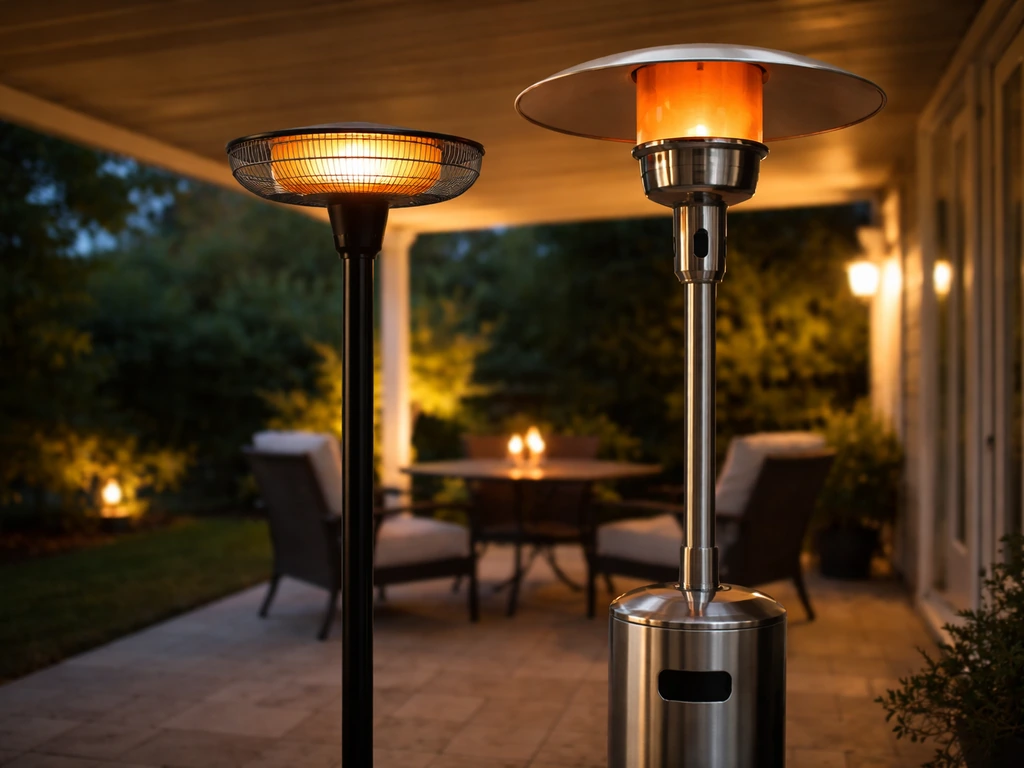
Where to Buy a Patio Heater: Best Places and Types
Where to buy a patio heater now, plus electric vs gas vs propane tips, safety checks, and size/BTU buying checklist.