
For most covered patios, a hardwired electric infrared heater mounted overhead is the best way to go. It works safely under a roof, heats people directly rather than wasting energy warming air, installs cleanly without fuel lines or venting concerns, and gives you instant on/off control. If you have natural gas already running to the area, a gas infrared heater is a close second and costs less to run over time. Portable propane and pellet options have their place, but they come with more hassle and more safety considerations under a covered structure.
Best Way to Heat a Covered Patio: Heater Guide

Caleb Vale
5 Jul 2026
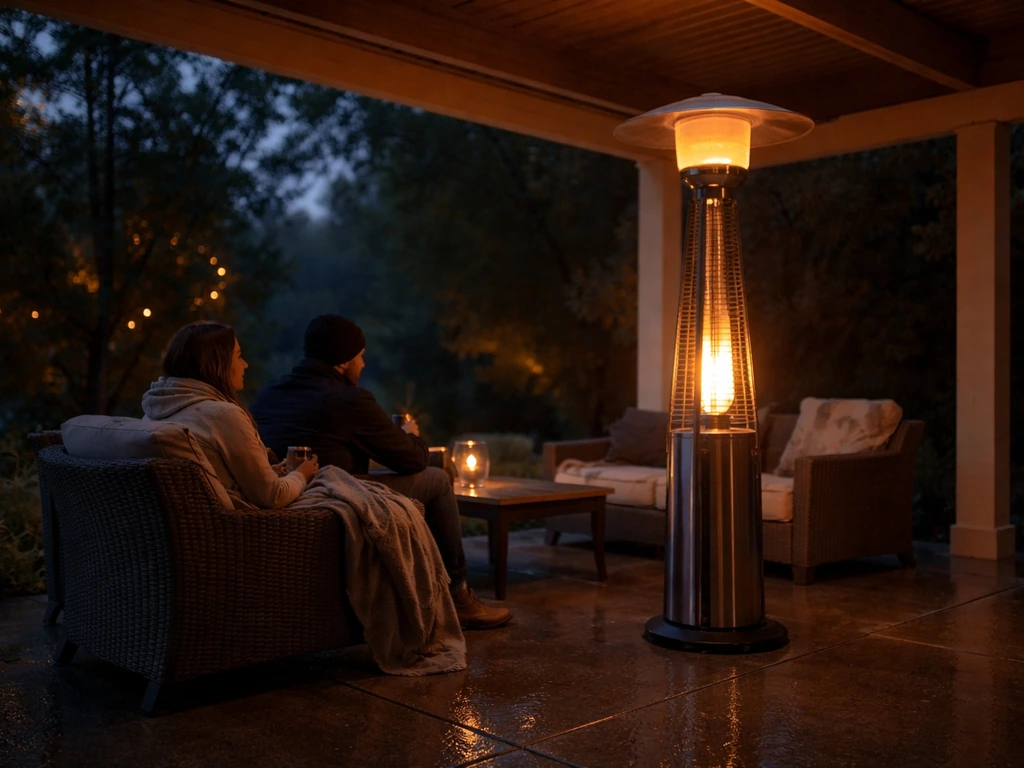
Pick the right heater type first
A covered patio is a different environment than an open one. You have a roof above you, which helps contain some warmth but also creates real constraints: gas combustion needs airflow, clearances to combustibles matter a lot, and tall freestanding mushroom-style heaters can become a fire hazard under low ceilings. That narrows your realistic choices faster than people expect.
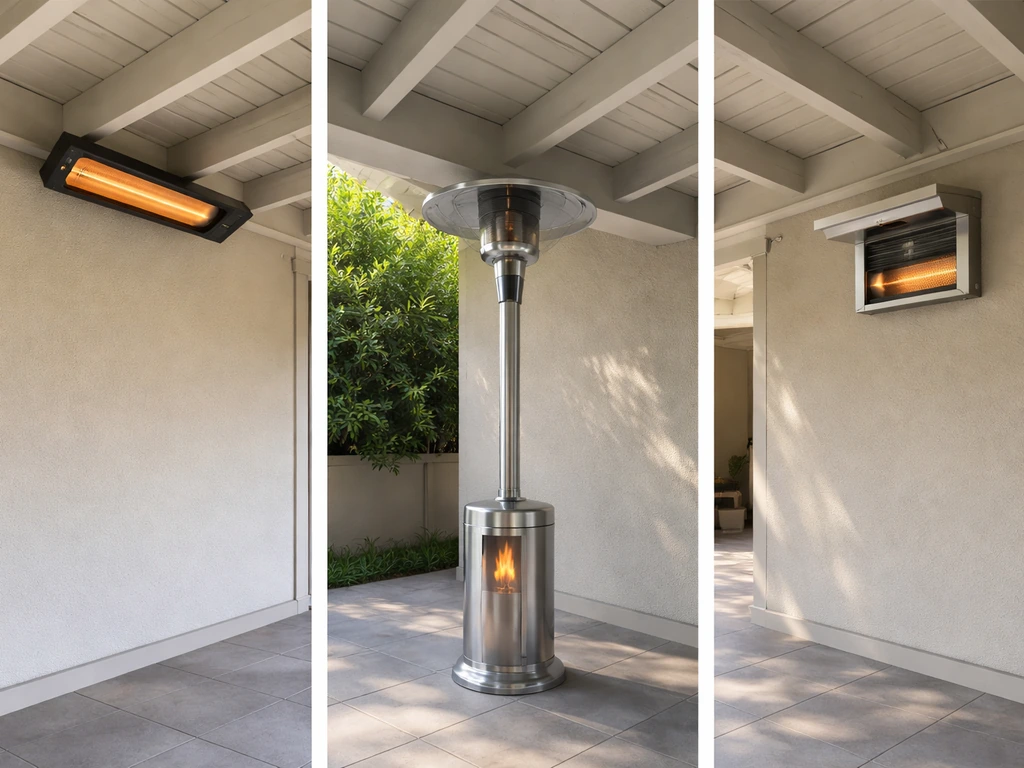
Here is how the main heater types stack up for a covered patio specifically. Electric infrared heaters (hardwired or plug-in) are almost always the most practical choice. A good starting point when you are choosing is the best covered patio heater style: electric infrared for most patios Electric infrared heaters. They mount to the ceiling or wall, point heat downward at the people sitting below, require no combustion and no venting, and can be installed where gas isn't available.
Gas infrared heaters (natural gas or propane, permanently mounted) are excellent performers with lower fuel costs, but they require adequate airflow and your local code will likely require a permit and inspection. Portable propane heaters are fine for occasional use if the space is open on at least two sides for ventilation, but they are genuinely risky in tighter covered spaces.
Pellet heaters are a niche option that work better on open or semi-open patios and are rarely worth the complexity under a roof.
If you are deciding between a fully covered patio and a screened-in space, note that screened structures have their own ventilation and clearance rules that differ from a solid-roof covered patio. An open patio also opens up options like tall freestanding propane towers that simply are not appropriate under a solid roof.
How much heat do you actually need
Outdoor infrared heaters are sized for spot comfort, not for heating a volume of air the way a furnace does. The practical rule of thumb is 10 watts per square foot in mild climates or well-sheltered spaces, and up to 20 watts per square foot in colder conditions or where wind regularly sweeps through. So a 200 sq ft covered patio in a mild climate needs roughly 2,000 watts of electric infrared output. In a colder region or a drafty space, budget closer to 3,500 to 4,000 watts for that same area.
For reference: a single 1,500W electric infrared heater covers roughly a 5 ft by 6 ft zone (about 30 sq ft) effectively. A 3,000W unit roughly doubles that. On the gas side, a mounted propane radiant heater at 30,000 BTU can cover up to 750 sq ft, and a full-size freestanding 40,000 BTU propane tower heats an area roughly 20 feet in diameter. The freestanding tower is not suitable under a roof, but the mounted radiant propane heater absolutely is, with proper clearances.
For most covered patios in the 150 to 300 sq ft range, two or three 1,500W to 2,000W electric infrared heaters positioned over the seating zones give better, more even coverage than one large unit centered overhead. Zone placement beats raw output every time.
| Patio Size | Mild Climate (10 W/sq ft) | Cold Climate (20 W/sq ft) | Suggested Setup |
|---|---|---|---|
| Up to 80 sq ft | 800W | 1,600W | 1x 1,500W–2,000W unit |
| 80–150 sq ft | 800–1,500W | 1,600–3,000W | 1–2x 1,500W units |
| 150–300 sq ft | 1,500–3,000W | 3,000–6,000W | 2–3x 1,500W–2,000W units |
| 300–500 sq ft | 3,000–5,000W | 6,000–10,000W | 3–4x 2,000W–3,000W units or gas infrared |
Electric vs propane vs natural gas: cost, power, and convenience
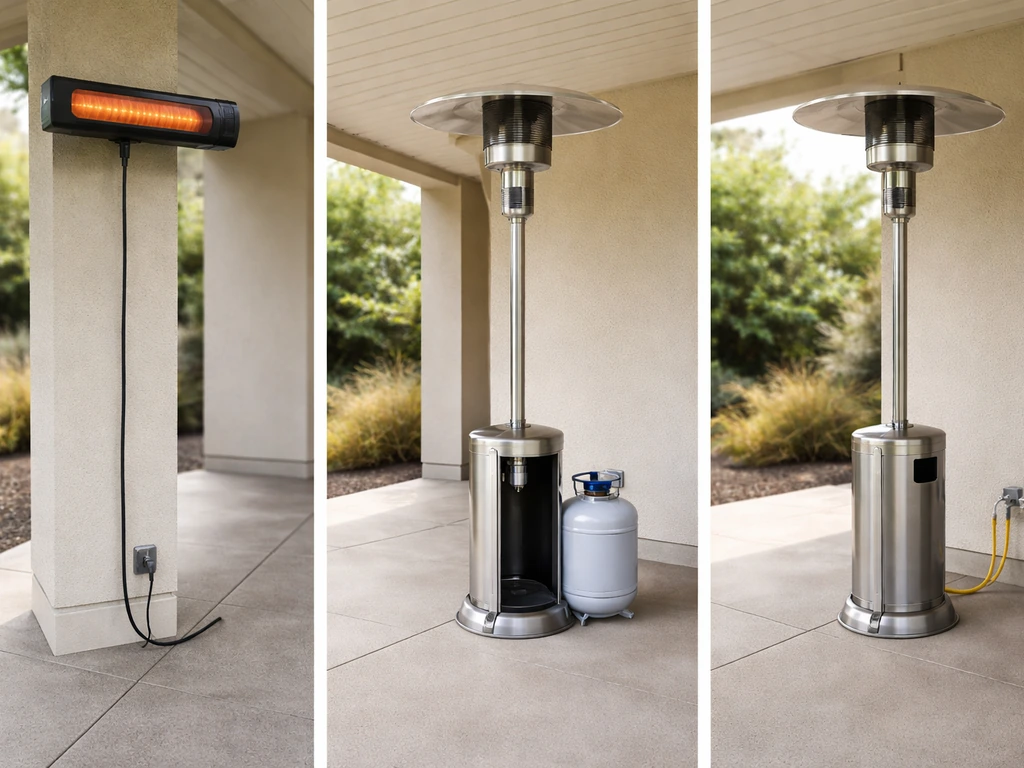
These three fuel types cover 95% of real-world covered patio installs, so it is worth being direct about the trade-offs.
| Heater Type | Upfront Cost | Running Cost | Installation | Covered Patio Suitability |
|---|---|---|---|---|
| Electric infrared | Low–moderate ($100–$600) | Higher per BTU, but efficient targeting | Simple; needs outlet or hardwire | Excellent — no venting needed |
| Natural gas infrared | Moderate–high ($300–$1,000+) | Lowest ongoing cost | Requires gas line + permit | Very good — needs airflow, permit |
| Propane (mounted radiant) | Moderate ($200–$700) | Mid-range; tank refills add cost | Gas line or tank; needs airflow | Good — requires ventilation, permit |
| Portable propane | Low ($80–$300) | Mid-range | No install; tank swap | Limited — ventilation required |
| Pellet | High ($500–$2,000+) | Low fuel cost | Complex setup | Poor — not recommended under roof |
Electric infrared wins on simplicity. A 1,500W heater running at average U.S. electricity rates (roughly $0.16 per kWh as of mid-2026) costs about $0.24 per hour. A 3,000W unit costs about $0.48 per hour. Natural gas is cheaper per BTU if you are running the heater for many hours per week, which makes it the better long-term value for heavy users. Propane falls in the middle but adds the inconvenience of tank management. For most homeowners who use the patio a few evenings a week, electric is simply the most practical choice even if the per-hour cost is a bit higher.
One honest caveat on electric: if you are heating a large covered patio in a cold climate and running multiple units for hours at a time, your electricity bill will feel it. In that scenario, a natural gas infrared system with a proper install is genuinely worth the upfront investment.
Infrared vs convection: what actually feels warm and where
Almost every heater worth recommending for a covered patio uses infrared radiant heat, not convection. Here is why that matters. Convection heaters warm the air, and warm air on an open or semi-open patio just floats away. Infrared heaters emit radiant energy that warms objects and people directly, the same way the sun does.
NIST's Handbook of Radiant Heating and Cooling explains mean radiant temperature (MRT) and its role in radiant thermal comfort. You feel it on your skin, not just in the air around you.
Studies by ASHRAE confirm that infrared systems raise mean radiant temperature (MRT), which lets people feel comfortable at lower air temperatures, and that the heaters reach full output almost immediately after switching on.
blank" rel="noopener noreferrer">ASHRAE notes that infrared radiant heating can quickly switch on and off and improves comfort by increasing mean radiant temperature, which is why it is often used for open or outdoor areas such as outdoor restaurants and under marquees infrared radiant heating can be turned off/on quickly and improves comfort via increased mean radiant temperature.
Under a covered patio, infrared is even more advantageous. The roof reflects some of the radiant energy back down, which improves efficiency compared to a fully open space. The tradeoff is that a covered structure means combustible materials are closer overhead, which is why clearance requirements matter so much with infrared (more on that below).
One practical thing to understand: infrared heaters heat in a cone or beam pattern, not a wide bubble. The zone directly below and in front of the heater is warm; step outside that zone and it drops off quickly. Placement is everything. Multiple smaller units aimed at seating zones will always feel better than one powerful unit centered in the middle of the ceiling.
Wind complicates things even under a covered patio. Electric infrared heater output is not diminished by wind the way a gas flame is, but once wind moves across a person's skin, it pulls heat away from them and comfort drops. Re-Verber-Ray's own design guidance notes that heater effectiveness can be meaningfully reduced when wind velocities exceed about 5 mph. If your covered patio is open on multiple sides and catches regular breezes, factor that into your sizing: go toward the higher end of the wattage range and consider partial side enclosures.
Installing a heater under a roof: clearances, mounting height, and placement
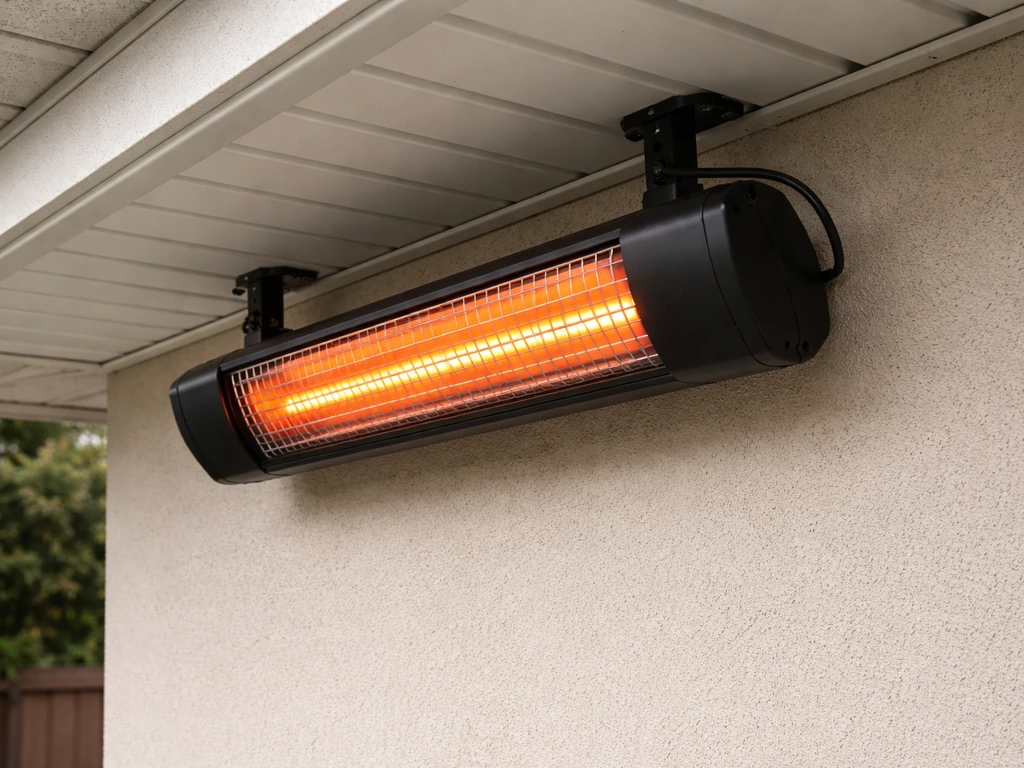
This is where most DIY installs go wrong. Every electric infrared heater has published clearance-to-combustibles requirements, and they are not suggestions. A typical wall or ceiling-mounted electric infrared unit requires at least 3 feet of clearance from combustible materials in front of and around the heater. Some units specify a minimum 4 feet in certain mounting configurations. Gas infrared heaters have stricter requirements and vary significantly by model.
Mounting height matters for both safety and comfort. Most overhead electric infrared heaters are specified to mount at a minimum of 8 feet above the finished floor. Real-world users and testing both suggest that around 9 feet is a sweet spot for a covered patio: close enough to feel genuinely warm, far enough to meet clearance requirements. Going significantly higher (say, 12 feet or more) reduces the perceived warmth considerably. If your covered patio has a ceiling below 8 feet, you will need to use wall-mounted units aimed downward rather than overhead ceiling mounts.
Mounting angle also affects effective clearance. Tilting a heater changes the geometry of what is in the heat path. If you mount a heater on a wall at an angle pointing downward toward the seating area, confirm that the clearance-to-combustibles measurement is taken along the heater's actual aim direction, not just the straight-down vertical. The heater's installation manual will show a diagram for this; follow it exactly.
For placement strategy: position heaters directly above or just behind seating areas, aimed at the people, not at a blank floor or table surface. Avoid mounting them where the heat path passes directly over or through fabrics, wood beams, or combustible ceiling materials without adequate clearance. Keep the area around the heater clear of hanging lights, plants, and decorations.
Safety, ventilation, and permits you actually need
Electric infrared heaters are the safest option for a covered patio from a combustion and ventilation standpoint. There is no flame, no combustion gas, and no carbon monoxide risk. You still need to follow clearance requirements and use a heater rated for outdoor or damp locations if there is any exposure to rain splash or moisture, but there is no venting requirement.
Gas heaters (natural gas or propane) are a different story. Any gas appliance under a covered structure produces combustion byproducts, including carbon monoxide. The space must have adequate airflow, which typically means the patio must be open on at least two sides or meet a minimum percentage of open wall area as defined by your local code. NFPA 54 (the National Fuel Gas Code) governs installation requirements for gas appliances, and ANSI Z83.26 specifically covers gas-fired outdoor infrared patio heaters. Your municipality almost certainly requires a permit for a permanently installed gas heater, and an inspection before use. Do not skip this. Carbon monoxide poisoning in outdoor structures is a real risk and it happens every year.
For propane specifically, the NFPA requires LP-gas containers to be stored and used in compliant ways, which affects where and how you position a propane-connected heater on a covered patio. If you use a portable propane heater under a covered structure, always ensure there is substantial airflow and never use it in a fully or mostly enclosed space.
- Permit required: yes for any permanently installed gas heater; check with your local building department
- Ventilation required: yes for all gas combustion appliances; patio must meet open-air requirements per local code
- Carbon monoxide detector: strongly recommended any time gas heat is used in a covered structure
- Electric heaters: no permit typically required for plug-in; hardwired installs may need an electrical permit
- Clearance to combustibles: always follow the specific heater's manual; do not use generic rules of thumb
- GFCI protection: required for all outdoor electrical outlets; confirm your circuit is GFCI-protected before installing any electric heater
Operating costs, controls, and what to actually buy
Smart controls make a real difference in operating cost. Many electric infrared heaters now include programmable timers, remote controls, and thermostat functions. A model like the Dimplex DIRP15A10GR lets you set a standby timer from 1 to 13 hours, so you are not paying to heat an empty patio. The King Electric SmartWave 3,000W unit has a built-in controller with selectable heat levels and a 24-hour timer. For a covered patio where you want set-and-forget convenience, these features are worth paying for. On the RADtec and similar mid-range units, remote control and temperature settings are increasingly standard even at the 1,500W price point.
If you are installing multiple heaters across a larger covered patio, consider running them on a single wall controller or a smart plug system so you can control zones independently. Heating only the seating area you are using rather than the entire patio is the single biggest way to cut operating costs.
For a straightforward buying recommendation: if your covered patio is under 200 sq ft and in a mild to moderate climate, one or two 1,500W electric infrared heaters mounted at 8 to 9 feet overhead with timer/remote controls will handle it for $150 to $400 total. If you want the best heater for screened in patio conditions, start with electric infrared heaters and match the wattage to your square footage and climate covered patio. For a 200 to 400 sq ft covered patio in a cold climate, step up to two or three 2,000W to 3,000W units and expect to spend $400 to $900. If you entertain frequently, the space is large, and you have natural gas available, budget $800 to $1,500 for a professionally installed gas infrared system and you will recoup the difference in lower fuel costs within a few seasons of regular use.
The bottom line is this: match the heater type to your patio's structure and your willingness to deal with installation complexity, size it based on your square footage and climate using the 10 to 20 watts per square foot guideline, position it directly above or behind where people sit, follow every clearance requirement in the manual, and add a timer or thermostat so you are not heating a patio no one is sitting on. Do those four things and you will have a warm, safe, comfortable covered patio regardless of which specific model you end up choosing. If you want a quick recommendation tailored to your setup, start with the best patio heater for screened porch and then verify the clearance and heat coverage details for your space.
FAQ
Can I use a portable electric infrared heater on a covered patio instead of hardwiring?
Yes, but make sure it is specifically rated for outdoor or damp locations, and place it so the heater’s clearance-to-combustibles zone is not blocked by nearby furniture, cushions, or wall trim. If you want real savings, use a thermostat or timer, because running a single portable unit on full power often wastes heat when people are not seated.
What clearance distance should I follow if my heater is mounted under a roof with wood beams?
Use the clearance numbers in the heater’s manual, not a generic “rule of thumb.” Clearance is measured along the heater’s heat path and in the directions specified (front, sides, and sometimes above). If you have ceiling beams or decorative soffits, measure from the exact mounting point and confirm the heater can be aimed without violating the stated minimums.
How do I calculate wattage if my covered patio has partial enclosures or wind exposure?
Start with the 10 to 20 watts per square foot guideline for your climate, then adjust upward if the patio is open on multiple sides or experiences breezes. A practical approach is to treat partially enclosed areas like semi-open patio zones, because people will still feel heat loss when air moves across their skin even if combustion is not involved.
Is it better to buy one larger heater or two smaller heaters for a covered patio?
Two smaller heaters are usually more comfortable because infrared heat fades outside the beam or cone. If your seating is spread across different zones (couch and dining area), aim one heater toward each seating cluster rather than centering everything over an empty middle area.
Do I need to worry about carbon monoxide with electric infrared heaters under a cover?
No, electric infrared heaters do not produce combustion, so there is no carbon monoxide risk from the heater itself. The remaining safety checks are electrical and location based, such as using outdoor-rated equipment and avoiding installation over or near combustible materials inside the clearance zone.
What’s the safest way to deal with rain, snow, and condensation on a covered patio?
Choose a heater rated for outdoor or damp locations, and keep the control area and power connections protected from direct splash. Also confirm the mounting surface is stable and non-combustible in the relevant clearance directions, since moisture can reduce how reliably some fasteners hold long term.
How high should an overhead infrared heater be mounted, and what if my ceiling is low?
Most units call for at least about 8 feet overhead; about 9 feet is often a practical comfort sweet spot if it also meets the manual’s clearance. If your ceiling is below the minimum, switch to wall-mounted models aimed downward, because dropping the heater lower than allowed can violate clearance requirements and reduce safety margins.
Can I mount an infrared heater on a wall and tilt it toward the seating?
You can, but verify the clearance measurement is taken along the heater’s actual aiming direction, not just straight down. The manual typically includes a diagram showing how to measure around the heater, and following that diagram matters most when the heater is angled.
Do gas infrared heaters always require major ventilation under a covered patio?
They require adequate airflow based on local code and the specific appliance installation instructions, and many jurisdictions treat gas patio heaters as permit-required permanent appliances. Do not assume a roof alone provides enough ventilation, and never use a gas heater if you cannot meet the minimum open-area or airflow requirements for that installation.
Is a screened-in patio treated the same as a solid-roof covered patio for heating?
Not exactly. Screens can still limit airflow differently than an open patio, and they may alter how clearance-to-combustibles, wind effects, and gas ventilation rules apply. If you are using gas, check whether your screening setup changes the required open areas, and if you are using electric, re-check coverage because screens often reflect and alter wind patterns.
What are the most common mistakes that reduce how well infrared heaters feel?
The biggest ones are aiming at the floor or tables instead of directly at people, placing heaters too high so the beam misses seating, and ignoring the cone-shaped drop-off outside the target zone. Another frequent issue is violating clearance-to-combustibles by assuming the roof or nearby decor “counts” as non-combustible, which it usually does not.
How can I cut operating costs without buying a more expensive heater?
Use zoning, timers, and a setback schedule. If you have multiple heaters, control them independently so you only heat the seating area in use, not the entire patio footprint. Also avoid running at full output when guests arrive late, because many units reach comfort quickly and staged heating usually costs less.
Should I run patio heaters the same way in summer evenings as in winter nights?
No. In warm weather, you will usually want lower settings or shorter run times because the roof only moderates losses, it does not remove wind and skin-level heat loss. Use a thermostat or manual schedule so the heater cycles based on comfort, especially when the patio is intermittently occupied.
Next Articles
Best Way to Heat an Outdoor Patio: Propane, Gas, Electric
Compare propane, natural gas, electric, infrared and pellet patio heaters with placement, winter tips, costs and safety.
Best Covered Patio Heater Buying Guide and Heater Cover Tips
Choose the best covered patio heater by BTUs, coverage, fuel type, safety placement, costs, and the right protective cov
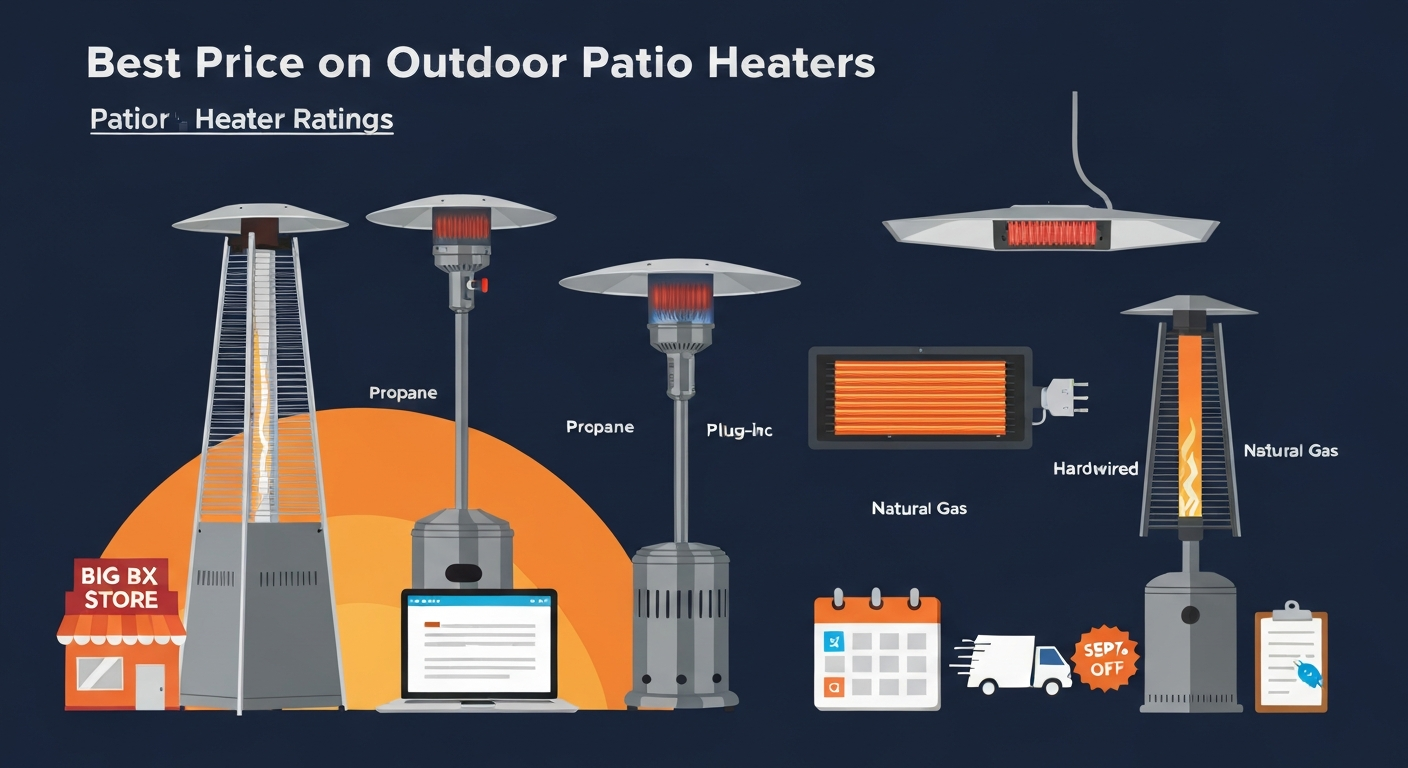
Best Price on Outdoor Patio Heaters: Compare Costs & Deals
Score the best price on outdoor patio heaters, price ranges, top picks, deal tactics, total-cost & safety checklist.