
The best patio heaters for raw heat output are high-BTU propane and natural gas models for open, exposed areas, and hardwired electric infrared panels for covered or enclosed patios. A 40,000–50,000 BTU propane heater covers roughly 100–150 ft² of comfortable radiant warmth under calm conditions, while a 6,000 W electric infrared panel like the Bromic Tungsten Smart-Heat Electric reaches up to 144 ft² with zero combustion risk. Which one is actually best for you comes down to your patio layout, local fuel prices, and how much wind you're fighting. For a full buyer's guide and our ranked patio heater best picks, see our detailed roundup of top models and use-case recommendations.
Best Patio Heaters for Heat: Top Picks & Buying Guide

Caleb Vale
22 Jul 2026
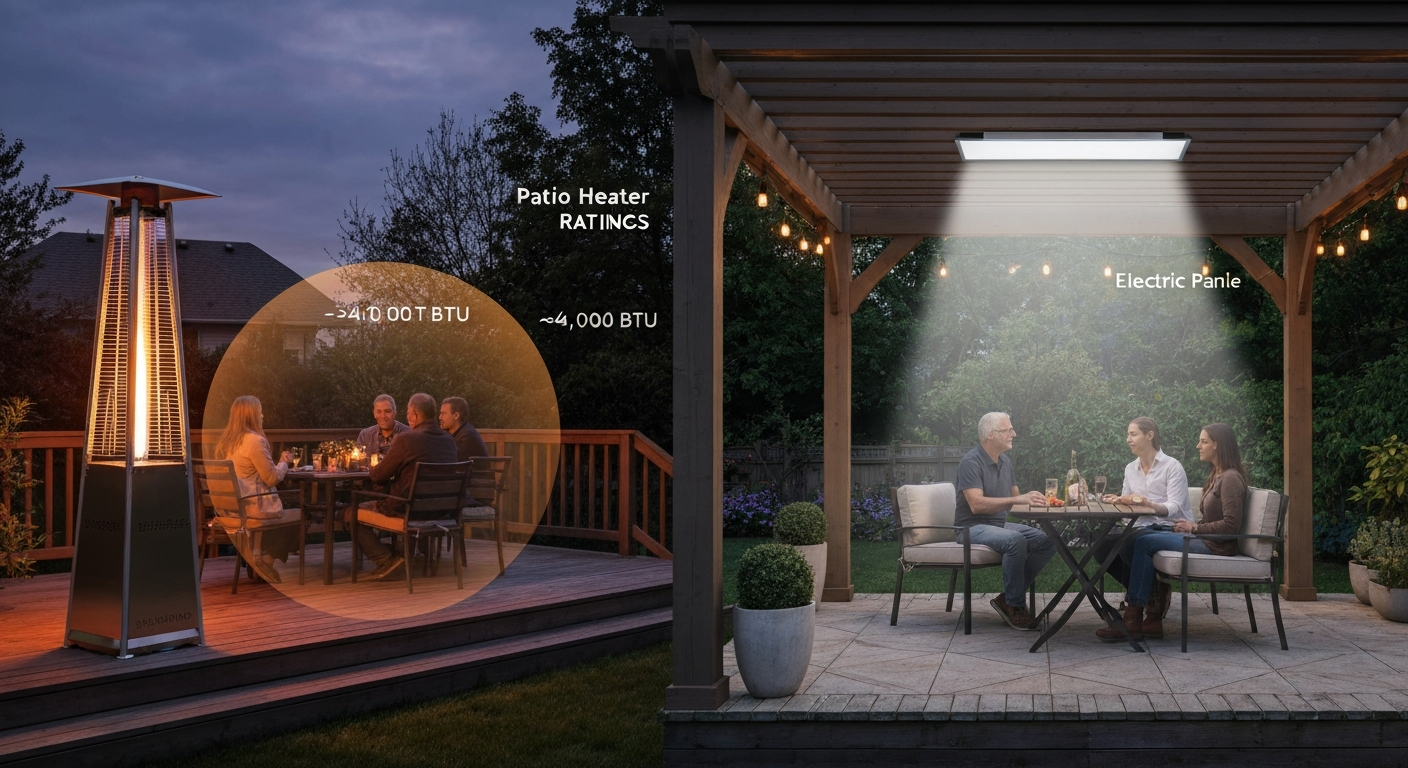
Our top patio heater picks for heat at a glance
After testing across open decks, covered pergolas, and commercial restaurant patios, these are the models and categories we keep recommending. For more model-by-model advice, see our patio heater recommendations. Every pick below has to justify itself on actual warmth performance, not just wattage or BTU claims on a box.
| Model / Category | Fuel Type | Output | Best For | Approx. Coverage |
|---|---|---|---|---|
| Bromic Tungsten Smart-Heat Electric 6000 W | Electric (240 V) | 6,000 W / ~20,500 BTU | Covered patios, commercial installs | Up to 144 ft² |
| Bromic Tungsten Gas Portable | Propane | 38,500 BTU | Large open patios, portability | Up to ~215 ft² |
| Infratech WD3 Dual-Element 3000 W | Electric (240 V) | 3,000 W / ~10,200 BTU | Small covered patios, residences | ~100 ft² |
| 40,000–50,000 BTU pyramid/glass-tube propane (e.g., BaliOutdoors-style) | Propane | 40,000–50,000 BTU | Budget buyers, open patios | 100–150 ft² |
| Natural gas overhead commercial burner | Natural gas | 30,000–50,000 BTU | Commercial spaces, fixed installs | 150–200 ft² |
| Pellet patio heater (tabletop/column) | Wood pellets | ~15,000–25,000 BTU | Aesthetics, ambiance patios | 50–80 ft² |
Quick summary: why each pick earns its spot
The Bromic Tungsten Smart-Heat Electric 6000 W is the top ceiling or wall-mount choice for serious heat under a covered patio. At 6,000 W drawing 25 A on a 240 V dedicated circuit, it delivers focused radiant warmth across up to 144 ft² and is CSA/ETL certified for North America. It's not cheap and it needs a licensed electrician, but the directed heat and dimmer compatibility make it the most controllable option we've tested. For open-air spaces where you need portability and serious BTU, the Bromic Tungsten Gas Portable at 38,500 BTU moves with you and claims up to 215 ft² of coverage from the manufacturer. Real-world performance in moderate wind is closer to 120–150 ft² of genuine comfort zone, but that's still excellent for a freestanding unit. Budget buyers who want good warmth without the premium price tag will find that a 40,000–50,000 BTU glass-tube or pyramid propane heater delivers nearly as much heat for a fraction of the cost. A standard 20 lb (4.7 gallon) propane tank at full output gives roughly 11–12 hours of run time. The Infratech WD3 at 3,000 W is the go-to for smaller covered patios where you don't need the full 6,000 W but still want clean, quiet infrared warmth without combustion fumes. Pellet models earn their place for aesthetics-first buyers: the flame and glow are genuine, the BTU is lower, and fuel cost adds up, but for a boutique restaurant patio or a design-forward backyard, nothing else looks quite like it.
Top picks by use case
Small covered patios (under 100 ft²)
Pick: Infratech WD3 Dual-Element 3,000 W. Under a pergola or covered porch, combustion heaters (propane, natural gas) need adequate ventilation or you're taking a CO risk. A 3,000 W hardwired electric infrared panel keeps it safe, quiet, and effective. Infratech's published guidance targets approximately 100 ft² of coverage for this model. Mount it at 8 ft or higher per the installation manual (the W-series specifies a minimum 8 ft mounting height for certain UL-listed configurations), angle it toward seating, and it warms the people underneath rather than trying to heat open air. Wiring requires a 240 V dedicated circuit, so factor in electrician costs.
Large open patios (150–300 ft²)
Pick: Bromic Tungsten Gas Portable (propane) or a high-BTU 48,000–50,000 BTU pyramid heater. Open patios with no overhead cover lose heat to wind fast. Radiant output matters more than air heating here, and propane wins because you can position the heater where it's most useful. The Bromic portable's 38,500 BTU is real-world tested closer to the 150 ft² zone in moderate wind. For patios over 200 ft², run two mid-range 40,000 BTU units at opposite corners rather than one giant unit in the middle. The heat footprint overlaps and coverage is much more even.
Commercial spaces (restaurants, bars, event venues)
Pick: Hardwired commercial electric infrared panels (Bromic Tungsten or Platinum series) or fixed natural gas overhead heaters. Commercial spaces benefit most from ceiling or wall-mounted systems because they don't consume floor space, can't be knocked over by staff or guests, and deliver consistent directional radiant heat. The Bromic Tungsten and Platinum series are CSA/ETL certified and offer wall, ceiling, and recess mounting options with low-recess kits for flush architectural integration. Natural gas is the lower per-BTU operating cost option where a gas line is already available. For a 600 ft² commercial terrace, expect to zone 4–6 ceiling-mount units and wire each on a dedicated 240 V circuit.
Budget buyers
Pick: A 40,000–50,000 BTU freestanding glass-tube or pyramid propane heater in the $80–$200 range. These aren't glamorous, but they work. At roughly $2.67/gallon for propane (US residential benchmark as of early 2026) and a burn rate of about 0.4 gal/hr for a 40,000 BTU unit, you're spending around $1.07/hr to run it flat out. A 20 lb tank runs 11–12 hours. The tradeoff is wind sensitivity and a wider, less directed heat pattern compared to infrared panels. Still, for occasional weekend use on an open patio, there's no more cost-effective warmth source.
Aesthetics-first buyers
Pick: Pellet patio heater or a pyramid propane heater with a flame column. If the visual experience matters as much as the warmth, a pellet heater delivers a real wood flame in a column or tower format. Heat output is modest (15,000–25,000 BTU is typical), coverage is limited to roughly 50–80 ft², and pellet fuel costs add up faster than propane per BTU. But for a wine bar patio or a design-driven residential space, the ambiance is unmatched. Pyramid propane heaters with a visible flame column split the difference: genuine warmth output (up to 40,000 BTU) with a visible flame that looks intentional rather than utilitarian.
How to choose the right patio heater
Rating criteria we use
When we test and rate patio heaters, we weight five factors: heat output versus stated BTU/wattage (do the real-world numbers hold up?), effective coverage area in typical wind conditions, operating cost per hour at local fuel prices, installation complexity and safety compliance, and durability based on customer feedback and material quality. Aesthetic design is noted but never bumped a poor performer into a top-pick position.
Step-by-step sizing checklist
- Measure your patio area in square feet (length × width). For irregular shapes, break it into rectangles and add them up.
- Identify whether the space is open (no roof/walls), semi-enclosed (pergola, one or two walls), or fully covered (roof, three or four walls). Covered spaces retain radiant heat better; open spaces need more BTU per ft².
- Check your wind exposure. A exposed coastal or rooftop patio may need 30–50% more BTU capacity than a sheltered garden patio of the same size.
- Decide on fuel availability. Do you have a natural gas line within reach? A 240 V outdoor circuit? Or are you working with a portable propane setup?
- Apply the sizing heuristic: plan for at least 1 BTU per ft² per degree Fahrenheit of temperature rise you need outdoors (rough guide). For most US climates, budget 400–500 BTU per ft² for open patios, 200–300 BTU per ft² for covered patios.
- For electric infrared, use the wattage-to-coverage guideline: approximately 10 W per ft² for covered areas, 15–20 W per ft² for open or windy areas.
- Check local electrical and gas codes. High-output (3,000 W+) electric heaters require 240 V dedicated circuits and permitted installation in most jurisdictions. Natural gas connections require a licensed plumber or gas fitter.
- Factor in run time and operating cost using your local utility and propane rates, then set a monthly budget cap.
Understanding heat output and coverage
BTU (British Thermal Unit) and watts are both just measurements of energy flow, not comfort. One watt equals 3.412 BTU/hr, so a 6,000 W electric heater puts out about 20,472 BTU/hr. One gallon of propane contains roughly 91,452 BTU, and one cubic foot of natural gas contains about 1,036 BTU. These EIA conversion figures are the standard basis for any operating-cost or sizing calculation. The key thing most buyers miss is that manufacturers' advertised coverage areas (say, 215 ft² for a 38,500 BTU portable) are measured under ideal, wind-free conditions. Real-world coverage is almost always 30–50% smaller once you factor in even modest wind.
The reason radiant heaters are superior outdoors compared to forced-air units comes down to mean radiant temperature (MRT). ASHRAE's thermal comfort research confirms that it's MRT at the person's body, not ambient air temperature, that drives perceived warmth. A 40,000 BTU infrared propane heater heating bodies directly in a cold outdoor space feels warmer than a similar BTU convective unit warming the surrounding air, which promptly blows away. When you're sizing for outdoor use, think radiant reach, not room temperature.
Coverage area quick-reference
| Heat Output | Fuel | Covered Patio Coverage (est.) | Open Patio Coverage (est.) |
|---|---|---|---|
| 1,500 W (5,118 BTU/hr) | Electric | ~50 ft² | ~30 ft² |
| 3,000 W (10,236 BTU/hr) | Electric | ~100 ft² | ~60 ft² |
| 6,000 W (20,472 BTU/hr) | Electric | ~144 ft² | ~90 ft² |
| 40,000 BTU/hr | Propane | ~130 ft² | ~100 ft² |
| 48,000–50,000 BTU/hr | Propane / Natural Gas | ~150 ft² | ~120 ft² |
Fuel types compared
Each fuel type has a genuine sweet spot, and the right answer shifts depending on your setup. Here's the honest breakdown.
| Fuel Type | Heat Output Range | Operating Cost (est.) | Best Setting | Key Tradeoffs |
|---|---|---|---|---|
| Propane | 30,000–50,000 BTU/hr | ~$1.00–$1.50/hr at $2.67/gal | Open patios, portability | Tank refills, ~11-12 hrs per 20 lb tank, wind sensitivity |
| Natural Gas | 30,000–60,000 BTU/hr | ~$0.30–$0.60/hr (piped) | Fixed commercial/residential installs | Requires gas line, permits, professional install |
| Electric (infrared, 240 V) | 1,500–6,000 W | ~$0.26–$1.00/hr at $0.17/kWh | Covered patios, enclosed/semi-enclosed | Needs dedicated circuit, electrician, no open flames |
| Infrared/Heat Lamp (120 V) | 750–1,500 W | ~$0.13–$0.26/hr at $0.17/kWh | Small covered areas, supplemental heat | Low output, limited coverage, best used close-in |
| Pellet | 15,000–25,000 BTU/hr | Variable by pellet price | Aesthetic/ambiance patios | Lower heat output, more maintenance, fuel sourcing |
Propane
Propane is the most flexible high-BTU option. You don't need a gas line, and you can move the heater wherever it's needed. A 40,000 BTU propane heater burns through roughly 0.4 gallons per hour. The Patio Heater Buying & Safety Guide, BaliOutdoors (propane consumption rule‑of‑thumb) states ~0.01 gallons of liquid propane per 1,000 Btu delivered, implying a 40,000 Btu/hr heater consumes about 0.4 gal/hr blank" rel="noopener noreferrer">Patio Heater Buying & Safety Guide — BaliOutdoors (propane consumption rule‑of‑thumb). At the current US residential benchmark of about $2. EIA weekly data aggregated at PropanePricePerGallon.com, US residential propane price benchmark (EIA‑based weekly series) report a US average residential propane price of about $2.67/gal for the week ending Mar 30, 2026 blank" rel="noopener noreferrer">PropanePricePerGallon.com — US residential propane price benchmark (EIA‑based weekly series). 67/gal, that's around $1.07/hr at full output. A full 20 lb cylinder (4.7 usable gallons at the standard 80% fill limit) lasts about 11–12 hours. The real limitation is wind: open patios with exposed propane heaters lose a significant portion of radiant output in anything above a light breeze. If you're on a gusty hillside patio, propane alone won't cut it without windbreaks.
Natural gas
Natural gas is the lowest per-BTU operating cost once the infrastructure is in place. You'll never run out mid-evening, and there are no tanks to haul. The catch is the upfront cost: a gas line extension, licensed plumber, gas fitter, and permits can easily run $500–$2,000+ depending on distance and local code. For a permanent commercial installation or a home where a gas line already runs near the patio, this is the right call. If you need to trench a gas line from scratch, do the math on whether propane or electric payback makes more financial sense first.
Electric infrared (240 V)
Electric infrared at 240 V is the only credible high-output option for covered patios with limited ventilation. There's no combustion, no CO risk, and no open flame. At roughly $0.17–$0.19/kWh (US residential average, early 2026 EIA data), running a 6,000 W unit costs about $1.02–$1.14/hr at full power. That's higher per-hour than natural gas but competitive with propane at current prices, and you get precise dimmer control and instant on/off. The installation requirement (240 V dedicated circuit, potential permit, licensed electrician) is the barrier, but it's a one-time cost. These heaters are also far more wind-resistant than open-flame models because they heat objects and people directly, not air.
Infrared heat lamps (120 V)
Standard 120 V plug-in heat lamps (750–1,500 W) are best treated as supplemental or close-range warmth sources. At 1,500 W, you're working with about 5,100 BTU/hr, which covers maybe 30–50 ft² of genuine comfort under ideal conditions. They're easy to install and don't require permits, but they're not a substitute for a real heater in cold conditions. That said, they're extremely useful over a small bistro table or as a secondary heat source in a corner that the main unit doesn't reach. These overlap with the patio heat lamps category and are worth looking at if you need targeted close-in warmth rather than broad coverage.
Pellet heaters
Pellet heaters produce real wood-fire ambiance and heat, but they sit at the lower end of the BTU range for patio heaters (typically 15,000–25,000 BTU). They require more attention (loading pellets, cleaning ash) and aren't suitable for windy spaces because the flame is disrupted. Fuel costs vary more than propane or electricity, and finding pellets in bulk can be inconvenient. The use case is specific: an aesthetically-driven outdoor lounge where the fire experience is part of the product.
Mounting and placement options
Where you put a heater matters almost as much as what heater you choose. Each mounting configuration has real implications for how much warmth reaches people and how complex the installation is.
| Mount Type | Heat Performance | Installation Complexity | Best For | Key Cons |
|---|---|---|---|---|
| Freestanding | Good (portable, adjustable) | Very low (plug-in or tank) | Open patios, flexibility | Tip-over risk, takes floor space, wind exposed |
| Tabletop | Limited (1–2 people) | Very low | Small dining tables, close-range warmth | Very limited coverage area |
| Wall-mounted | Good (fixed directional) | Medium (wiring or gas line) | Covered patios, narrow spaces | Fixed position, clearance requirements |
| Ceiling-mounted | Excellent (broad downward radiant) | High (electrical/structural) | Covered patios, commercial spaces | Requires adequate ceiling height, permits likely |
| In-floor (recessed) | Excellent (zone-based, architectural) | Very high (structural, gas/electric) | High-end residential, commercial | Most expensive, complex, long-term fixed install |
Freestanding and tabletop
Freestanding propane heaters are the most popular for residential patios because they require zero installation. The downside is that they're more exposed to wind, take up floor space, and present a tip-over hazard on uneven decking or around kids and pets. Always anchor or ballast the base. Tabletop heaters are essentially supplemental warmth for one or two people at close range. Don't expect a tabletop unit to heat your whole patio.
Wall and ceiling mounted
Wall-mounted electric or gas infrared heaters free up floor space and deliver more consistent radiant coverage because they're aimed directly at the seating area. Ceiling-mounted units (particularly electric infrared panels like the Bromic Tungsten series) are the gold standard for covered patios: they heat downward efficiently, can be recessed for a clean look using low-recess kits, and are far less vulnerable to wind disruption than freestanding models. Bromic's Tungsten and Platinum series support all three options (wall, ceiling, recess) with specified clearances in their installation manuals.
Performance in wind and different climates
Wind is the single biggest enemy of outdoor heating performance. Convective heat loss from wind strips warmth away from both the heater itself and from people's bodies. Even a 5–10 mph breeze can cut the effective comfort radius of a freestanding propane heater by 30–50%. Radiant infrared heaters are more wind-resistant because they heat solid objects and bodies directly rather than warming air, but they still lose some efficiency when mounted at angles where wind disrupts the radiant path.
- In windy climates: prioritize hardwired ceiling or wall-mount electric infrared over freestanding propane. Add windbreak panels, screens, or pergola curtains to extend the effective comfort zone significantly.
- In mild, calm climates: a standard 40,000 BTU freestanding propane heater performs close to its rated coverage and is the most cost-effective setup.
- In cold climates (below 30°F regularly): consider two lower-output units zoned across the seating area rather than one large unit. Distributed radiant heat keeps MRT higher across more seats.
- In coastal or humid climates: choose stainless steel or powder-coated aluminum housings with rust-resistant hardware. Avoid chrome-plated steel, which corrodes quickly in salt air.
- For semi-enclosed spaces (three walls, roof): electric infrared is safer and actually performs better because the enclosure retains more radiant energy. Propane/natural gas in enclosed spaces requires verified ventilation.
- For hot climates with occasional cool nights: lower-output 1,500–3,000 W electric panels or smaller BTU propane units are sufficient. Oversizing heaters in mild climates wastes fuel and money.
Installation guidance and safety checklist
Installation mistakes are the most common source of patio heater problems, from fire hazards to void warranties. Here's what needs to happen correctly before you fire up any unit.
Clearances and mounting heights
Every heater has manufacturer-specified minimum clearances to combustibles, and these are not suggestions. Bromic Tungsten installation manuals specify exact clearance distances in diagrams for wall, ceiling, and recess configurations. Infratech W-series units specify a minimum mounting height of not less than 8 ft for certain configurations. Violating clearance specs can cause fires, void warranties, and fail insurance inspections. Read the specific clearance diagram for your exact model, not just the general product category.
Pre-use safety checklist
- Read the installation and operation manual for your specific model before doing anything else.
- Verify mounting height and clearance to combustibles (ceiling material, wood beams, curtains, furniture) against manufacturer specs.
- For gas heaters: inspect all gas connections with soapy water before first use to check for leaks. Never use an open flame to check for leaks.
- For electric heaters: confirm the circuit is dedicated, properly sized (amperage matches the unit's label), and installed by a licensed electrician. A 6,000 W unit at 240 V requires a 25 A circuit minimum.
- For propane portables: ensure the tank is properly secured in the base, the regulator is correctly seated, and the tank valve is opened slowly.
- Check local permit requirements. Many jurisdictions require a permit for hardwired electric patio heaters and all gas-line connections. Operating without required permits can affect homeowner's insurance.
- Anchor freestanding heaters on hard or uneven surfaces using the base ballast ring filled with sand, or ground stakes if on a lawn.
- Keep a minimum 3 ft clearance from any flammable materials (patio curtains, wood overhangs, furniture) at all times during operation.
- Never leave a combustion heater unattended or operating while you sleep.
- For ceiling-mount electric units: clean reflectors and elements annually per manufacturer guidance (Infratech specifies routine reflector cleaning in the W-series care manual) to maintain output efficiency.
Gas hookup and permit notes
Natural gas connections require a licensed plumber or gas fitter in virtually every US jurisdiction. Even a simple flex-line hookup to an existing gas stub-out often requires a permit and inspection. Propane portable connections via standard QCC-1 regulator fittings are typically permit-free, but check local ordinances if you're in an HOA community or commercial building. For any commercial installation (restaurant, event venue), expect the local fire marshal to require documentation of CSA/ETL or UL certification, clearance compliance, and in some cases a specific inspection before the heater can be used for customers.
Ongoing maintenance and cost tracking
Operating cost tracking matters for both residential and commercial buyers. A 40,000 BTU propane heater running 4 hours per evening, 3 evenings a week, burns through roughly 1.6 gallons per session and about 4.8 gallons per week. At $2.67/gal, that's about $12.82/week. Over a 20-week season that's around $256 in propane. A 6,000 W electric unit at the same schedule (4 hrs, 3 evenings) consumes 72 kWh/week. At $0.18/kWh, that's roughly $12.96/week, and about $259 over 20 weeks. The two fuel types come out very close at current benchmark prices, which means installation cost and convenience end up being the real decision factor between propane and electric infrared for most buyers.
For specific product comparisons beyond the picks above, our detailed reviews of individual units cover warranty terms, customer feedback patterns, and long-term durability data. Whether you're deciding between a freestanding propane tower and a wall-mount infrared panel, or comparing a budget buy against a premium commercial unit, matching the heater's real-world heat footprint to your specific patio geometry and climate is always the right starting point. See our guide to the best patio space heater for detailed side-by-side comparisons and buying advice.
FAQ
Which patio heaters give the best warmth for different patio sizes and climates?
Best warmth depends on size and exposure: for small covered patios (up to ~100–150 ft²) high‑watt electric infrared (3,000–6,000 W) or low‑output gas wall/ceiling units provide strong radiant comfort; for large open patios (150–400+ ft²) high‑BTU propane or natural‑gas tube/pyramid heaters (30,000–50,000 Btu) or multiple distributed infrared units are best; for windy or very open commercial spaces use high‑BTU gas or multiple mounted infrared arrays; for semi‑enclosed or fully roofed areas electric infrared (hard‑wired 240 V models) is safer and more effective at close‑range radiant comfort.
Which specific models are top tested picks for heat performance?
Representative top picks by use case: Small covered patios — electric infrared panels (3,000–6,000 W) such as Bromic Tungsten 6000 W for concentrated radiant warmth; Large open patios — portable 38,000–50,000 Btu gas tower or glass‑tube heaters (commercial‑grade Bromic or similar) for high output; Commercial/restaurant spaces — ceiling/wall‑mounted commercial gas or commercial Tungsten/Platinum series infrared with multiple zones; Budget pick — compact 1–2 burner electric or small propane tower for localized warmth; Aesthetic pick — designer glass‑tube or pyramid propane heaters with high BTU and visual appeal. Choose specific models after matching mounting, certification and site power/fuel.
How do I size a patio heater — step‑by‑step checklist?
Sizing checklist: 1) Measure usable seating area (ft²) to be heated. 2) Determine enclosure: open, semi‑enclosed, or covered. 3) Use target sizing: open areas ≈400–600 Btu/ft² (rule‑of‑thumb), semi‑enclosed ≈200–400 Btu/ft², covered/enclosed ≈60–120 W per 10–15 ft² for electric infrared — adjust upward for wind. 4) Select heater type: gas for high‑BTU open spaces, electric/infrared for covered/semi‑enclosed. 5) Calculate number/placement: distribute radiant units so each seat sees direct radiant flux; avoid single high unit in windy spaces. 6) Check clearances, mounting height and coverage specs from the manufacturer. 7) Verify fuel/power availability and professional installation needs.
How do BTU and watts translate when comparing heaters?
Conversion: 1 kWh = 3,412 Btu. Use this to compare: watts × 3.412 = Btu/hr (e.g., 6,000 W ≈ 20,472 Btu/hr). For fuel sizing, remember gas/heater ratings are in Btu/hr; electric heaters are in watts. Use these conversions to compare theoretical output, but adjust for real‑world losses (wind, geometry, radiant vs convective).
What are the pros and cons of each fuel/type (propane, natural gas, electric, infrared, pellet)?
Propane — pros: high BTU, portable, strong radiant comfort in open spaces; cons: tank swaps, fuel cost variability, indoor/semi‑enclosed safety limits. Natural gas — pros: continuous fuel, lower operating cost for heavy use, good for fixed commercial setups; cons: requires permanent line/plumbing, installation cost. Electric infrared — pros: best for covered/enclosed areas, instant on, low maintenance, clean; cons: needs 240 V for high output, higher electricity cost per Btu, limited range per unit. Infrared/heat‑lamp (electric or gas) — pros: radiant warmth improves perceived comfort, effective at seat‑level; cons: directional coverage, affected by obstructions. Pellet — pros: niche aesthetic, renewable fuel potential; cons: lower output, more maintenance, uncommon for large patio heat.
How does wind and climate affect heater performance?
Wind increases convective heat loss and reduces effective radiant comfort zone, often requiring higher BTU or more units to compensate. In cold or windy climates choose more powerful heaters, sheltered placements (windbreaks, partial enclosures), and focus on radiant options placed close to users. For very windy sites, gas units with broader radiant footprint or multiple mounted infrared arrays perform better than single freestanding units.
Next Articles
Best Patio Space Heater: How to Choose the Right One
Choose the best patio space heater for your patio size, wind, fuel and budget with a safety-first buying checklist.
Best Patio Heat Lamps in 2026: Buying Guide and Picks
Find the best patio heat lamps in 2026 with picks, buying criteria, coverage, safety tips, and running costs.
Patio Heater Best Guide: Types, Picking, Setup, Costs
Find the best patio heater: type guide, best picks by use and weather, setup tips, and real running cost estimates.