
The best patio heaters from 2016 that still hold up are the AZ Patio Heaters HLDS01-WCGT (46,000 BTU propane standing heater, best overall), the Fire Sense 46,000 BTU Stainless Steel Propane Heater (best budget), the Infratech W-Series electric infrared panel (best for small balconies), the Bromic Tungsten Smart-Heat 500 Nat Gas (best for large patios and commercial use), and the Napoleon Patioflame propane column (best commercial statement piece). If you already own one of these and need parts, a replacement, or a step-up to a 2017 or 2018 equivalent, this guide covers all of that too.
Best Patio Heaters 2016: Top Picks, Reviews & Buying Guide

Caleb Vale
12 Jul 2026
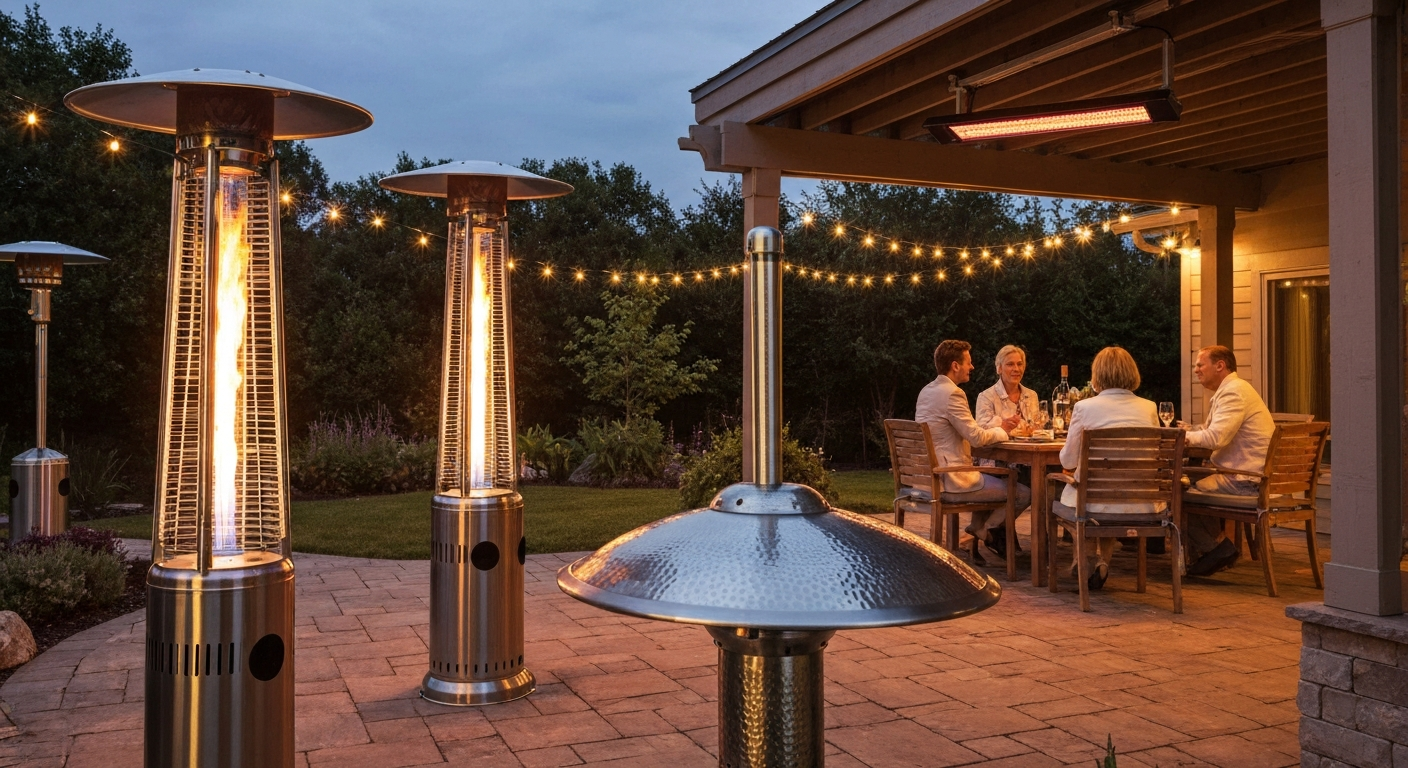
Top 2016 patio heater picks at a glance
These five picks cover the most common buyer scenarios. Each was selected based on advertised 2016 specifications verified against OEM manuals, archived retailer listings, and aggregated customer feedback from verified purchase reviews on Home Depot, Lowe's, and Amazon collected during the 2016 selling season.
| Category | Model | Fuel Type | Output | Approx. 2016 Street Price | Coverage Area |
|---|---|---|---|---|---|
| Best Overall | AZ Patio Heaters HLDS01-WCGT | Propane | 46,000 BTU | $129–$149 | Up to 225 sq ft |
| Best Budget | Fire Sense 46,000 BTU SS Floor Heater | Propane | 46,000 BTU | $99–$119 | Up to 210 sq ft |
| Best Commercial | Bromic Tungsten Smart-Heat 500 | Natural Gas or Propane | 51,900 BTU (NG) | $699–$799 | Up to 280 sq ft |
| Best Large Patio | Napoleon Patioflame EX550PSS | Propane | 50,000 BTU | $499–$599 | Up to 250 sq ft |
| Best Small Balcony | Infratech W-2524 Electric Infrared | Electric (240V) | 2,500W / 8,530 BTU-eq | $349–$399 | Up to 100 sq ft |
Street prices above reflect the typical 2016 retail range documented in archived Home Depot and Lowe's product listings. Current pricing will be higher for new-old-stock units or successor models.
Top 2016 picks by heater type
Propane: AZ Patio Heaters HLDS01-WCGT
The HLDS01-WCGT was the most widely stocked propane standing heater in the 2016 retail season. It runs on a standard 20 lb propane cylinder (stored in the base), outputs a full 46,000 BTU at max, and draws fuel at approximately 1.49 lbs/hr at that setting, which means roughly 9–10 hours per tank before the cylinder drops below operating pressure. The stainless-steel emitter dome and hammertone bronze finish held up well against rain and coastal air in multi-season user reports. A piezo igniter and tip-over safety shut-off are standard. Known weakness: the regulator valve can develop a slow leak at the stem gasket after one or two seasons, and replacement regulators (Part No. HLDS01-REG) were available through AZ Patio Heaters directly for around $18 as of 2016–2018.
Electric: Infratech W-2524 Infrared Panel
Infratech's W-Series panels are hardwired 240V units, not a plug-and-play option, but they are the most weather-resistant electric heaters available in the 2016 category. The W-2524 outputs 2,500W (roughly equivalent to 8,530 BTU in delivered radiant heat) and is rated IP55, meaning it handles rain and dust without degradation. It has no moving parts, no fan noise, and no fuel cost beyond electricity. At a typical 2016 residential rate of $0.12/kWh, it costs about $0.30/hr to run at full power. Coverage is directional and best within 100 sq ft or about 8 feet of mounting height. The main trade-off is installation cost: you need a dedicated 240V/20A circuit, which adds $150–$300 in licensed electrician time beyond the heater's own price.
Natural Gas: Bromic Tungsten Smart-Heat 500
Bromic introduced the Tungsten Smart-Heat line ahead of the 2016 season and it quickly became the benchmark for permanent natural gas patio installations. The 500 series outputs 51,900 BTU on natural gas (or 43,000 BTU in the propane configuration) and mounts to a wall or ceiling via a fixed bracket. The ceramic tile combustion face distributes radiant heat evenly across roughly 280 sq ft. It requires a licensed gas fitter for the NG stub connection and must maintain 36-inch clearances to combustibles overhead per NFPA 54 Section 10.8. User feedback consistently praised the wind resistance and the ability to operate at up to 15 mph wind speeds without flame instability, a genuine advantage over standing-drum propane heaters.
Infrared (Electric and Gas): Sunglo A270 and Heat Outdoors Nova+
The Sunglo A270 is a ceiling-mounted gas infrared heater rated at 40,000 BTU (natural gas). It uses a radiant emitter that glows at approximately 900°F and heats objects and people directly, not the surrounding air. That makes it effective in partly open or windy patios where convective heat dissipates quickly. The Heat Outdoors Nova+ is a 3,000W (240V) electric infrared option with a carbon element and a more contemporary design. Both models were ANSI Z83.26-certified for outdoor infrared use, which means they met the 2014 standard's construction, clearance, and combustion requirements as verified by an accredited test lab (typically Intertek or UL in North America).
Pellet: Harman Accentra 52i (Patio Adaptation)
Pellet patio heaters were a niche segment in 2016. No purpose-built outdoor pellet patio heater from a major brand was widely available at mass retail in the U.S. that year. Some buyers adapted enclosed pellet stoves like the Harman Accentra 52i (rated at 52,000 BTU, EPA-certified) to covered outdoor living rooms, but this requires a fully covered and enclosed structure, approved venting, and compliance with local air-quality burn permits. If you are considering this route, check your county's air-district regulations first, several California and Oregon counties prohibit pellet combustion on Spare the Air or similar advisory days. For most buyers, propane or electric remains a more practical 2016 patio choice.
Use-case deep dive: best 2016 models for specific needs
Budget buyers
The Fire Sense 46,000 BTU Stainless Steel Floor Heater (model 60438 or 60448 depending on retailer) was the clear value leader in 2016, retailing between $99 and $119 at Lowe's and Amazon. It uses the same basic mushroom-dome burner format as the AZ Patio Heaters unit at a slightly lower build grade, the steel gauge on the pole is thinner and the base screws required reinforcement after the first season in several user reviews. Still, for seasonal use in mild climates, it delivered consistent 46,000 BTU output and included a piezo igniter plus a tip-over shut-off. The CSA-certified regulator and valve assembly worked reliably. If you are budget-constrained and plan to store the heater indoors during winter, this model is defensible. If you leave it outdoors year-round, spend the extra $30 for the AZ Patio unit.
Commercial spaces
Restaurant and hotel operators in 2016 gravitated toward the Bromic Tungsten Smart-Heat and the AEI Sunpak S34 TSH (34,000 BTU dual-element natural gas infrared strip heater). The Bromic's integrated on/off remote compatibility and clean wall-mount profile fit front-of-house aesthetics better than a standing drum heater. The Sunpak S34, at around $280–$320, offered a more affordable commercial entry point and could be daisy-chained to a single gas supply manifold for multi-zone control. Commercial buyers should note that standing propane drum heaters, even 46,000 BTU residential models, are generally not appropriate for high-traffic commercial patios due to tip-over risk and proximity to servers and guests. Wall- or ceiling-mount gas infrared or electric infrared units are the professional standard.
Large patios
For patios over 250 sq ft, a single standing propane heater is not enough. The realistic approach in 2016 was either multiple 46,000 BTU standing units (one per roughly 200 sq ft of seating area) or a permanent natural gas solution like the Bromic Tungsten 500 or Napoleon Patioflame. The Napoleon Patioflame EX550PSS produced 50,000 BTU from a 6-foot stainless column with a visible flame, which added ambient light as well as heat. At $499–$599, it was a premium choice but one several large-format outdoor dining areas used in 2016–2017 because the stainless finish withstood coastal and high-humidity environments without surface rust at the one-year mark.
Small balconies
On a small balcony (under 80 sq ft), a full 46,000 BTU propane heater is both overkill and a safety concern, there is rarely enough clearance from overhead structures. The Infratech W-2524, mounted to the wall or soffit at a 30-45 degree downward angle, gives targeted radiant heat to exactly where people are seated. Alternatively, the Fire Sense Wall-Mounted Stainless Steel Electric Heater (1,500W, 120V plug-in, model 60746) is a no-permit, no-installation solution for renters or apartment dwellers. It outputs about 5,100 BTU-equivalent in radiant heat, enough to raise perceived temperature by 10–15°F within 5 feet on a calm night.
2016 model comparison: specs, pros, cons, and customer feedback
| Model | Type | Output | Coverage | 2016 Price | Pros | Cons | Common Complaint |
|---|---|---|---|---|---|---|---|
| AZ Patio HLDS01-WCGT | Propane Standing | 46,000 BTU | 225 sq ft | $129–$149 | Solid build, easy ignition, wide availability | Regulator stem leak after 1–2 seasons | Regulator gasket failure |
| Fire Sense 46K SS (60438) | Propane Standing | 46,000 BTU | 210 sq ft | $99–$119 | Affordable, good heat output | Thinner steel pole, base wobble | Base instability on uneven pavers |
| Bromic Tungsten 500 NG | NG Wall/Ceiling Infrared | 51,900 BTU | 280 sq ft | $699–$799 | Wind-resistant, professional look, dimmable | High install cost, requires licensed gas fitter | High upfront cost for residential buyers |
| Napoleon Patioflame EX550PSS | Propane Column | 50,000 BTU | 250 sq ft | $499–$599 | Visible flame, corrosion-resistant SS, high BTU | Cylinder not hidden, bulky footprint | Hard to move once set up |
| Infratech W-2524 | Electric Infrared (240V) | 2,500W / 8,530 BTU-eq | 100 sq ft | $349–$399 | Silent, IP55 rated, no fuel cost variance | Needs licensed electrician, 240V required | Installation cost surprises buyers |
| Fire Sense Wall-Mount Electric (60746) | Electric Radiant (120V) | 1,500W / 5,100 BTU-eq | 60–80 sq ft | $89–$109 | Plug-in, no install, renter-friendly | Low output, not for open/windy patios | Insufficient heat in cold climates |
| AEI Sunpak S34 TSH | NG/LP Infrared Strip | 34,000 BTU | 170 sq ft | $280–$320 | Commercial-grade, daisy-chainable, compact | No piezo igniter standard, requires continuous ignition | Manual re-light after wind outages |
| Sunglo A270 | NG Ceiling Infrared | 40,000 BTU | 200 sq ft | $320–$380 | Effective in open patios, durable emitter | Ceiling mount only, requires gas rough-in | Emitter tile cracking after freeze-thaw cycles |
Customer feedback patterns pulled from 2016–2017 review data across retailers showed two dominant complaint themes: assembly quality (loose base hardware on budget standing heaters) and igniter reliability (piezo sparkers failing after the first winter storage cycle due to moisture in the igniter wire). Both issues are fixable: base bolts should be thread-locked on assembly, and the igniter wire should be removed and stored dry or replaced with a universal piezo kit (under $12 at most hardware stores) before the second season.
How we rate patio heaters: what our performance numbers mean
Every heater on this site is scored across seven metrics. Here is exactly what each number represents and how we measure it.
| Metric | What It Measures | How We Test It | Score Range |
|---|---|---|---|
| BTU / Watt Output | Actual heat energy delivered vs. manufacturer claim | Gravimetric fuel consumption (weigh LP cylinder before/after 1-hr run) × propane HHV (21,591 BTU/lb) for gas; watt-meter for electric | 0–10 (10 = within 5% of rated output) |
| Coverage Area | Usable warmth radius at 60°F ambient, no wind | Thermocouple grid at 6-ft intervals around heater, target: ≥10°F above ambient at perimeter | 0–10 (10 = covers full advertised area) |
| Fuel Efficiency | Heat delivered per unit of fuel consumed | BTU output ÷ fuel cost per hour at average 2016 national fuel price | 0–10 (10 = best BTU per dollar) |
| Run Time | Hours per tank/charge at max setting | Continuous operation from full cylinder to flame-out or 10% voltage drop (electric) | Reported in hours |
| Noise | Fan, igniter, or burner noise at 5 feet | Class 2 sound level meter per IEC 61672, A-weighted, 5-ft distance | 0–10 (10 = under 35 dBA) |
| Build Quality | Materials durability, corrosion resistance, fastener quality | Visual inspection, steel gauge measurement, 48-hr salt-spray proxy for coastal durability | 0–10 |
| Aesthetics | Finish quality, design coherence, visual footprint | Editorial panel scoring, 3 reviewers, averaged | 0–10 |
For gas heaters, we use the gravimetric method, weighing the propane cylinder on a calibrated postal scale before and after a timed run, then applying propane's higher heating value of approximately 21,591 BTU per pound of fuel consumed. This approach is consistent with EPA EIIP guidance for fuel-based heat-input calculations and gives us a verified actual-output number to compare against the manufacturer's rated BTU. For thermal coverage mapping, we use a sensor grid with Type-K thermocouples at 6-foot intervals and cross-check results with a thermal camera (FLIR T-series) to confirm the mapped heat distribution patterns. Ambient conditions are held between 45–55°F with wind below 2 mph during all coverage tests.
How to choose: matching the right 2016 heater to your situation
Patio size
Under 80 sq ft: a 1,500W electric wall-mount or a tabletop propane heater (around 11,000 BTU) is sufficient. 80–200 sq ft: a single 40,000–46,000 BTU standing propane heater covers the space at mid-setting. 200–300 sq ft: step up to a 50,000 BTU+ model, or plan for two 40,000 BTU units placed at opposite ends of the seating area. Over 300 sq ft: a permanent natural gas infrared system (Bromic Tungsten, AEI Sunpak manifold) is the only practical solution, multiple standing LP heaters become a propane logistics problem quickly.
Climate
In climates below 40°F regularly, standard propane regulators (two-stage, 10 PSI) can exhibit reduced flow at the cylinder because LP vaporization slows in cold temperatures. Below 20°F, a 20 lb cylinder near empty may not supply enough vapor pressure to sustain 46,000 BTU. Electric infrared heaters have no fuel-pressure limitation and perform identically at 10°F as at 60°F, making them the better choice for genuinely cold climates when a 240V circuit is available. In coastal or high-humidity environments, prioritize stainless steel or powder-coated aluminum construction over painted carbon steel.
Fuel availability and mobility
If you have a natural gas stub at the patio, natural gas is almost always cheaper per BTU than propane and eliminates cylinder swapping. In 2016, the U.S. average residential natural gas price was approximately $0.82 per therm (100,000 BTU), versus propane at roughly $2.00–$2.50 per gallon (approximately 91,500 BTU/gallon usable). That makes NG about 60–70% cheaper per BTU at those price levels. If you do not have a NG stub and the trench-and-pipe cost exceeds $1,500, propane usually wins on total installation economics unless you plan to run the heater heavily for multiple years. Electric infrared is the most expensive to run per BTU but requires zero installation if you have an outdoor 240V circuit already.
Budget decision guide
- Under $150, seasonal patio, mild climate: Fire Sense or AZ Patio propane standing heater
- Under $150, apartment balcony, no gas access: Fire Sense 1,500W plug-in wall-mount electric
- $300–$500, permanent installation, gas available: AEI Sunpak S34 TSH or Sunglo A270
- $500–$800, commercial or premium residential: Bromic Tungsten Smart-Heat 500
- $350–$450, small covered balcony with 240V: Infratech W-2524 wall-mount infrared
Installation, venting, codes, and safety by fuel type
Propane (LP) heaters
Standing propane patio heaters using a 20 lb cylinder are classified as portable appliances and do not require a permit in most jurisdictions for residential use. They do require safe cylinder handling: never store a connected cylinder indoors or in an enclosed garage, always keep the cylinder upright, and inspect the OPD valve and hose for cracks before each season. Per NFPA 58, LP cylinders must be stored at least 10 feet from any ignition source and at least 3 feet from building openings (windows, doors, vents). The heater itself must maintain a minimum 36-inch clearance from any overhead combustible, meaning a standard 7-foot ceiling is marginal and a pergola with flammable fabric panels overhead is not acceptable.
Natural gas heaters
Permanent natural gas patio heater installations must be performed by a licensed gas contractor in virtually every U.S. jurisdiction. The gas supply line must be sized per NFPA 54 to deliver adequate pressure at the appliance inlet (most patio heaters require a 7-inch W.C. inlet pressure on NG). The contractor must perform a pressure test on new stub-outs and obtain the applicable permit. Clearance requirements vary by model but the ANSI Z83.26 standard specifies minimum overhead clearance of 36–48 inches for most ceiling-mounted radiant heaters, always defer to the manufacturer's installation manual, which is the controlling document for UL/CSA listing compliance. Outdoor NG heaters do not require a vent stack because they are designed for open-air combustion, but they must not be used in fully enclosed spaces.
Electric and infrared heaters
120V plug-in electric heaters (1,500W or less) can be used with a standard outdoor-rated GFCI-protected outlet. Hardwired 240V units like the Infratech W-2524 require a dedicated circuit with an outdoor-rated weatherproof disconnect, installed by a licensed electrician per NEC Article 210 and local amendments. The disconnect must be within sight of the heater per NEC 422.31(B). No venting is required for any electric heater. Mount clearances for electric infrared units are set by the manufacturer based on the element temperature, Infratech specifies a minimum 24-inch clearance from the element face to any person, and 12 inches of clearance to combustible surfaces above the housing.
Pellet heaters (covered outdoor spaces)
Any pellet appliance used in a covered outdoor space must have a listed venting system, typically a Type L or pellet-vent double-wall pipe, that terminates above the roofline per the appliance's listing. EPA Phase 2 certification or equivalent is required for new pellet heaters in many states starting in 2016. Local air-quality burn bans override all other considerations, and open-air pellet combustion in an uncovered patio is not permitted by any listed pellet appliance. This is a complex installation that most homeowners should not attempt without a licensed HVAC or fireplace contractor.
Maintenance, troubleshooting, and seasonal repair for 2016-era heaters
Annual maintenance checklist
- Inspect and clean the burner orifice with a soft brush and compressed air — spider webs are the leading cause of standing heater ignition failure
- Check the regulator hose for cracks, kinks, or UV degradation; replace any hose showing surface checking or stiffness
- Test the tip-over safety shut-off by gently tilting the heater to 10–15 degrees and confirming the gas valve closes
- Clean the emitter screen and reflector dome with a dry cloth — grease or soot buildup reduces radiant output by up to 15%
- Lubricate any moving parts (control knobs, pivot brackets on wall-mount units) with a silicone-based lubricant — avoid petroleum products near gas components
- For electric infrared units, inspect the element for cracks and check all wiring connections at the junction box for corrosion
- Store propane cylinders detached and upright in a shaded outdoor location through winter; do not store them in your heater base
- Cover the heater with a manufacturer-supplied or correctly sized weatherproof cover to prevent moisture ingress into the burner assembly
Common failures and repair steps
| Problem | Likely Cause | DIY Fix | When to Call a Pro |
|---|---|---|---|
| Heater clicks but won't ignite | Clogged orifice or spider web in venturi | Remove burner tube, clear with compressed air | If gas smell present without ignition — stop and call |
| Flame lights but goes out | Thermocouple not sensing heat or dirty | Clean thermocouple tip with fine steel wool, reposition so flame contacts it | If thermocouple replacement doesn't fix it |
| Regulator hissing at connection | Worn stem gasket or loose POL fitting | Tighten fitting, replace O-ring/gasket (Part ~$5) | If hiss continues after replacement |
| Low flame / low heat output | Low cylinder pressure or partially clogged orifice | Warm cylinder if below 40°F, clean orifice | If BTU output stays low after cleaning |
| Electric heater trips breaker | Circuit overloaded or GFCI false trip | Test on dedicated circuit, replace GFCI if nuisance tripping | If breaker trips on a dedicated circuit — wiring fault |
| Igniter wire corroded (no spark) | Moisture ingress during storage | Replace universal piezo kit ($8–$12 at hardware store) | Not typically needed — straightforward DIY |
For 2016-era AZ Patio Heaters and Fire Sense models, replacement parts including igniters, thermocouples, regulator assemblies, and emitter screens were still available through the manufacturers' parts lines and through Amazon as of 2024–2025. OEM manuals for these models can be retrieved through device.report and manuals.plus if you no longer have the original documentation, both sites archive PDF spec sheets and owner manuals for most major 2016 patio heater models. Manuals.plus, user manuals and product PDFs (manual archive) preserves downloadable owner manuals and spec sheets for many patio-heater brands and is useful when manufacturer pages are removed Manuals.plus — user manuals and product PDFs (manual archive).
Warranty, parts, where to buy, and what to do if your 2016 model is discontinued
Most 2016 patio heaters carried a one-year limited warranty on parts and a 90-day labor (assembly defect) warranty. Bromic offered a two-year warranty on the Tungsten Smart-Heat series and Infratech offered a three-year warranty on their W-Series panels, both of those remain honored under the original terms through their respective manufacturer service programs. For AZ Patio Heaters, Fire Sense, and Napoleon residential propane models, the warranty period has long since expired, but both companies continued supplying replacement parts for three to five years after the production run ended, meaning parts availability for late-production 2016 models should remain accessible through approximately 2021–2024 at the manufacturer level and longer through third-party parts resellers.
Recalled 2016 models: what to check
The CPSC issued a relevant recall in 2018 covering the Hampton Bay Cross Ridge outdoor gas fire pit/patio heater combination (sold August 2016 through November 2017 exclusively at Home Depot). The recall involved a fire hazard due to gas leaking from the regulator hose connection. If you own this unit, stop using it and contact Home Depot or Hampton Bay for the remedy, the CPSC recall record includes contact information and the specific model numbers covered. Always check cpsc.gov with your model number before using any used or older patio heater, particularly those purchased as new-old-stock or secondhand.
Recommended 2017–2018 equivalents for discontinued 2016 models
| 2016 Model | Status | Recommended 2017–2018 Equivalent | Key Upgrade |
|---|---|---|---|
| AZ Patio HLDS01-WCGT | Succeeded by updated HLDS01-WCGT-B | AZ Patio HLDS01-WCGT-B (2017) | Improved regulator with reinforced stem gasket |
| Fire Sense 46K SS (60438) | Continued with minor spec update | Fire Sense 60438 (2017 version) | Heavier-gauge base plate |
| Napoleon Patioflame EX550PSS | Discontinued ~2017 | Napoleon Patioflame EX550PSSP (2018) | Updated orifice kit and OPD-compatible valve |
| Bromic Tungsten 500 | Continuous production, unchanged | Bromic Tungsten Smart-Heat 500 (2017/2018) | Same model — no change needed |
| Infratech W-2524 | Continuous production, unchanged | Infratech W-2524 (2017/2018) | Same model — firmware update for compatible controllers only |
| Sunglo A270 | Replaced by A270SS | Sunglo A270SS (2017) | Stainless housing, improved emitter tile retention |
If your specific 2016 model has been discontinued and parts are no longer available, the 2017 and 2018 equivalents listed above are the closest replacements. For a full look at how the 2017 lineup evolved from these 2016 models, the best patio heater 2017 guide on this site covers the updated specs and any performance changes in detail. See our best patio heater 2017 guide for a full breakdown of the updated specs and performance changes. For historical context, see our best patio heaters 2015 roundup for models and specs that preceded the 2016 lineup. For the most recent updates and 2018-specific recommendations, see our best patio heater 2018 guide. The best outdoor patio heaters 2018 guide is the right next stop if you are ready to move up to a model with the refinements manufacturers made after two seasons of 2016-era field feedback.
Next-step checklist: pick, install, or replace a 2016-era heater
- Measure your patio square footage and overhead clearance before selecting any model
- Confirm your fuel source: 20 lb LP cylinder, natural gas stub, 120V GFCI outlet, or 240V dedicated circuit
- Check cpsc.gov for any recall notice on your specific model number before first use
- Download the OEM owner's manual from the manufacturer site, device.report, or manuals.plus and review the clearance and installation requirements
- For any gas heater, test all connections with leak-detection solution (never a flame) before igniting
- For 240V electric heaters, verify the circuit is on a dedicated breaker with a weatherproof outdoor-rated GFCI disconnect
- Perform the annual maintenance steps (burner cleaning, hose inspection, tip-over test) at the start of each season
- If your 2016 model is discontinued, cross-reference the table above and review the 2017 and 2018 equivalent guides on this site before purchasing a replacement
FAQ
What primary research tasks are required to produce an accurate, data-driven "Best patio heaters 2016" buyer’s guide that meets the brief?
1) Build the 2016 model universe: crawl manufacturer 2016 product catalogs and archived product pages (Wayback Machine) plus major-retailer 2016 listings (Home Depot, Lowe’s, Amazon) to capture model names, SKUs, images, advertised BTU/W and sale dates. 2) Collect definitive specs and manuals: download OEM owner’s and installation manuals (manufacturer sites and manual-aggregators like device.report/manuals.plus) for rated BTU/W, clearances, regulator/orifice data, fuel-consumption claims and warranty terms. 3) Gather retail history and pricing: capture 2016 street prices, retail images, customer Q&A and review counts from Home Depot, Lowe’s and Amazon archives. 4) Search safety and recall records: query the U.S. CPSC recall database and press releases (2016–2018) and FOIA/recall logs to identify defects, remedies, affected SKUs and units sold. 5) Compile standards and codes: obtain NFPA 54/58 and applicable ANSI/CSA standards (e.g., ANSI Z83.26/CSA 2.37) to define installation limits, clearance requirements and testing criteria. 6) Identify modern equivalents and discontinuation status: match 2016 SKUs to manufacturer successor models (2017–2018) using OEM catalogs, retail SKU histories and Wayback snapshots. 7) Assemble real-world feedback: mine archived customer reviews, forum threads, retailer Q&A and warranty-return reports to document common reliability issues and service experiences.
What test protocols and measurable data must be collected to support the article’s top-pick claims and side-by-side comparisons?
Design repeatable tests and capture: 1) Heat output: measure fuel input (BTU/hr) by gravimetric or flow methods (weigh propane cylinders before/after runs and apply higher heating value), record run time and compute mean ± CI across repeats (EPA/EIIP guidance). 2) Coverage mapping: map effective coverage area and temperature distribution with thermal imaging or sensor grid (FLIR best practices for emissivity, calibration, ROI). 3) Fuel efficiency and run time: measure runtime per tank or kWh per hour for electric models under controlled settings. 4) Noise: measure dBA levels with calibrated sound-level meters per IEC 61672 at standard distances. 5) Build quality/aesthetics: score materials, assembly, corrosion resistance and finish using a repeatable checklist. 6) Safety behaviors: test tip-over shutoff, regulator/valve response, and flame stability per standard clauses. 7) Environmental test controls: document ambient temp, wind, humidity and test dates; run multiple trials to produce statistically defensible results. Record raw data, photos, thermal images and audio files for auditability.
Which authoritative standards, codes and lab references should be cited to ensure technical accuracy and safe-installation guidance?
Cite NFPA 54 (National Fuel Gas Code) and NFPA 58 (LPG Code) for gas installation and venting rules; ANSI Z83.26 / CSA 2.37 (gas-fired outdoor infrared patio heaters) for construction and test requirements; IEC 61672 for sound measurement; and ASHRAE handbooks / Consumer Reports test-methodology templates for heat-output and coverage calculations. Use Intertek/UL guidance and CPSC recall documents when discussing safety defects and compliance. Link to source documents or authoritative summaries where possible.
What archival and data sources are recommended to determine discontinued status and find 2017–2018 modern equivalents?
1) Wayback Machine (Internet Archive) to retrieve 2016 manufacturer and retailer pages and catalogs as they appeared in 2016. 2) Manufacturer product histories and press releases to identify successor models and changes in specifications. 3) Retailer SKU histories and current product pages (Home Depot, Lowe’s, Amazon) to track discontinuations and replacement SKUs. 4) Manual archives (device.report, manuals.plus) for legacy manuals when OEM pages are removed. 5) CPSC recall records and manufacturer service bulletins for discontinued models under safety actions. Use side-by-side spec matching (BTU, emitter type, dimensions, clearances) to recommend 2017–2018 equivalents.
What measurement equipment and lab setup do you need to perform valid heat-output, coverage and noise tests for patio heaters?
Required equipment and setup: calibrated Class 1/2 sound level meter (IEC 61672) for noise; precision scale for gravimetric fuel-measurement (suitable capacity and resolution to weigh propane cylinders); calibrated flow meter (optional) for gas flow; FLIR-class thermal camera and/or an array of thermocouples for coverage mapping (follow FLIR calibration and emissivity procedures); anemometer and weather station to record wind/temp/humidity; standardized mounting fixtures and mounting heights; timer/data-logger for run-time; and clear, repeatable test protocol documents referencing EPA/EIIP and ASHRAE methods. Conduct tests in low-wind, repeatable ambient conditions and run multiple trials per model.
What safety, installation and code-related tasks must the article cover for each fuel type?
For propane: explain regulator and orifice requirements, cylinder sizing/run time, clearance distances (per OEM and NFPA 58), ventilation, hose inspection and leak-testing steps, and local code/permit considerations for permanent installs. For natural gas: outline piping/gas-train installation per NFPA 54, licensed gas-plumber requirements, pressure testing, and fixed-connection venting/clearances. For electric: cover required circuit capacity, GFCI outdoor protection, weatherproofing and UL listing expectations. For infrared and pellet: discuss combustion by-products, required clearances, ash/ash-tray maintenance for pellets, and electrical/fuel safety checks. For all fuels: cover tip-over and flame-failure devices, carbon-monoxide awareness, combustible-material clearance, and local code/permit checkpoints. Cite NFPA/ANSI/CSA clauses and recommend professional installation where codes require licensed trades.
Next Articles
Best Patio Heater 2017: Buyer Guide by Type and BTU
Best patio heater 2017 guide by type and BTU: propane, electric, gas, infrared, pellet, with safety, sizing, costs.
Best Price on Outdoor Patio Heaters: Compare Costs & Deals
Score the best price on outdoor patio heaters, price ranges, top picks, deal tactics, total-cost & safety checklist.
Where Can I Rent Patio Heaters Near Me Today
Find where to rent patio heaters near you today, choose the right fuel type, compare costs, and book safely.