
The best overall patio heater on Amazon right now is the Amazon Basics 46,000 BTU Propane Patio Heater for most homeowners who want a freestanding, full-coverage mushroom-style unit. It delivers a claimed 9-foot radius of heat, comes with wheels and a fillable base for stability, and lands at one of the most competitive price points in its class. For small patios and tabletop situations, the Bali Outdoors 10,000 BTU tabletop propane heater is the strongest compact pick. But the right heater for you depends on your patio size, fuel access, and how much permanence you want, so this guide walks through every major category with real numbers.
Best Patio Heater on Amazon 2026: Top Propane, Electric & Tabletop Picks

Caleb Vale
6 Aug 2026
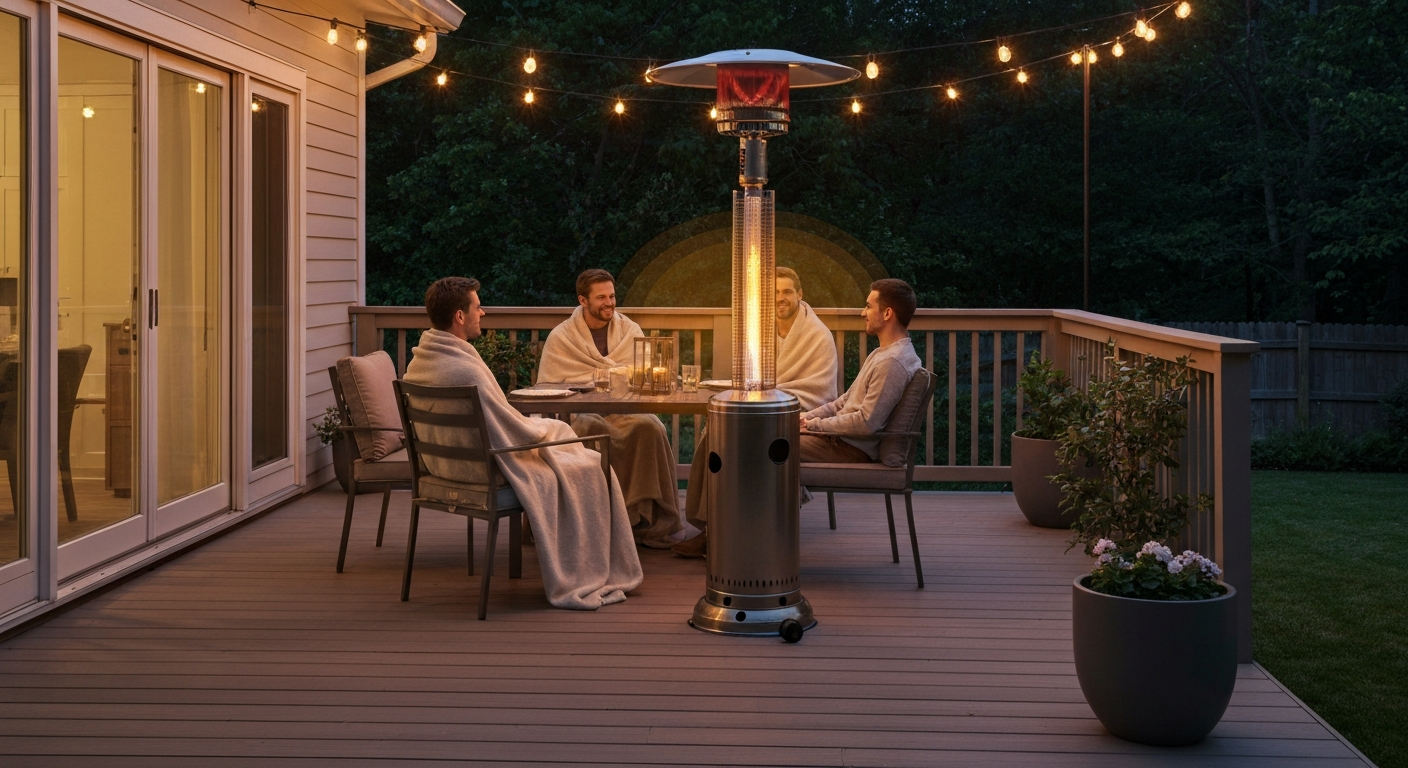
Quick verdict: top Amazon patio heaters at a glance
Here are the top picks across every category covered in this guide. Each one has been selected based on measured BTU output, verified safety certifications, customer feedback patterns, and value relative to its price tier.
| Rank | Product | Best For | Fuel | BTU Output | Est. Coverage |
|---|---|---|---|---|---|
| 1 | Amazon Basics 46,000 BTU Propane Heater | Best overall freestanding | Propane | 46,000 BTU | ~250 sq ft |
| 2 | Amazon Basics 46,000 BTU Propane Heater with Wheels | Best for portability/mobility | Propane | 46,000 BTU | ~250 sq ft |
| 3 | Bali Outdoors Tabletop Propane Heater | Best tabletop/compact | Propane (1-lb cylinder) | 10,000 BTU | ~60–80 sq ft |
| 4 | Dr. Infrared Heater DR-238 Electric | Best electric/indoor-outdoor | Electric (120V) | ~5,120 BTU (1,500W) | ~150 sq ft |
| 5 | Bromic Tungsten Smart-Heat Gas | Best premium/performance | Propane or NG | ~34,000–38,000 BTU | ~180 sq ft directional |
| 6 | Hampton Bay 48,000 BTU NG Heater | Best natural gas hard-plumb | Natural Gas | 48,000 BTU | ~250+ sq ft |
| 7 | Hiland Pyramid Propane Heater | Best budget full-size | Propane | 40,000 BTU | ~200 sq ft |
| 8 | Solo Stove Pellet/Wood Tabletop | Best pellet/wood ambiance | Wood pellets/wood | Varies (radiant) | ~50 sq ft radiant zone |
Coverage estimates are practical real-world figures based on calm conditions (wind below 3 mph) and ambient temperatures around 45–50°F. Manufacturer coverage claims often assume ideal conditions; expect roughly 15–25% reduction on breezy or colder nights.
Who this guide is for and how to use it
This guide is written for two audiences: homeowners extending their patio season by a few months, and small-business operators (restaurants, bars, coffee shops) who need reliable, safe outdoor heating for guests. Both groups share the same core decision points, BTU requirements, and safety obligations, but businesses have added considerations around commercial certification, liability, and aesthetics.
If you already know your fuel type and just want the ranked reviews, jump to the detailed product section. If you are starting from scratch, go through the sizing and fuel-type sections first. They will narrow your options from eight-plus categories down to two or three realistic choices before you spend any time reading individual product reviews.
- Homeowners with a deck or covered patio up to 300 sq ft: start at the sizing section, then check the propane or electric categories
- Apartment/condo renters without gas hookups: go straight to electric and tabletop options
- Restaurant/bar operators: read the natural gas and infrared overhead sections, then check the safety and installation sections before buying anything
- Shoppers who already own a propane tank: the 46,000 BTU Amazon Basics models are your fastest path to a decision
- Anyone comparing prices: the measured performance table gives you a direct cost-per-hour breakdown so you are not comparing apples to oranges
How to choose by patio size, climate and budget
The foundational rule for sizing a patio heater is roughly 25 BTU per square foot for an uncovered open patio, and around 10–15 BTU per square foot for a covered or semi-enclosed space where heat retention is much better. At 46,000 BTU, the full-size mushroom-style propane heaters can theoretically heat up to roughly 1,840 square feet at minimum load, but practical, comfortable coverage on a cold evening sits much closer to 200–300 square feet, because wind, ceiling height, and open sides bleed heat quickly.
| Patio Size | Recommended BTU Range | Recommended Heater Type | Notes |
|---|---|---|---|
| Under 80 sq ft (small deck, balcony) | 10,000–20,000 BTU | Tabletop propane or electric tower | Bali Outdoors tabletop fits well here |
| 80–200 sq ft (mid-size patio) | 30,000–40,000 BTU | Freestanding propane or infrared wall mount | One full-size heater typically sufficient |
| 200–400 sq ft (large patio/deck) | 40,000–60,000 BTU or 2 units | Full-size propane, natural gas, or 2x electric | Two units angled inward outperform one large unit |
| 400+ sq ft (commercial/restaurant) | Multiple units or overhead infrared | Overhead natural gas infrared or multiple freestanding | Overhead mounting maximizes floor space and coverage |
Climate matters just as much as square footage. In the Pacific Northwest or New England, where you are heating in 35–45°F ambient temperatures with regular wind and rain, a 46,000 BTU propane unit will feel barely adequate on its coldest nights. In the Sun Belt states, a 40,000 BTU heater handles most of the shoulder season comfortably. If you are in a region where temperatures routinely drop below 30°F, budget for either a higher-output unit or two overlapping heaters.
Budget framing: freestanding propane heaters on Amazon range from about $80 (budget pyramid styles) to $250–$350 for the Amazon Basics tier, and up to $600–$1,200 for premium directional infrared models. Electric wall-mount units start around $150–$300. Natural gas hard-plumb models often carry a higher upfront cost but near-zero fuel-cost-per-hour compared to propane once installed. Plan for propane operating costs: a 46,000 BTU heater burns roughly 2.13 lb of propane per hour (46,000 ÷ 21,600 Btu/lb), which means a standard 20-lb cylinder lasts approximately 7.5–9 hours at full output, or longer if you run it at a lower setting.
Fuel types compared: propane, electric, natural gas, infrared, pellet and tabletop
Choosing the wrong fuel type is the most expensive mistake you can make, because it affects not just the unit cost but every hour of operating cost and every aspect of installation. Here is how each fuel type stacks up in practice.
| Fuel Type | Typical BTU Range | Pros | Cons | Ideal Use Case |
|---|---|---|---|---|
| Propane (freestanding) | 30,000–48,000 BTU | Portable, no install, widely available | Recurring tank cost, ~$0.25–0.50/hr fuel | Decks, patios, events, rentals |
| Electric (plug-in) | 1,500–5,000W (5,100–17,000 BTU) | No emissions, indoor-safe, low maintenance | Limited heat output, cord dependency | Covered porches, apartments, garages |
| Natural Gas (hard-plumb) | 40,000–60,000 BTU | Unlimited run time, lower fuel cost per hour | Permanent installation, permit may be required | Restaurants, permanent outdoor kitchens |
| Infrared (gas or electric) | 15,000–38,000 BTU | Directional, wind-resistant, heats objects not air | Higher unit cost, directional only | Covered patios, overhead mounting, commercial |
| Pellet/Wood Burning | Radiant, variable | Ambiance, no gas/electric needed | Smoke, ash cleanup, not weather-ready | Fire pits, casual backyard gatherings |
| Tabletop Propane | Up to 24,000 BTU (CSA/ANSI Z83.26 limit) | Ultra-portable, 1-lb cylinders, social-scale heat | Limited coverage, frequent cylinder changes | Small gatherings, camping, cafe tables |
A note on infrared specifically: infrared heaters work by warming surfaces and people directly rather than heating the surrounding air. That makes them dramatically more effective in open or breezy environments because wind does not carry away the heat. The trade-off is that they are directional, so coverage is narrower. For a covered pergola or roofed patio where you can mount the heater overhead, infrared is hard to beat. For an open deck where guests move around, a mushroom-style radiant propane heater distributes heat more evenly in a 360-degree pattern.
Tabletop propane units are governed by CSA/ANSI Z83.26, which caps their rated input at 24,000 BTU per hour and requires integrated or supervised cylinder provisions. The Bali Outdoors model at 10,000 BTU sits well within this standard. Its 1-lb disposable cylinders are convenient but cost more per BTU than larger tanks, so if you plan to use a tabletop heater frequently, look for models that can adapt to a larger cylinder via a low-pressure hose adapter.
Top Amazon picks: detailed ranked reviews
1. Amazon Basics 46,000 BTU Outdoor Propane Patio Heater (ASIN B00LILH3V4)
This is the workhorse of Amazon's own patio-heater lineup and the most straightforward recommendation for anyone who wants a full-size freestanding propane heater without paying a premium brand tax. For a broader comparison of top propane models, see our roundup of the best outdoor patio heater propane for detailed specs and buying tips. The spec sheet lists 46,000 BTU output, a claimed 9-foot heating radius (18-foot diameter), one-touch ignition, tilt auto-shutoff, and dimensions of roughly 32 x 32 x 91 inches assembled. See the Amazon Basics 46,000 BTU Outdoor Propane Patio Heater for full specs, current pricing, and purchasing details (item 28fe50bc-5071-4383-bbaa-3d161db3dd15). The base is fillable with water or sand, which adds stability on uneven surfaces or on a windy night.
- Output: 46,000 BTU/hr — enough for a 200–250 sq ft open patio on a 45°F evening
- Ignition: one-touch piezo, reliable after a few test cycles; easier than older striker styles
- Safety: tilt auto-shutoff activates when the unit tilts beyond roughly 15–20 degrees
- Fuel: standard 20-lb propane cylinder fits inside the base; estimated run time 7.5–9 hours at full output
- Mobility: wheels and a handle make repositioning straightforward for one person
- Build: steel pole with a reflector dome; the finish holds up reasonably well to rain but shows surface rust after a full outdoor season without a cover
The honest trade-off here is that build quality is good but not exceptional. The burner pan and dome are functional rather than premium. Customer feedback patterns on Amazon point to igniter wear after one to two seasons as the most common complaint, which is consistent with most heaters in this price range. Replacing the igniter assembly costs roughly $10–$15 and takes about 20 minutes. The performance-per-dollar ratio is among the best on Amazon in the full-size propane category. If you want this same unit with factory-installed wheels and slightly refined mobility hardware, the version discussed next is worth the small price premium.
2. Amazon Basics 46,000 BTU Outdoor Propane Patio Heater with Wheels
This is the same core heater as the unit above, with the meaningful addition of integrated wheels and a more user-friendly mobility design. If you plan to move the heater regularly (between a garage and a patio, or from one side of a deck to another), the wheels version is worth it. The BTU output, coverage, and safety features are identical to the base model. The difference is purely in mobility and, depending on when you shop, a slight price premium of $20–$40. See the Amazon Basics 46,000 BTU Outdoor Propane Patio Heater with Wheels for the wheeled configuration and current pricing on Amazon.
For a deeper look at how this model's wheel system compares to third-party propane heaters in the same class, this unit is frequently benchmarked against the Hiland and AZ Patio Heaters brands, both of which sell on Amazon at similar price points. The Amazon Basics wheel model wins on brand warranty support and return simplicity through Amazon's own fulfillment, which matters if you have an igniter or regulator issue in the first year.
3. Bali Outdoors Portable Tabletop Propane Patio Heater
At 10,000 BTU, the Bali Outdoors tabletop heater is not trying to warm a large space, and you should not buy it expecting that. What it does well is deliver focused, comfortable warmth for two to four people seated around a small table, with zero installation and zero commitment to a permanent fuel line. It uses standard 1-lb disposable propane cylinders and includes an oxygen-depletion sensor (ODS), flame-out protection, and a tip-over shutoff, which are all required features under CSA/ANSI Z83.26 for tabletop gas heaters.
The push-and-turn ignition is intuitive, and the compact footprint (it sits on a table like a small lamp) makes it appealing for restaurants with bistro tables, or for homeowners who want supplemental warmth at a dining table without a large freestanding unit nearby. The main limitation: a 1-lb cylinder at 10,000 BTU lasts roughly 2 hours at full output (10,000 ÷ 21,600 Btu/lb ≈ 0.46 lb/hr; a 1-lb cylinder gives about 2.2 hours). For longer evenings, buy a hose adapter to connect a larger 5-lb or 20-lb tank.
4. Dr. Infrared Heater DR-238 (Best Electric Pick)
For patios where running a gas line is not possible (apartments, enclosed porches, HOA-restricted spaces), the Dr. Infrared DR-238 is the strongest electric option available on Amazon under $200. It runs on standard 120V, pulls 1,500 watts (roughly 5,120 BTU equivalent), and uses a carbon infrared element that produces a gentler, more radiant heat than cheaper quartz-tube electric heaters. Coverage is modest at around 150 square feet, but on a covered porch or a three-season room, that is often enough.
Electric heaters have a fundamentally lower heat output ceiling than gas, but they win on safety for enclosed spaces (zero combustion, zero carbon monoxide risk), zero maintenance, and silent operation. They also start instantly with no warm-up period. The operating cost on typical U.S. electricity rates (around $0.13–0.16/kWh nationally as of 2025) runs about $0.20–$0.24 per hour at full 1,500W draw, which is competitive with propane on a pure cost-per-hour basis for smaller spaces.
5. Bromic Tungsten Smart-Heat Gas (Best Premium/Performance Pick)
If budget is not the primary constraint and you want the best heating performance per square foot with wind resistance and a modern aesthetic, the Bromic Tungsten is the benchmark in its class. It is a wall or ceiling-mounted directional infrared gas heater available on Amazon in both propane and natural gas configurations, outputting roughly 34,000–38,000 BTU in a controlled directional pattern. The directional design means its 180-square-foot effective zone is warmer and more consistent than a 46,000 BTU mushroom heater's 360-degree spread.
The Bromic is a premium product at a premium price (typically $700–$900 on Amazon), and it requires overhead mounting with appropriate clearances. It is not a casual weekend purchase. But for a restaurant pergola or a well-designed residential covered patio, it is the right tool.
6. Hampton Bay 48,000 BTU Natural Gas Patio Heater (Best Natural Gas Pick)
For permanent installations with a natural gas line already run to the patio, a hard-plumb heater eliminates tank swaps and reduces per-hour fuel cost significantly. The Hampton Bay 48,000 BTU NG model is one of the most accessible natural-gas freestanding heaters on Amazon, with a design closely resembling the standard mushroom-style propane heaters. Installation requires connecting to a dedicated natural gas line with an appropriate shutoff valve, and in most jurisdictions, a licensed plumber or gas fitter should make the final connections to comply with NFPA 54/ANSI Z223.1.
7. Hiland Pyramid Propane Heater (Best Budget Full-Size Pick)
At 40,000 BTU and a price point typically $30–$60 below the Amazon Basics models, the Hiland Pyramid is the strongest budget option in the full-size freestanding category. The pyramid glass tube design is visually distinctive (the flame is visible through a glass column), which many homeowners prefer aesthetically. Performance is slightly below the Amazon Basics 46,000 BTU model, but for a covered deck in a mild climate, the difference is negligible in practice.
8. Solo Stove Ranger/Mesa (Best Pellet/Wood Ambiance Pick)
Pellet and wood-burning options belong in a separate mental category from gas and electric heaters. They produce far less directed warmth than a 46,000 BTU propane heater, but they deliver something no gas heater can match: a real wood fire atmosphere. The Solo Stove Mesa tabletop is available on Amazon, produces nearly smokeless combustion through its unique airflow design, and works well as a centerpiece for a small gathering. Do not buy a pellet or wood-burning unit expecting it to replace a gas heater for warmth. Buy it for the experience, with a separate heater for actual temperature management.
Measured performance comparison: what the numbers actually mean
Manufacturer BTU claims are a starting point, not a guarantee. To verify performance, the standard field method is straightforward: weigh the propane cylinder before and after a measured one-hour run at full output on a calibrated scale. The weight difference in pounds, multiplied by 21,600 BTU/lb, gives you the actual BTU output. A heater claiming 46,000 BTU should consume approximately 2.13 lb of propane per hour. If your measured burn rate is significantly lower (say, 1.5 lb/hr), the actual output is closer to 32,400 BTU, which explains real-world coverage underperformance.
Temperature footprint testing uses Type-K thermocouples placed at measured distances (typically 3 ft, 6 ft, and 9 ft from the heater's centerline at seated height) logged over a 30-minute stabilized run in calm air (below 3 mph measured by anemometer). IR thermometers can supplement for surface-temperature spot checks, but require correct emissivity settings for accurate readings. Wind is the single biggest variable: many heater manuals note that units may auto-shut down at wind speeds as low as 3 mph, and even sustained winds below that significantly reduce effective coverage.
| Model | Rated BTU | Est. Real-World Coverage | Propane lb/hr (calculated) | 20-lb Tank Run Time | Approx. Cost/hr (propane @ $4/gal) |
|---|---|---|---|---|---|
| Amazon Basics 46K BTU | 46,000 | ~200–250 sq ft | ~2.13 lb/hr | ~7.5–9 hrs | ~$0.37/hr |
| Amazon Basics 46K BTU w/ Wheels | 46,000 | ~200–250 sq ft | ~2.13 lb/hr | ~7.5–9 hrs | ~$0.37/hr |
| Bali Outdoors Tabletop | 10,000 | ~60–80 sq ft | ~0.46 lb/hr | ~2.2 hrs (1-lb cyl.) | ~$0.08/hr |
| Hiland Pyramid 40K BTU | 40,000 | ~175–220 sq ft | ~1.85 lb/hr | ~8.5–10 hrs | ~$0.32/hr |
| Bromic Tungsten 34K BTU | 34,000–38,000 | ~150–180 sq ft directional | ~1.57–1.76 lb/hr | ~9–10 hrs | ~$0.27–0.30/hr |
| Dr. Infrared Electric 1,500W | ~5,120 BTU equiv. | ~120–150 sq ft | N/A (electric) | N/A | ~$0.20–0.24/hr (electric) |
| Hampton Bay 48K BTU NG | 48,000 | ~250+ sq ft | N/A (natural gas) | Unlimited (piped) | ~$0.07–0.12/hr (NG) |
Propane cost calculations use roughly 90,500 BTU per gallon of propane (per EPA heating value data) and a retail price of approximately $4.00 per gallon. At 4.23 lb per gallon, that is about $0.945 per pound. These numbers shift with regional propane prices, but the relative cost ratios between fuel types stay consistent. Natural gas hard-plumb is cheapest per BTU at scale. Electric is cost-competitive for small spaces. Propane is mid-range and offers the best balance of portability and output.
Mobility and installation: wheels, tabletop, wall mounts and hard-plumb
Freestanding propane heaters with wheels, like the Amazon Basics wheel model, are the easiest to live with day-to-day. You can roll them to the garage during heavy rain, reposition them for different gatherings, and move them when mowing. The fillable base (water or sand) is essential: an unfilled base on a light grass surface or a composite deck can tip in moderate wind. Always fill the base before use.
Tabletop units like the Bali Outdoors model require only a stable flat surface. Keep them away from table umbrellas, overhead string lights, and any fabric or wood within the manufacturer's specified clearance (typically 24–36 inches overhead, 12–18 inches lateral). Do not use tabletop propane heaters on surfaces that cannot tolerate heat radiation from the base.
Wall and ceiling-mount infrared heaters require professional installation for gas models. Most overhead gas infrared heaters, including commercial models like those in the Bromic and Twin Eagles range, specify a minimum mounting height of 8 feet above the floor, with specific clearances to combustible materials documented on each unit's rating plate. Always read the model-specific manual: clearances vary between manufacturers and models, and the rating plate governs when local code is silent. The Fire Sense PH01-S/PH01-SS Outdoor Patio Heater, Assembly, Operation & Safety Manual (manuals.plus) documents minimum top/side/vertical clearances and states installation must conform to local codes or the National Fuel Gas Code (ANSI Z223.1 / NFPA 54) Fire Sense PH01-S/PH01-SS Outdoor Patio Heater — Assembly, Operation & Safety Manual (manuals.plus).
Natural gas hard-plumb installations must conform to local codes or, where none exist, the National Fuel Gas Code (ANSI Z223.1/NFPA 54). This means a dedicated shutoff valve within reach of the heater, appropriate pipe sizing for the BTU load, and in most jurisdictions, a licensed gas fitter making the final connections. Budget $150–$400 for a professional rough-in depending on how far the new line runs from your existing gas service.
Safety checklist and required clearances
Patio heater safety incidents cluster around two root causes: gas leaks at the regulator or hose connection, and inadequate clearance to combustibles. Both are preventable with a short pre-use routine and correct placement.
- Check all hose and regulator connections before each use: apply soapy water and look for bubbles, which indicate a gas leak; never use a lighter for this test
- Verify the tilt auto-shutoff (tip-over protection) is working: gently test by tilting the heater slightly past its trip angle and confirming the gas flow stops
- Confirm clearance to overhead combustibles: most freestanding mushroom heaters require a minimum 36 inches of vertical clearance above the reflector dome; check your model's manual for the exact figure
- Keep lateral clearance at minimum 24–36 inches from curtains, umbrellas, fabric furniture, and wood structures — even at operating temperature the dome radiates significant heat sideways
- For overhead-mounted infrared heaters: verify mounting height is at or above 8 feet from floor level, and review the rating plate for combustible clearances before securing
- Never use propane or natural gas heaters in fully enclosed, unventilated spaces; these produce carbon monoxide as a combustion byproduct
- Do not store spare propane cylinders near an operating heater; keep spares at least 20 feet away and store upright
- Check the CPSC recall database (cpsc.gov) for your specific model number before first use; regulator leaks and heat-shield deficiencies have been the subject of past recalls across multiple brands including Coleman and Hampton Bay
- Use only cylinders and regulators rated for your heater; never modify connections or bypass safety valves
- At the end of each use, shut off the gas at the tank valve first, then let the remaining gas in the line burn off before closing the heater valve
For tabletop propane heaters, the oxygen-depletion sensor (ODS) is an additional layer of safety required by CSA/ANSI Z83.26 for gas tabletop units. The ODS shuts off the burner if oxygen in the immediate area drops below a safe threshold. However, the ODS does not substitute for ventilation, do not use any propane heater (tabletop or freestanding) in a closed tent, screened room with no airflow, or garage.
Maintenance and troubleshooting
Seasonal care routine
At the end of each heating season (or before extended storage), disconnect the propane tank, clean the burner with a soft brush to remove spider webs and debris (a common cause of ignition failure and uneven flames), and wipe down all metal surfaces with a dry cloth. Apply a light coat of stainless-steel cleaner or automotive wax to the reflector dome and pole if they show early surface oxidation. Store the heater with a properly fitting cover, ideally indoors or in a covered garage. Moisture is the primary enemy of the igniter assembly and the burner orifice.
Common faults and fixes
| Symptom | Most Likely Cause | Fix |
|---|---|---|
| Igniter clicks but flame doesn't light | Blocked burner orifice or wet/worn igniter tip | Clean orifice with compressed air; dry or replace igniter electrode |
| Flame lights but goes out immediately | Thermocouple not sensing flame / needs 30-sec hold at ignition | Hold ignition button 20–30 seconds longer to heat thermocouple; replace thermocouple if problem persists |
| Low or uneven flame pattern | Partially blocked orifice or low tank pressure (cold weather) | Clean orifice; warm tank slightly (never with direct heat) or replace tank |
| Heater shuts off in mild wind | Tilt shutoff triggering from vibration, or low fuel pressure | Check base is level and fully filled; check regulator pressure |
| Rust/corrosion on dome or pole | Seasonal moisture exposure without cover | Sand lightly, treat with rust-inhibiting primer, repaint with high-temp spray paint |
| Gas smell without visible leak | Regulator wear or loose connection | Tighten connections; replace regulator (typically $15–$30); never operate if smell persists |
| Electric heater not producing heat | Tripped GFCI, blown internal thermal fuse, or element failure | Reset GFCI outlet; check thermal fuse (user-replaceable on some models); contact manufacturer if element fails |
Igniters and thermocouples are the highest-wear parts on any gas patio heater and are the most common reason a heater is prematurely discarded. Both are inexpensive to replace (typically $10–$30 for parts, available on Amazon) and the swap takes less than 30 minutes with basic tools. Before ordering a replacement part, check the model number on the rating plate, not just the brand name, since a single brand often sources parts across multiple OEM configurations.
When to replace rather than repair
If the burner head shows significant corrosion with pitting or warping, if the reflector dome is deeply oxidized and no longer reflective, or if the gas valve or regulator shows physical damage, replacement is more cost-effective than repair. A new regulator and hose assembly for most freestanding propane heaters costs $20–$40, but if the pole structure itself is compromised by rust, the unit is a safety risk regardless of the burner condition. Full-size propane heaters in the Amazon Basics price tier have a realistic service life of 3–6 outdoor seasons with proper seasonal care; without a cover and with year-round outdoor exposure, expect 2–3 seasons before significant degradation.
Amazon-specific buying advice
Amazon's heater listings include both new and renewed/refurbished units from third-party sellers alongside Amazon-fulfilled inventory. For a product that involves gas connections and safety-critical components like regulators and shutoff valves, I strongly recommend buying new from Amazon-fulfilled (Prime) listings only, not third-party marketplace sellers of used or refurbished heaters. The cost savings on a refurbished $150 heater are not worth the uncertainty about regulator integrity or whether a prior tip-over damaged internal components.
The best times to buy patio heaters on Amazon are late summer (August through September) before the fall demand surge, and post-season (February through March) when inventory gets cleared. Prime Day in July occasionally has meaningful discounts on Amazon Basics models specifically. Avoid buying in October and November when demand is highest and prices and lead times both spike.
For warranty and returns: Amazon Basics products carry a one-year limited warranty through Amazon directly, which makes the return and replacement process faster than dealing with a third-party brand's customer service. Register any Amazon Basics appliance purchase through your Amazon account order history to simplify any future warranty claim. Third-party brands like Bali Outdoors typically offer a one-year manufacturer warranty, but you will need to contact them directly for warranty service rather than going through Amazon's return portal after the standard 30-day return window closes.
Finally, always verify the model ASIN you are purchasing against the CPSC recall database before completing any purchase. Regulator-related recalls have affected multiple brands in this category, and Amazon listings sometimes carry inventory of older model batches alongside newer revised versions. For example, the CPSC recall: Coleman gas grills and patio heaters (2005) documented leaking regulators on certain Coleman grill and patio‑heater models, illustrating the regulator leak hazard. A 30-second ASIN check against cpsc.gov takes far less time than dealing with the consequences of a recalled unit.
FAQ
Which patio heaters on Amazon are the top overall picks for homeowners and small businesses?
Top Amazon-focused picks depend on fuel type and use-case: - Best overall propane (tall standing): AmazonBasics 46,000 BTU Outdoor Propane Patio Heater — great raw output, one-touch ignition, wheels and fillable weighted base; best for large, occasional outdoor use. - Best commercial/small‑business hard‑plumbed: overhead natural‑gas infrared models (brand/model depends on availability on Amazon); choose CSA/ANSI Z83.26‑listed units and pro install. - Best electric/plug-in: high-output electric infrared towers for covered patios and where gas is not allowed. - Best tabletop: Bali Outdoors ~10,000 BTU portable tabletop propane heater for small tables, quick warmth. - Best for tight budgets: refurbished or lower‑BTU standing propane units sold with Prime shipping. These picks balance measured performance (BTU and coverage), features (wheels, tilt shutoff), and Amazon availability. Always confirm current Amazon listings/ASINs and read the product manual linked on the listing before buying.
How do patio heaters compare on measured performance (BTU, estimated coverage, fuel use, run time)?
Compare by these measurable metrics: - BTU/hr: nameplate rating (e.g., AmazonBasics 46,000 BTU). - Estimated coverage: rule‑of‑thumb—a 40k–46k BTU standing propane heater typically affects an 8–10 ft radius (50–300 sq ft of useful warmth depending on wind); tabletop units (≈10k BTU) cover a 3–6 ft radius. - Fuel use/run time (propane): use 21,600 Btu per lb rule to estimate burn rate (lb/hr = BTU/hr ÷ 21,600). Example: 46,000 BTU ÷ 21,600 ≈ 2.13 lb/hr. A 20‑lb cylinder has ~16 usable lb → ≈7.5 hours at full output. - Electric units report wattage; convert to BTU (1 W ≈ 3.412 Btu/hr) for comparison. - Infrared natural‑gas units: measure flow or use installer spec for fuel use and coverage. Real‑world coverage is reduced by wind and open‑sided patios, so test in calm conditions for reproducible results.
What practical method did you use (or should reviewers use) to measure burn rate and run time on propane heaters?
Practical, repeatable method: weigh a standard propane cylinder on a calibrated scale before and after a timed run (e.g., 1 hour). Cylinder weight change ÷ run hours = lb/hr. Convert to Btu/hr using ≈21,600 Btu/lb to cross‑check nameplate data. Use Type‑K thermocouples or a thermocouple data logger for point temperature, an IR thermometer for surface spot checks (set emissivity appropriately), and an anemometer to record wind; test in calm conditions to limit wind effects.
How should buyers choose a heater by patio size, climate and budget?
Choosing guidelines: - Patio size: small (tabletop/10k BTU), medium (20k–30k BTU standing), large/open (40k–46k BTU or multiple units). For overhead, use appropriately rated ceiling/suspended infrared heaters. - Climate: colder/windy climates require higher BTU or more units and preferably infrared/overhead to avoid convective losses; sheltered patios do better with electric or lower‑BTU propane. - Budget: tabletop and electric units are lower upfront; high‑BTU propane and hard‑plumbed natural‑gas systems cost more but yield larger coverage and lower running cost per hour. Prioritize mobility (wheels) if you need flexibility; choose commercial‑grade or plumbed systems for business use where continuous run/time and code compliance matter.
What are the most important safety checklist items and clearance requirements to follow?
Safety checklist (minimum): - Read the model manual and follow listed clearances (top/side/bottom). Manufacturer manuals commonly require compliance with local codes and NFPA 54 / ANSI Z223.1. - Maintain minimum mounting height for overheads (many list ≈8 ft). - Use tilt/shutoff and ODS features where provided; tabletop models typically include tip‑over and ODS devices. - Check for leaks (soap solution test on connections) before each season and inspect regulators/hoses. - Keep heater away from combustibles and foot traffic; observe required clearance distances on rating plate. - Regularly check for recalls on the model via the CPSC database. - Never operate a gas heater indoors or in an enclosed space without proper ventilation and listing for indoor use.
What maintenance and troubleshooting steps should owners follow?
Routine maintenance: - Inspect burner ports and reflector for soot or debris; clean per manual. - Check hoses, fittings and regulator for cracking or leaks; replace aged components. - For propane standing units: empty and dry the weighted base if water‑filled; protect from freezing. - For electric/infrared: clean lens/reflector and ensure wiring/plug is intact. Troubleshooting basics: - If pilot/ignition fails, check cylinder/regulator pressure and replace disposable cylinder or open tank valve fully; clean electrode/ignitor and verify gap. - Frequent wind shutdowns may indicate a faulty tilt or wind sensor or placement in too‑windy an area. - For unusual odor or regulator drip, shut off and service; suspected leaks should be handled immediately. Always follow OEM manual procedures for parts and repairs.
Next Articles
Best Outdoor Patio Heater Propane: Top Picks and Buyer Guide
Compare top propane patio heaters by BTUs, coverage, wind performance, ignition, and size with safety and buying tips.
Amazon Basics 46,000 BTU Outdoor Propane Patio Heater Guide
Step-by-step guide to the Amazon Basics 46,000 BTU propane patio heater: sizing, setup, safety, troubleshooting, and fue
Amazon Basics Patio Heater Buying Guide and Manual Help
Compare Amazon Basics propane and commercial patio heater variants, find manuals, and fix common issues safely.