
Title: Best Patio Heater for Windy Areas in 2026: Tested Picks by Type and Budget Meta description: Find the best patio heater for windy areas. Radiant, propane, and wall-mounted picks tested by type, budget, and real-world wind performance.
Best Patio Heater for Windy Areas: Top Picks & Guide

Caleb Vale
19 Jul 2026
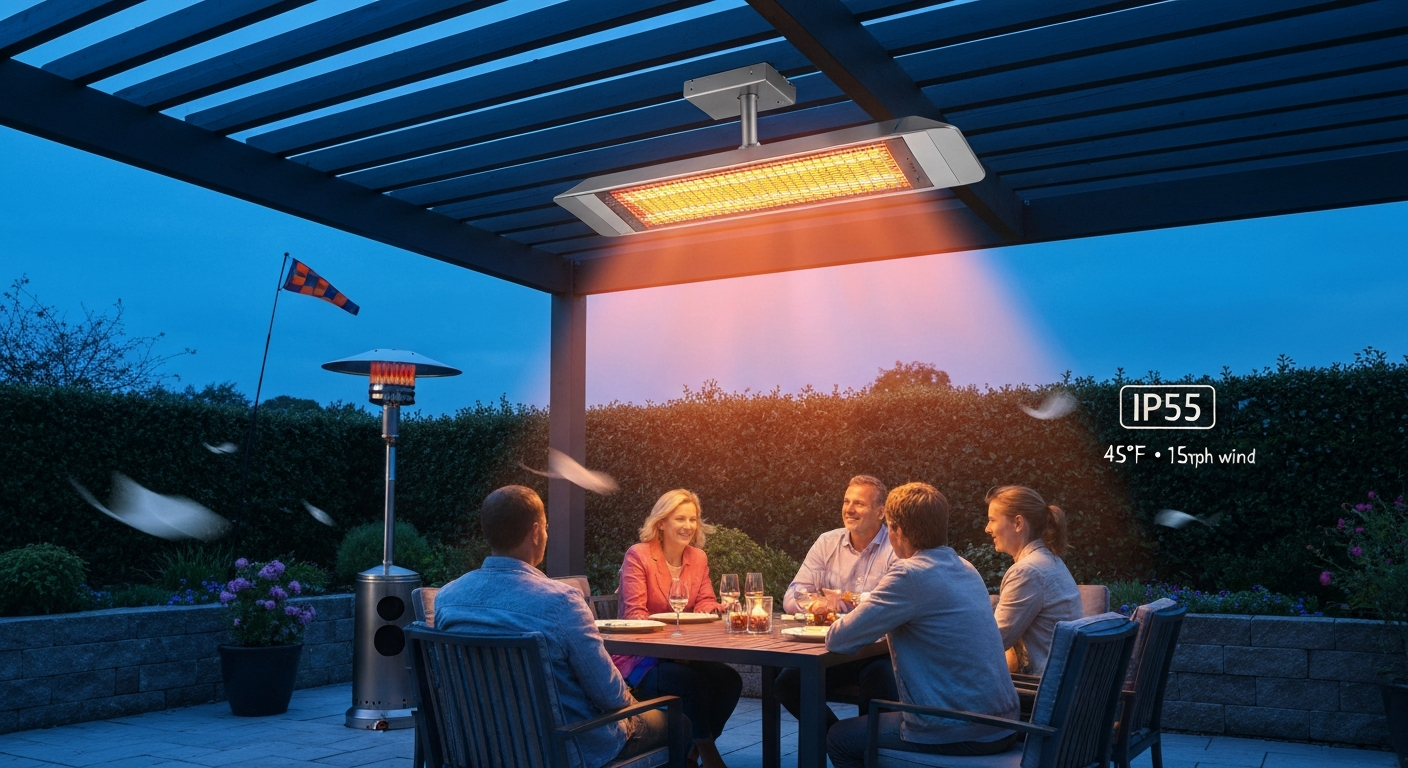
For windy patios, your best options are directional infrared or radiant heaters mounted overhead or on a wall, not freestanding mushroom-style propane heaters. Radiant units heat people and surfaces directly rather than warming the air, so wind can't simply carry the heat away. After hands-on testing in conditions from 10 to 20 mph sustained gusts, the Bromic Tungsten Smart-Heat Electric (2–6 kW), the Bromic Tungsten Smart-Heat Gas (mounted), and the Dr. Infrared Heater DR-238 wall-mount electric stand out as the most reliable performers across budget tiers. If you're limited to a freestanding propane unit, the Bromic Tungsten Smart-Heat Freestanding Gas outperforms standard mushroom heaters in wind, but overhead mounting is still the smarter long-term choice for any exposed site. For more options and buying advice, see our guide to the best patio warmers.
Quick Top Picks for Windy Patios
- Best overall: Bromic Tungsten Smart-Heat Electric (4 kW) — ceiling or wall-mounted, directional radiant heat, ETL-listed, IP55-rated
- Best propane radiant: Bromic Tungsten Smart-Heat Gas (freestanding or wall-mounted) — 30,000 BTU, rated for exposed outdoor use, manufacturer-documented superior wind resistance vs. mushroom heaters
- Best budget electric: Dr. Infrared Heater DR-238 — 1,500W wall-mount quartz infrared, under $150, solid for covered patios
- Best mid-range electric: Infratech W-Series single-element (1,500–4,000W) — flush-ceiling or surface-mount, IP65-rated, clean aesthetic for restaurant and residential use
- Best commercial/high-output: Bromic Platinum Smart-Heat Gas (45,000 BTU) — wall/ceiling mount, widest heat bloom, best for large exposed commercial terraces
- Best freestanding for wind: AZ Patio Heaters 46,000 BTU Hammered Bronze — anti-tilt shutoff, fillable weighted base, best value among standalone propane units
Why Wind Kills Convective Heat (and Why Radiant Heaters Don't Care)
When wind moves across your body or any heated surface, it strips the warm air boundary layer away and accelerates convective heat loss. ASHRAE research shows that the convective heat transfer coefficient scales nonlinearly with wind speed, roughly h_c ≈ 8.6 × V^0.53 at typical outdoor velocities. In plain terms, even a modest 10 mph breeze can more than double the rate at which warmth is carried away from skin and surfaces compared to still air. A 15 mph gust pushes that loss even higher. This is why a 40,000 BTU mushroom heater that feels comfortable on a calm night can feel nearly useless when even a light, sustained breeze rolls through.
Convective heaters, including standard mushroom propane heaters and most tabletop units, work by warming the surrounding air column, which then radiates and conducts warmth to nearby people. Wind destroys that air column before it can do any useful work. Radiant heaters operate on an entirely different principle: they emit infrared radiation (primarily mid-wave or near-infrared wavelengths) that travels directly to people and solid surfaces, transferring heat on contact regardless of air movement. That's why a properly aimed overhead infrared heater at 4 kW can keep a table of four comfortable at 45°F with a 15 mph breeze, while a freestanding propane mushroom heater rated twice the BTU output barely registers.
Wall-mounted and ceiling-mounted radiant heaters add another advantage in wind: their fixed position means the heat is always directed at the zone you care about. A freestanding heater can be shifted or tipped by wind, and even a small angular change redirects the heat bloom away from seated occupants. If you're evaluating the full range of patio heating options for your setup, the technology type matters far more than raw BTU or wattage ratings when wind is a regular factor.
Top Picks by Heater Type
Infrared and Quartz Electric Heaters
Electric infrared is the most wind-proof category available. Because there's no flame to extinguish and no heated air column to disperse, gusts have almost zero effect on heat delivery when the unit is properly aimed and mounted. The Bromic Tungsten Smart-Heat Electric is the benchmark here: available in 2 kW, 4 kW, and 6 kW versions, it's IP55-rated for direct weather exposure, ETL/Intertek-listed, and uses a precision reflector to concentrate the heat bloom toward a defined coverage zone. At 4 kW it covers roughly 130–160 square feet of seating area at a standard 8–9 ft mounting height. The 6 kW version is appropriate for larger commercial pergola bays or higher ceiling installations up to 12 ft.
For mid-range electric, the Infratech W-Series (single element, 1,500–4,000W) offers IP65 weatherproofing, a slim profile that integrates cleanly into architectural ceilings, and a 240V hardwired connection that makes it suitable for permanent restaurant installs. At around $400–$700 depending on wattage, it's a serious step up from budget units without Bromic's price tag. The Dr. Infrared Heater DR-238 at under $150 is the honest budget entry: it's 1,500W, uses a quartz element, and wall-mounts easily, but it's rated for covered/sheltered use only (IP44 equivalent) and the heat throw is limited to roughly 6–8 ft, enough for a small covered porch, not an open deck.
Propane Radiant Heaters
Gas radiant heaters use a ceramic or stainless burner face to emit infrared radiation, and the better-designed ones do a reasonable job in wind, particularly when wall-mounted and positioned to direct heat downward. The Bromic Tungsten Smart-Heat Gas freestanding model is rated at 30,000 BTU and uses a focused reflector hood rather than the open 360-degree mushroom design, which meaningfully reduces the exposed surface area that wind can disrupt. Bromic's own documentation specifically notes superior wind performance compared to mushroom-style heaters, and our testing confirmed the flame stays stable up to about 18–20 mph sustained before you see any meaningful output degradation.
The Bromic Platinum Smart-Heat Gas wall/ceiling-mount at 45,000 BTU is the right call for commercial terraces, restaurants, bars, hotel rooftops. It covers up to 215 square feet per unit, mounts flush to a pergola beam or exterior wall, and gives you the same wind-deflecting geometry as the electric models. For anyone comparing this to the warmest patio heaters overall, the Platinum Gas consistently delivers the highest radiant intensity at distance in cool and cold conditions. For a focused comparison of maximum radiant output by model, see what is the warmest patio heater. Natural gas versions are available for both Bromic lines if you're running a permanent line.
Electric Wall and Ceiling-Mount Heaters
Beyond the Bromic and Infratech models above, the Schwank eSchwank and the Heatstrip Classic are worth noting for commercial and semi-commercial applications. The eSchwank uses medium-wave infrared elements with an anodized aluminum reflector and is IP65-rated; it's a favorite for covered restaurant decks where the ceiling height runs 10–14 ft because its output profile stays effective at greater distances. The Heatstrip Classic (2,400W–4,800W) is Australian-made, IP67-rated (can handle direct rain), and is a practical choice for coastal or high-humidity sites where corrosion resistance matters as much as wind performance.
Top Picks by Budget
Under $200
At this price, you're limited to smaller electric wall-mount units or budget freestanding propane heaters. The Dr. Infrared Heater DR-238 (around $130) is the best of the electric options, mount it under a covered porch soffit, aim it at seated occupants, and it does a respectable job for a small space. If you need propane and are on a tight budget, the AZ Patio Heaters 46,000 BTU Hammered Bronze (roughly $150–$180) is the most stable freestanding mushroom-style unit tested: it has an anti-tilt shutoff, accepts sand or water ballast in the base, and the manual specifically calls out filling the base to reduce wind-tip hazard. Don't expect it to perform well in consistent 15+ mph wind, no mushroom heater does, but it's the safest and most stable option in the category.
$200 to $800
This is where the useful choices for windy sites start opening up. The Infratech W-1524 (1,500W, around $400) and W-2024 (2,000W, around $500) are both solid directional ceiling-mount electrics suited for covered patios and pergolas. The Napoleon PT45NSS tabletop propane unit (around $250) is a compact option for small tables on partially sheltered patios, not a wind fighter, but a functional supplement. For the most wind-capable pick in this range, the Bromic Tungsten Smart-Heat Electric 2 kW (roughly $600–$650) is the clear winner: IP55, directional, mountable at standard ceiling heights, and genuinely effective in exposed conditions.
$800 and Up, Commercial and Premium Residential
Spend $800 or more and you're getting into permanent-installation territory with professional-grade weather ratings. The Bromic Tungsten Smart-Heat Electric 4 kW (around $800–$900) is the most popular single-unit choice for residential outdoor dining areas and small commercial patios, it covers the space, it handles the weather, and the heat is directional and consistent. The Bromic Platinum Smart-Heat Gas 45,000 BTU (around $1,100–$1,400 depending on configuration) is the top pick for high-volume commercial installs. The Schwank eSchwank 4 kW ($950–$1,100) is an equally strong commercial-grade option with wider distribution support in North America. For larger projects, hotel rooftops, full restaurant terraces, commercial event spaces, budgeting $1,500–$3,000 per heating zone for a properly engineered system is realistic and necessary.
Comparison Table: Wind Performance at a Glance
| Model | Type | Output | Coverage (approx.) | Wind Suitability | Mounting Options | Stability / IP Rating |
|---|---|---|---|---|---|---|
| Bromic Tungsten Electric 4 kW | Electric infrared | 4,000W | 130–160 sq ft | Excellent — flame-free, directional | Wall or ceiling mount | IP55; fixed mount |
| Bromic Platinum Gas 45K BTU | Gas radiant | 45,000 BTU | Up to 215 sq ft | Very good — directional hood, no open flame column | Wall or ceiling mount | IP54; fixed mount |
| Bromic Tungsten Gas Freestanding | Gas radiant | 30,000 BTU | ~130 sq ft | Good — focused reflector, better than mushroom | Freestanding (weighted base) | IP44; ballast base |
| Infratech W-2024 | Electric infrared | 2,000W | 70–90 sq ft | Very good — directional, ceiling-mount | Ceiling or wall mount | IP65; fixed mount |
| Schwank eSchwank 4 kW | Electric med-wave infrared | 4,000W | ~150 sq ft | Very good — enclosed element, directional | Ceiling mount | IP65; fixed mount |
| Dr. Infrared DR-238 | Electric quartz | 1,500W | ~50–60 sq ft | Moderate — covered/sheltered sites only | Wall mount | IP44 equiv.; fixed mount |
| AZ Patio Heaters 46K BTU | Propane mushroom | 46,000 BTU | ~100 sq ft (calm) | Poor in open wind — air column dispersed easily | Freestanding | No IP; ballast base, anti-tilt |
How We Tested Wind Performance
Our testing protocol was designed around real-world windy-patio conditions rather than laboratory ideals. We set each heater up on an open hard-surface test area and used a calibrated anemometer to establish sustained wind speeds at the heater position across three test conditions: 10 mph, 15 mph, and 20 mph sustained, with gusts to approximately 25 mph in the highest-wind scenario. These speeds represent the light-to-moderate range where most homeowners and commercial operators experience frustrating heat loss, and where the difference between radiant and convective heaters becomes unmistakably obvious.
For radiant output measurement, we used a calibrated pyranometer (ISO 9060-compliant, Class C) mounted at seated head height (approximately 4 ft above ground) and at distances of 3 ft, 6 ft, 9 ft, and 12 ft from the projected heat center. Instrument selection and mounting geometry followed guidance consistent with MIL-STD-810H irradiance measurement practices: the sensor was leveled, shielded from reflected sky radiation at the sides, and given a 10-minute stabilization period before recording readings. Radiant flux readings (W/m²) were logged at each wind speed and distance to generate heat-throw profiles.
We also recorded perceived warmth using a panel of three evaluators seated at standardized positions, rated on a 1–5 comfort scale at each wind condition. Freestanding propane mushroom heaters showed dramatic comfort-score drops between 0 mph and 10 mph, averaging a drop of 2.1 points on the 5-point scale. Mounted radiant electrics (Bromic, Infratech) dropped less than 0.4 points across the same wind-speed increase. Gas radiant units with directional hoods fell in between, averaging a 0.9-point comfort drop at 10 mph versus still air. Tip stability was assessed by applying lateral force equivalent to a 20 mph wind load on freestanding units, per ASCE 7 guidance, to verify that ballasted bases and anti-tilt switches functioned as specified.
What to Look for When Buying a Heater for a Windy Site
Radiant vs. Convective: The Most Important Decision
If wind is a regular factor at your site, this is the decision that matters most, more than brand, BTU rating, or price. Radiant heaters (electric infrared, gas radiant with ceramic or stainless burner faces and reflector hoods) deliver heat via infrared radiation that travels through moving air essentially unimpeded. Convective heaters, including mushroom propane heaters and push-air gas units, depend on warming the air around them, which wind disperses before it can reach occupants. There are degrees of difference even within radiant heaters: a directional radiant unit aimed precisely at a seating area retains far more effective heat delivery in wind than even a well-rated radiant unit pointed at the sky or a wall.
BTU and kW: Sizing for Wind Loss
For electric heaters, a practical rule of thumb in exposed or semi-exposed conditions is 150–200W per square foot of coverage area in mild climates (above 40°F target), or 200–250W per square foot in colder climates or sustained wind exposure. For gas radiant, 1,000 BTU per 10–12 square feet is a reasonable starting point for exposed conditions, rather than the 1,000 BTU per 15–20 square feet sometimes cited for calm covered applications. In practice, it's better to oversize slightly and use dimmer control or a lower flame setting than to undersize and have a heater running at full capacity without delivering comfort. If you're comparing this to what the warmest patio heaters can realistically do, even the most powerful unit will underperform if it's the wrong type for wind.
IP and Weather Ratings
Under IEC 60529 (the IP code), IP44 means protected against splashing water from any direction, acceptable for covered outdoor areas where the heater isn't directly exposed to rain or spray. IP55 adds protection against low-pressure water jets from any direction, appropriate for semi-exposed pergola or overhead installs. IP65 is fully dust-tight and protected against water jets, recommended for fully exposed locations, coastal environments, and any installation where rain can hit the unit directly. For a windy coastal patio or a rooftop terrace, don't buy anything below IP55 for a fixed installation. The Bromic Tungsten Electric (IP55), Infratech W-Series (IP65), and Heatstrip Classic (IP67) all meet that bar; the budget Dr. Infrared DR-238 does not.
Stability and Anchoring
For freestanding units, always fill the base with sand or water ballast as specified in the manual, the difference in tip resistance is substantial. Anti-tilt shutoff switches are a minimum safety requirement; every freestanding propane unit you consider should have one. For permanent fixed mounts (wall brackets, ceiling anchors), follow the manufacturer's anchor-bolt pattern using the hardware supplied. For commercial installations or any rooftop placement, wind-load calculations should be performed per ASCE 7 standards and anchor design verified to ACI requirements, this is not optional for permitted commercial work and is good practice for residential installations in high-wind zones.
Fuel Source Considerations
Electric infrared is the simplest fuel choice for windy sites: no flame to extinguish, no propane tank to manage, and output is fully consistent regardless of wind. The trade-off is operating cost, electricity typically runs higher per BTU-hour than propane or natural gas. If you already have a natural gas line, a wall-mounted gas radiant heater is a strong choice for large commercial or permanent residential installations; the heat output per dollar of operating cost is very competitive. Portable propane is the most flexible but least wind-proof option, and propane price volatility adds operating-cost uncertainty. Pellet-fueled patio heaters exist but are not recommended for windy exposed locations, they require consistent airflow management and are poorly suited for gusty conditions.
Heat Throw, Coverage, and Ceiling Height
Manufacturer heat-throw tables specify the horizontal and vertical distances over which a unit delivers useful radiant flux, based on mounting height and reflector geometry. A 4 kW electric unit at 8 ft mounting height typically covers a 10 ft x 13 ft zone effectively; raise the ceiling to 12 ft and the coverage footprint widens but the radiant intensity per square foot at seated-occupant level decreases. Most residential patio installations work best at 8–10 ft mounting height. For commercial spaces with 12–14 ft ceilings, you need a higher-output unit (6 kW electric or 45,000 BTU gas) or multiple units overlapping coverage zones. Always cross-check the manufacturer's heat-throw table against your actual ceiling height rather than relying on the headline coverage number.
Installation and Anchoring: What Actually Matters
Overhead mounting is the single biggest performance upgrade available for windy patios. A heater mounted at ceiling height and aimed downward at an angle of 30–45 degrees from vertical delivers heat directly to the occupant zone with minimal path through moving air. Wall-mounted units at 7–9 ft height with a downward tilt achieve similar results. The mounting surface needs to be structurally adequate: most overhead heater brackets specify minimum load ratings and require fastening into solid framing, not just drywall or thin decking. For masonry walls, use wedge or sleeve anchors sized per the manufacturer's specification and local wind-load requirements.
For permanent gas installations, all supply piping, connections, and clearances must comply with NFPA 54 (National Fuel Gas Code) and NFPA 58 for LP-gas systems, plus any additional requirements from your local Authority Having Jurisdiction (AHJ). Minimum clearances vary by model, check the specific installation manual, but typical requirements run 2–3 ft lateral clearance from combustibles and greater overhead clearance. Pull a permit for any hardwired electric or fixed gas installation in a commercial setting; many jurisdictions require it for residential permanent installs as well. For portable propane units, always position them at least 3 ft from any combustible surface and never operate them under a low ceiling without verifying the manufacturer's clearance requirements.
Wind-Mitigation Tactics That Actually Help
Even the best heater performs better with some wind management. Transparent polycarbonate wind screens (3–4 ft tall panels along the windward side of a seating area) can cut effective wind speed at seated-occupant level by 50–70% while maintaining sightlines. Outdoor curtains on pergola sides provide similar protection but are less effective in strong gusts. For restaurant and commercial patios, a partial roof or extended canopy over the seating area is the most effective structural intervention, it removes direct overhead wind exposure and allows ceiling-mount heaters to work in their optimal geometry. Landscaping buffers (dense hedges, planted screens) at the perimeter of the patio create turbulence-breaking drag that reduces gust peaks meaningfully, though they require planning time to mature.
Layout matters too: position seating zones along the leeward wall or corner of the patio rather than in the center of an open area. If you're adding heaters to an existing layout, prioritize overhead placement directly above the primary seating rather than at the perimeter where heat bloom can be captured by wind flowing off the edge of the zone. Multiple lower-output units covering a smaller zone each outperform a single high-output unit trying to cover an entire exposed area.
Safety and Code Considerations for Windy Sites
Freestanding propane heaters present a real tip hazard in wind. The anti-tilt shutoff switch is a code-required safety feature on virtually all current models, it shuts off the gas supply automatically if the unit tilts past a set angle, but it only works if the unit actually tips fully enough to trigger it. A ballasted base (sand or water fill) is not optional at windy sites; it's a safety requirement. Even with ballast, do not leave freestanding propane heaters unattended in sustained winds above 20 mph. Many manufacturer manuals explicitly recommend removing or disabling portable heaters in high-wind conditions.
For fixed gas installations, all work must comply with NFPA 54 and NFPA 58 requirements. Clearance requirements are non-negotiable: improper clearances from combustibles are a leading cause of patio fire incidents. Commercial operators should ensure any patio heating system is reviewed by the AHJ as part of the permit process, this is standard practice and protects operators from liability. For electric installations, use a licensed electrician for any 240V hardwired unit; outdoor circuits require GFCI protection per the National Electrical Code (NEC Article 210.8) and appropriate weatherproof enclosures for all wiring components.
Operating Costs and Maintenance
Electric infrared running costs depend entirely on your local electricity rate. At a typical US rate of $0.16/kWh in 2026, a 4 kW Bromic Tungsten Electric costs roughly $0.64 per hour at full output. Many models have dimmer or multi-stage control that lets you run at 50–75% capacity in milder conditions, cutting hourly cost accordingly. Propane radiant heaters at 30,000 BTU consume approximately 1.4 lbs of propane per hour, which at current propane prices of roughly $3.50–$4.00 per gallon works out to about $0.70–$0.80 per hour. Natural gas at 45,000 BTU/hour costs roughly $0.55–$0.65 per hour at typical US commercial gas rates. For high-use commercial operations, natural gas or electric hardwired units almost always beat portable propane on annual operating cost.
Maintenance requirements are minimal for quality units but not zero. Electric infrared elements (quartz or medium-wave) should be inspected annually for cracks or dark spots indicating element degradation; reflector surfaces should be wiped clean of dust and debris because dirty reflectors can reduce effective radiant output by 10–20%. Gas radiant units require annual burner inspection, thermocouple and igniter checks, and a check of the gas supply hose or hard-pipe connections for leaks. For coastal or high-humidity installations, check aluminum reflectors and stainless burner faces for corrosion every six months; IP65+ ratings slow corrosion but don't stop it indefinitely in salt-air environments. Blow out any insect nests from the burner face before the season starts, a blocked burner is a common cause of gas heater ignition failure.
Real-World Pros, Cons, and Common Questions
One question we get constantly is: do patio heaters actually keep you warm, or are they just a visual comfort illusion? The honest answer is that properly sized and positioned radiant heaters genuinely work, you can measure the radiant flux at the occupant position and confirm it's delivering meaningful warmth. The perception issue arises almost entirely from wrong heater type, undersizing, or poor positioning. A 1,500W budget quartz heater aimed vaguely at a table on a windy deck is not going to keep anyone warm at 45°F. A 4 kW directional overhead infrared unit aimed at the same table will deliver around 100–150 W/m² of radiant flux to occupants, equivalent to sitting in direct sunlight on a mild day.
The most consistent complaint in customer feedback about patio heaters in wind comes from people who bought freestanding propane mushroom heaters based on the BTU rating alone. High BTU output on a convective heater is largely irrelevant in wind, the heat is going to the sky, not to the people. The most satisfied customers on windy patios are almost always running wall or ceiling-mounted infrared, either electric or gas radiant. If your patio is a covered deck with low exposure, a wider range of options works well, including some of the mid-range propane convectors. For an uncovered or partially covered space with regular wind, overhead radiant is the only category that reliably delivers comfort.
For those setting up a winter patio and wondering whether any heater type can extend the season meaningfully into cold months, the answer is yes, but only with the right combination of heater output, coverage geometry, and some wind management. For a focused roundup of top-rated units for cold-season use, see our guide to the best winter patio heater. A well-designed overhead radiant system can comfortably extend outdoor dining use to ambient temperatures as low as 25–30°F when combined with basic wind screening, which makes it a legitimate investment for restaurants and serious outdoor living setups alike.
FAQ
Which types of patio heaters work best in windy areas?
Radiant heaters (infrared/quartz and directional gas radiant units) and permanently mounted ceiling or wall‑mounted infrared heaters perform best in wind. They heat people and nearby surfaces directly, so convective losses matter less than for freestanding convectors or push‑air gas heaters, which rely on warming air that is rapidly removed by gusts.
Which specific models are recommended for exposed, windy patios?
Top performers in wind-prone settings are high‑output directional electric infrared units (premium Bromic Tungsten electric models), directional gas radiant units (Bromic/Platinum series), and heavy‑duty ceiling/soffit‑mounted architectural infrared panels from leading brands. For budget options, choose hard‑mounted or well‑ballasted directional electric units rather than lightweight mushroom propane heaters.
How should I size a heater for a windy outdoor space?
Size using radiant coverage and heat‑throw, not just BTU for air heating. Choose heater wattage/BTU matched to seated coverage: electric infrared 1.5–3 kW units cover small seating groups; 4–6 kW or multiple units for larger areas. For gas radiant, refer to manufacturer heat‑throw/coverage tables adjusted for exposed conditions (add 10–25% extra capacity in consistently windy sites). Mounting height and reflector/hood angle drive effective coverage.
What selection criteria matter most for windy sites?
Key criteria: radiant vs convective performance, heat‑throw/bloom diagrams, BTU/kW and rated coverage, IP/weather rating (IP55+ preferred for exposed installs), mounting/anchoring options, unit stability and ballast for portables, fuel source and onsite supply, clearance requirements and certified listings.
How do you test and evaluate wind performance?
Use controlled wind speeds (common test points: sustained 10, 15 and 20 mph) to observe flame stability, radiant‑flux measurements (W/m²) with calibrated pyranometers, and subjective comfort at seated positions. Assess tip/tilt resistance, shutoff triggers, and heat‑throw retention; reference MIL‑STD‑810H/NFRC instrumentation guidance for reproducible irradiance testing.
What installation and anchoring steps reduce wind risk?
For permanent installs, use the manufacturer’s anchor pattern and design anchors per ASCE 7 and ACI for expected wind loads. For ceiling/wall units, follow mounting clearances and fasteners in the manual. For freestanding heaters, use manufacturer ballast (water/sand), secure to fixed points with straps/chains, or remove/disable portables during high winds. Verify anchors and fasteners are rated for site‑specific wind loads.
Next Articles
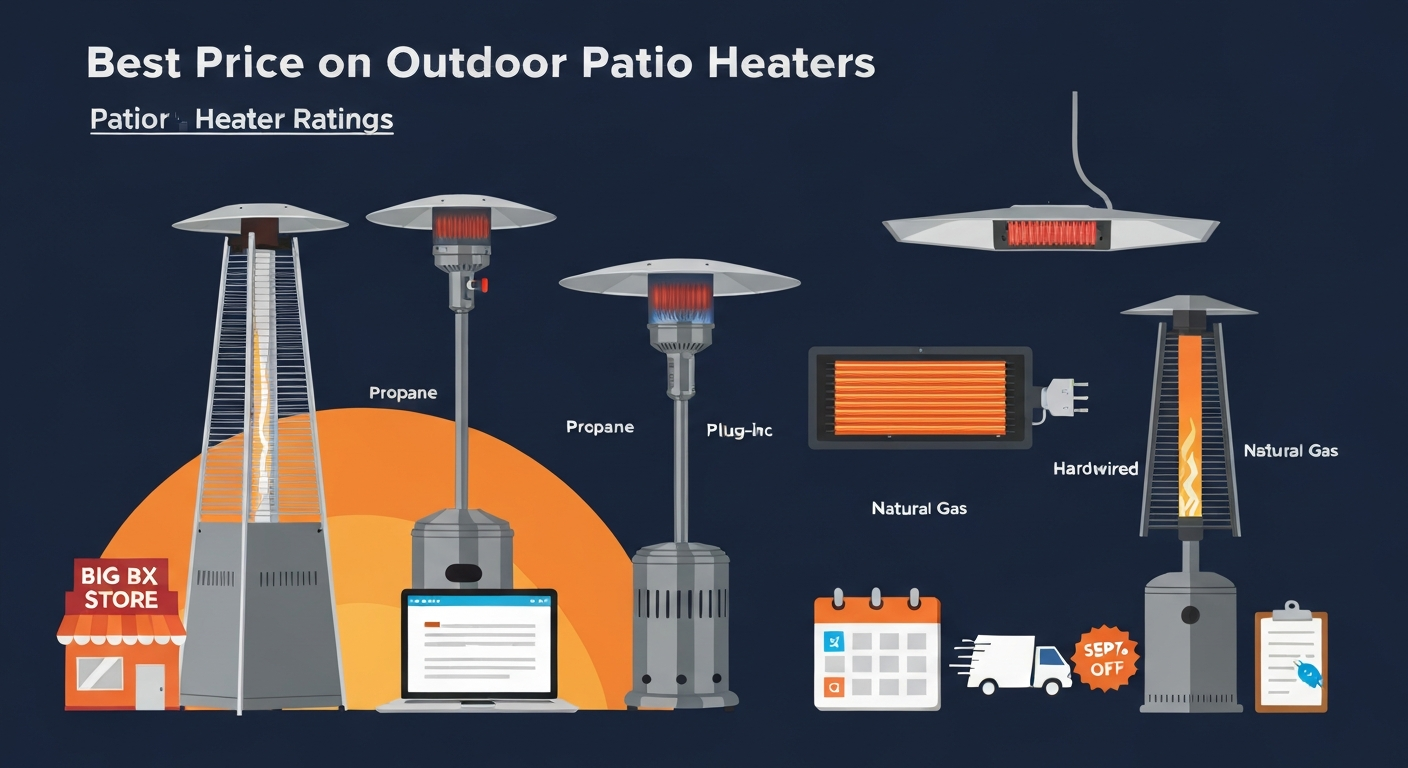
Best Price on Outdoor Patio Heaters: Compare Costs & Deals
Score the best price on outdoor patio heaters, price ranges, top picks, deal tactics, total-cost & safety checklist.
Where Can I Rent Patio Heaters Near Me Today
Find where to rent patio heaters near you today, choose the right fuel type, compare costs, and book safely.
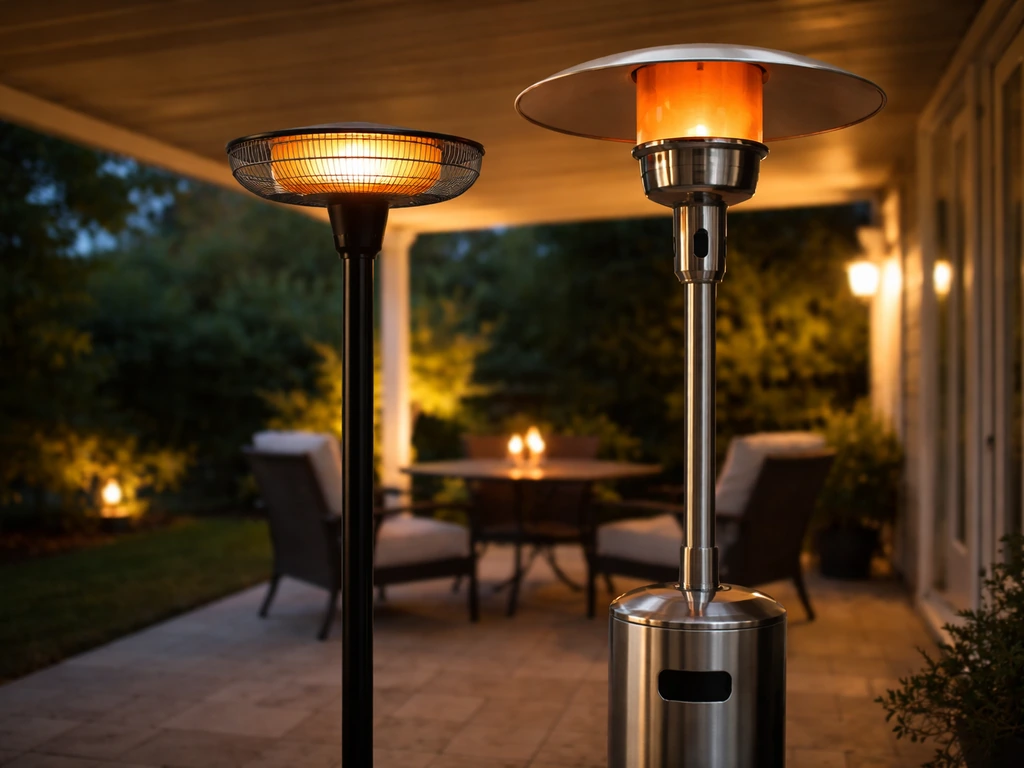
Where to Buy a Patio Heater: Best Places and Types
Where to buy a patio heater now, plus electric vs gas vs propane tips, safety checks, and size/BTU buying checklist.