
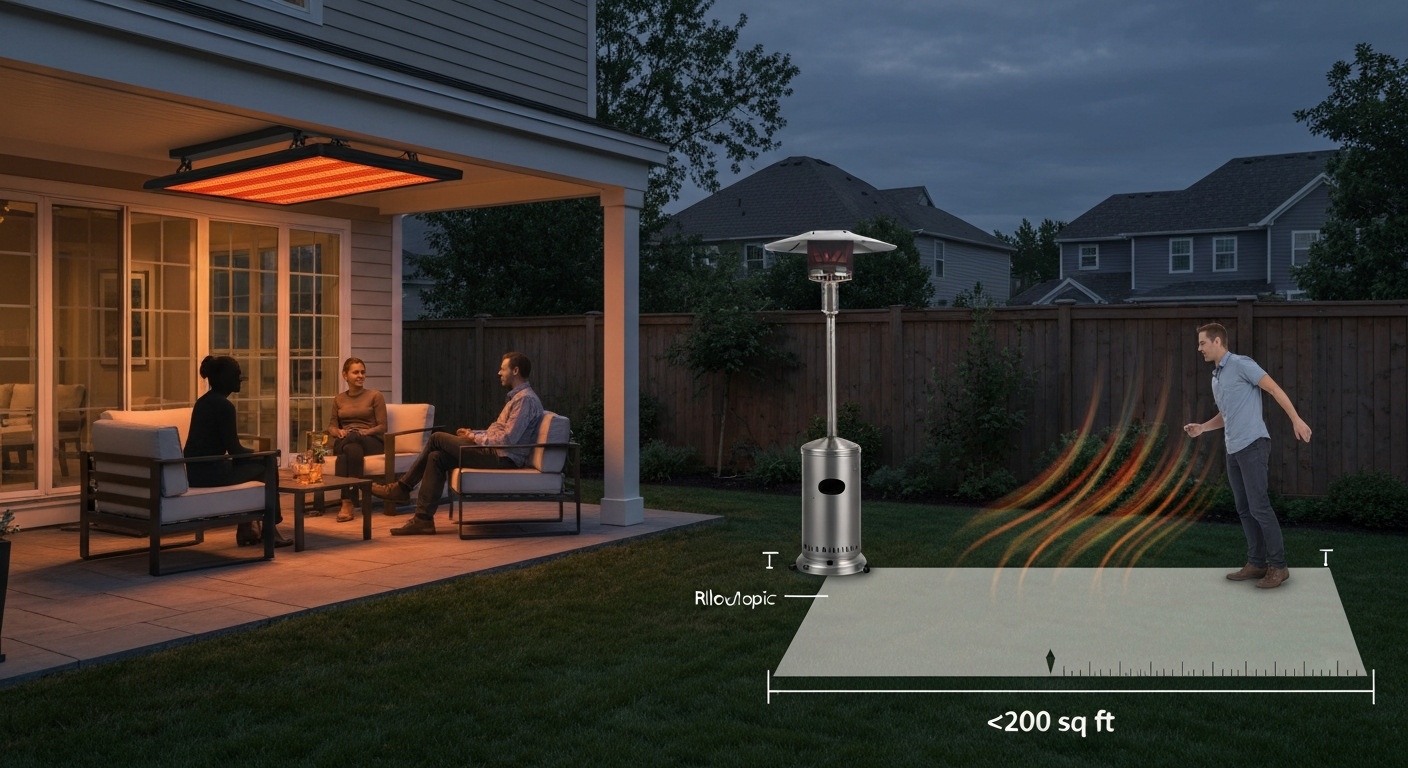
For a fully open, unenclosed patio, a freestanding propane heater or a wall/ceiling-mounted infrared heater gives you the best balance of heat output, wind resilience, and setup flexibility. A propane mushroom-style heater rated around 40,000–46,000 BTU/hr can warm roughly 200 sq ft in calm conditions, while a hard-wired infrared panel (2,000–4,000 W) delivers faster perceived warmth and handles light wind better because it heats people and surfaces directly rather than heating the air. Natural gas is the most cost-effective fuel long-term if you're willing to run a permanent line. Electric infrared is the cleanest, lowest-maintenance option but depends heavily on your local electricity rate.
Best Heater for Open Patio: Top Picks, Sizing & Costs Guide

Caleb Vale
16 Jul 2026
How to use this guide
This guide covers every common patio configuration: fully open patios with no overhead cover, covered patios with a solid or pergola roof, screened porches with partial wind protection, and fully enclosed patios or sunrooms. Each setup has different ventilation constraints, wind exposure, and mounting options, and those differences change which heater type is safe and practical. Work through the top picks and comparison sections first, then use the sizing math and operating cost examples to narrow down to a specific model and fuel type. If you're dealing with a covered or screened space, the safety and ventilation section near the end is required reading before you buy anything that burns fuel.
Top picks at a glance: best heaters by type
These are the models and categories I consistently recommend across testing and customer feedback, organized by fuel and heat-delivery technology. Prices reflect mid-2026 retail averages.
| Type | Top Pick / Example Model | Output | Best For | Approx. Price Range |
|---|---|---|---|---|
| Propane (freestanding) | Bromic Tungsten Freestanding Gas | 38,500 BTU/hr, up to ~215 sq ft | Open patios, portability, no electrical hookup | $600–$900 |
| Propane (tabletop) | Mid-range 11,000–15,000 BTU tabletop | 11,000–15,000 BTU/hr, ~50–80 sq ft | Small tables, balconies, supplemental heat | $80–$180 |
| Electric infrared (wall/ceiling) | Infratech W-Series 3000 W | 3,000 W (~10,236 BTU/hr), ~64 sq ft effective | Covered patios, screened porches, permanent install | $350–$600 |
| Electric infrared (mounted) | Bromic Tungsten Smart-Heat Electric | 2,000–6,000 W (model dependent) | Sleek permanent installs, commercial use | $700–$1,400 |
| Natural gas (mounted) | Bromic Tungsten 300 or 500 Gas | 26,000 or 43,000 BTU/hr | Permanent outdoor setups, high-use patios | $700–$1,200 (+ gas line cost) |
| Pellet | Mid-range outdoor pellet heater/fire pit | ~20,000–50,000 BTU/hr (variable) | Ambiance-focused, rural settings, no gas line | $300–$800 |
A quick note on pellet heaters: they produce real flames, good heat output, and strong ambiance, but they require regular pellet loading, ash cleanup, and ignition time. They work best where atmosphere matters as much as heat, and they are not appropriate for screened or enclosed spaces due to combustion products and spark risk.
Top picks by scenario
Best heater for an open patio
Open patios present the hardest heating challenge: wind carries warm air away almost immediately. Radiant infrared heaters win here because they heat objects and people rather than ambient air. For a permanently installed open patio, a ceiling- or wall-mounted infrared panel pointed directly at the seating area outperforms a free-standing convective propane heater in anything above a light breeze. The Bromic Tungsten Freestanding at 38,500 BTU/hr is a solid all-rounder if you want portability, but expect meaningful heat-loss in winds above 10 mph. For a fixed setup, a pair of Infratech W-Series 3000 W panels covering a 10 ft x 13 ft zone is a more reliable solution.
Best heater for a covered patio
A solid or pergola roof changes the equation significantly. The overhead structure traps radiant heat and blocks most wind, so both convective propane heaters and radiant infrared panels perform well. Ceiling-mounted electric infrared (Infratech, Bromic Electric) is the cleanest install option here because it requires no gas line and leaves zero floor footprint. If you already have a gas connection nearby, a Bromic Tungsten 300 (26,000 BTU/hr) or Tungsten 500 (43,000 BTU/hr) mounted under the eave handles a large covered seating area efficiently. Always confirm clearance requirements for combustion heaters under a solid roof, most manufacturers require 18–24 inches minimum overhead clearance, and some local codes add to that. For a concise, step-by-step comparison of options and the best way to heat a covered patio, see our dedicated guide that walks through safety, sizing, and installation choices. For a deeper look at covered setups specifically, a dedicated guide to covered patio heaters walks through ceiling-mount options and BTU sizing in more detail.
Best heater for a screened porch
Screened porches sit in a tricky middle ground: they have more wind protection than an open patio but the screening provides no meaningful insulation, and if the screens are tightly fitted, ventilation is reduced enough to make combustion heaters a real CO concern. My strong recommendation for a screened porch is electric infrared, full stop. A 3,000–4,000 W ceiling-mounted panel handles a 10 ft x 10 ft zone comfortably, produces zero combustion byproducts, and requires nothing more than a 240 V circuit. If you want fuel-burning heat in a screened porch, you need to verify that the screened walls provide genuine open-air ventilation (most code and safety guidance treats a screened porch as a semi-enclosed space). There are two other guides worth reading alongside this one if a screened space is your situation: one covering heaters specifically designed for screened porches, and another focused on screened-porch-specific considerations. See our guide on the best heater for screened in patio for specific model recommendations and screened-porch safety notes.
Best heater for a fully enclosed patio
A fully enclosed patio, sunroom, or converted porch with glass or solid walls is functionally an interior space. Unvented combustion heaters (propane, natural gas, pellet) are not safe in these environments. The only appropriate choices are electric (infrared panel, electric space heater, or mini-split) or a direct-vented gas appliance that exhausts combustion gases to the outside through a sealed flue. Electric infrared panels are ideal because they mount flush to ceiling or wall, require no venting, and produce comfortable radiant warmth. For year-round use in a cold climate, a ductless mini-split covers heating and cooling in one unit and is worth the higher upfront cost.
How heating technologies compare
| Technology | Heat Delivery | Wind Suitability | Coverage (typical) | Portability | Ventilation Required | Startup Time |
|---|---|---|---|---|---|---|
| Propane freestanding | Convective + some radiant | Poor–Fair (air-based) | 150–215 sq ft @ 38,500 BTU/hr | High (portable) | Open air required | 30–60 seconds |
| Natural gas mounted | Radiant infrared | Good (mounted, directional) | 200–400 sq ft @ 26,000–43,000 BTU/hr | None (permanent) | Open/covered only | 30–60 seconds |
| Electric infrared (panel) | Pure radiant | Excellent (heats objects, not air) | ~64 sq ft per 3,000 W element | Low–None (wired) | None | Instant |
| Electric infrared (portable) | Pure radiant | Good | ~50–100 sq ft | Medium | None | Instant |
| Pellet heater/fire pit | Convective + radiant flame | Poor (open flame) | Variable, ~100–200 sq ft | Medium | Open air required | 5–15 minutes |
The core performance distinction is radiant versus convective heat delivery. Radiant (infrared) heaters emit electromagnetic radiation that warms surfaces and bodies directly, similar to sunlight. Convective heaters (most freestanding propane mushroom heaters) warm the surrounding air, which then warms occupants, but warm air is easily displaced by wind. Independent testing and field reviews consistently confirm that infrared heaters deliver faster perceived warmth and maintain comfort at lower ambient temperatures in breezy conditions. On an open patio in a climate with regular evening breezes, this difference is tangible and significant.
Sizing your patio heater: the math you actually need
BTU and watt rules of thumb
The standard rule for outdoor heating is 10–20 watts per square foot (W/sq ft) of patio area, depending on how exposed the space is and how cold your climate gets. Use 10 W/sq ft for a sheltered covered patio in a mild climate and 20 W/sq ft for a fully open patio in a cold or windy environment. For gas heaters, use the NIST conversion factor: 1 kW = 3,412 BTU/hr. That means 10 W/sq ft is equivalent to about 34 BTU/hr per sq ft, and 20 W/sq ft is about 68 BTU/hr per sq ft.
Simple coverage math and sample calculations
Multiply your patio area (in sq ft) by your target watt density, then convert to BTU/hr if you're comparing against gas heaters. Here are worked examples for three common patio sizes:
| Patio Size | Scenario | Target Density | Total Watts Needed | Total BTU/hr Needed | Suggested Heater Setup |
|---|---|---|---|---|---|
| 100 sq ft (10x10) | Covered, mild climate | 10 W/sq ft | 1,000 W | ~3,400 BTU/hr | 1x 1,500 W electric panel or small propane tabletop |
| 200 sq ft (10x20) | Open patio, moderate climate | 15 W/sq ft | 3,000 W | ~10,236 BTU/hr | 1x 3,000 W Infratech W-series or 1 freestanding 40,000 BTU propane |
| 400 sq ft (20x20) | Open patio, cold/windy climate | 20 W/sq ft | 8,000 W | ~27,300 BTU/hr | 2x 4,000 W infrared panels OR Bromic Tungsten 500 (43,000 BTU) mounted gas |
| 600 sq ft (20x30) | Large covered patio, cold climate | 15 W/sq ft | 9,000 W | ~30,700 BTU/hr | 3x 3,000 W infrared panels OR 2x Bromic Tungsten 300 (26,000 BTU each) |
Manufacturer coverage claims, like Bromic's published 215 sq ft for the Tungsten Freestanding at 38,500 BTU/hr, are useful starting points but assume calm, still air. In real open-patio conditions, plan for 20–30% less effective coverage than the spec sheet claims if you get regular evening wind. Zone your heating: it is far more effective to heat specific seating areas than to try to warm the entire patio footprint uniformly.
Installation and placement options
Freestanding heaters
Freestanding propane heaters require no installation beyond filling the tank and positioning the unit. The base needs a stable, level surface. Keep them at least 3 feet from any combustible material (including overhead structures, umbrellas, and fabric furniture) and never position them under a low overhang. They should not be used on a covered deck where the roof creates a pocket for heat and combustion gases. Most residential freestanding heaters use a standard 20 lb propane tank.
Ceiling- and wall-mounted heaters
Mounted infrared panels, whether electric or gas, require structural attachment to a rafter, beam, or masonry wall rated for the heater's weight. Bromic's Tungsten electric models specify a minimum 3-foot (0.9 m) side clearance from combustibles, and gas-fired mounted models add overhead clearance requirements. Mounting height affects coverage area: most manufacturers provide a mounting height vs. coverage table in the installation manual. For infrared panels, higher mounting delivers broader coverage but lower intensity, follow the manufacturer's specified mounting height range rather than guessing.
Hard-wired electric heaters
A 3,000–4,000 W infrared heater requires a 240 V dedicated circuit with appropriate amperage (typically a 20–30 amp circuit). This is a licensed-electrician job in most jurisdictions. The circuit and wiring must meet the National Electrical Code (NEC / ANSI NFPA 70) standards for outdoor wet-location use. Specify weatherproof junction boxes and appropriate wire gauge for the run length. Check your heater's IP rating for outdoor water resistance, most quality outdoor electric infrared heaters carry at least an IP55 or IP65 rating.
Permanent natural gas line
Running a natural gas branch line to an outdoor patio heater requires a licensed gas contractor and must conform to the National Fuel Gas Code (ANSI Z223.1 / NFPA 54). The work requires a permit in most US jurisdictions. Gas patio heaters must be listed/certified to CSA/ANSI Z83.26 (the North American standard for gas-fired outdoor infrared patio heaters) and carry an ETL, CSA, or UL listing mark. Expect to pay $500–$1,500 for the gas line extension and installation labor, depending on run length and local rates. Once installed, operating costs drop substantially compared to propane, natural gas typically costs 60–70% less per BTU delivered than retail propane.
Placement best practices
- Position radiant heaters to point directly at the primary seating zone, not up at the ceiling or across an empty walkway.
- For open patios, place freestanding heaters on the windward side of the seating area so wind carries heat toward occupants, not away.
- For ceiling-mounted panels, aim slightly angled toward where people sit — straight-down mounting loses efficiency at the perimeter.
- Avoid placing any heater where a person could brush against it while walking through — maintain the manufacturer's minimum clearance distances on all sides.
- For propane cylinders, store and connect in well-ventilated locations; never store a connected spare cylinder under a closed patio enclosure.
Portability vs. permanent install: which makes sense for you
Portable freestanding heaters cost less upfront, require no installation, and can be moved indoors or to storage when not in use. That last point matters more than people expect: a quality freestanding propane heater stored inside or under a proper cover lasts significantly longer than one left outdoors year-round in rain, snow, and UV exposure. The trade-off is ongoing propane cost, refill logistics, and the fact that they simply do not perform as well in wind as a mounted infrared unit.
Permanent installed heaters (mounted electric or gas) deliver better performance, more consistent heat, and a cleaner aesthetic, particularly for commercial settings or a high-use residential patio where you'll run the heater multiple nights per week for months. The higher upfront cost (unit + installation) pays off over two to three seasons of regular use when you account for lower propane costs (for natural gas) or zero fuel cost (for electric). If you're renting your home, or if your patio configuration might change, portable wins by default.
| Factor | Portable Freestanding | Permanently Installed |
|---|---|---|
| Upfront cost | $80–$900 | $350–$2,000+ (including installation) |
| Installation | None | Electrician or gas contractor required |
| Wind performance | Poor–Fair | Good–Excellent (especially infrared) |
| Operating cost | Higher (propane) | Lower (NG) or moderate (electric) |
| Aesthetics | Utilitarian | Clean, integrated look |
| Flexibility | High — move it anywhere | Fixed location |
| Storage/winter | Can store inside | Stays outdoors (weatherproofing important) |
| Permit required | No | Usually yes (gas line or 240V circuit) |
Operating costs: running the numbers on fuel types
Use these reference values for cost math: propane contains approximately 91,500 BTU per gallon (HD-5 spec). Electricity converts at 1 kW = 3,412 BTU/hr (NIST). U.S. average residential electricity in 2025–2026 runs around $0. EIA, Electricity Monthly Update (retail price context) reports the U.S. average residential electricity prices used for the 2025–2026 per‑kWh inputs in these operating‑cost examples EIA — Electricity Monthly Update (retail price context). 14–$0.16 per kWh depending on region (EIA data), though some markets run considerably higher. Retail propane averages $2.50–$3.50 per gallon regionally (EIA winter fuels data); natural gas is generally $1.00–$1.50 per therm (100,000 BTU), making it the cheapest fuel per BTU by a wide margin.
Sample hourly and monthly cost examples
| Fuel / Heater Type | Output | Fuel/Energy per Hour | Hourly Cost | Est. Monthly Cost (3 hrs/day, 30 days) |
|---|---|---|---|---|
| Propane freestanding (38,500 BTU/hr) | 38,500 BTU/hr | 0.42 gal/hr (38,500 ÷ 91,500) | $1.05–$1.47 @ $2.50–$3.50/gal | $94–$132 |
| Natural gas mounted (43,000 BTU/hr) | 43,000 BTU/hr | 0.43 therms/hr | $0.43–$0.65 @ $1.00–$1.50/therm | $39–$59 |
| Electric infrared 3,000 W | 3,000 W / ~10,236 BTU/hr | 3 kWh/hr | $0.42–$0.48 @ $0.14–$0.16/kWh | $38–$43 |
| Electric infrared 1,500 W (small panel) | 1,500 W / ~5,118 BTU/hr | 1.5 kWh/hr | $0.21–$0.24 | $19–$22 |
| Pellet heater (variable, avg ~30,000 BTU/hr) | ~30,000 BTU/hr | ~1–2 lb pellets/hr @ $6–$8/40-lb bag | $0.15–$0.40 | $14–$36 (pellets only, + ignition time) |
These numbers assume full-power continuous operation. Most infrared heaters can be dimmed or zone-controlled, which reduces actual consumption. A 3,000 W panel running at 70% output costs closer to $0.30/hr. Natural gas comes out cheapest per BTU delivered, but the gas line installation cost needs to factor into your payback calculation, at roughly $90/month savings versus propane, a $1,000 installation pays back in about 11 months of regular use. For occasional use (one or two nights per week), the payback stretches to 2–3 seasons and a portable propane unit may make more financial sense.
Safety, ventilation, and local-code cautions
Open vs. screened vs. enclosed: the ventilation hierarchy
This is where heater selection becomes a genuine safety question, not just a preference. EPA, CDC, and OSHA guidance is consistent and clear: unvented combustion appliances (propane, natural gas, wood, pellet) produce carbon monoxide (CO) and other combustion byproducts. In open-air conditions with free airflow, CO disperses safely. In any semi-enclosed or fully enclosed space, including tightly screened porches, covered patios with solid walls on three sides, and any glass-enclosed sunroom, combustion products can accumulate to dangerous levels faster than most people expect.
- Fully open patio (no roof, open sides): any heater type is acceptable with standard clearances observed.
- Covered patio with open sides: combustion heaters are generally acceptable, but confirm the roof and support structure provide adequate overhead clearance and that the sides are truly open, not partially enclosed by screens or glass.
- Screened porch: use electric infrared only, or verify with a licensed contractor that your screening configuration provides genuine open-air ventilation equivalent. Never use an open-flame propane or pellet heater in a screened porch.
- Fully enclosed patio or sunroom: electric only, or a direct-vented gas appliance that exhausts combustion gases through a sealed exterior flue. No unvented combustion heaters under any circumstances.
- Install UL 2034-listed CO alarms in any space where a combustion heater is used near or within a partially enclosed area — do not rely on ventilation alone.
Clearance rules and code compliance
Gas patio heater installations must conform to the National Fuel Gas Code (ANSI Z223.1 / NFPA 54) and the product must carry a listing to CSA/ANSI Z83.26 (the dedicated standard for gas-fired outdoor infrared patio heaters). These requirements cover orifice sizing, gas connection specifications, altitude de-rating (relevant above 2,000 ft elevation), and clearance from combustibles. Bromic's Tungsten gas models publish model-specific clearance distances in their installation manuals, for example, minimum side clearances from combustibles are specified per model and must be followed exactly, not approximated. Electric heaters require compliance with NEC for outdoor wiring and must carry a UL or ETL listing appropriate for outdoor wet-location use. Electric infrared and other electric space heaters are commonly evaluated to standards such as UL 499 (standard for electric space heaters), see UL 499 (standard for electric space heaters), UL standards catalog blank" rel="noopener noreferrer">UL 499 (standard for electric space heaters) — UL standards catalog.
Permit triggers: when you need to call a pro
A permit is almost always required when you run a new gas branch line, add a dedicated 240 V circuit, or permanently attach a heater to a structure. A permit may also be required for mounting a heater to a deck that's already permitted, check with your local AHJ (Authority Having Jurisdiction). Failure to permit gas line work creates insurance and liability risk beyond just the code violation. The practical rule: if it involves a gas line or hardwired 240 V, call a licensed contractor and pull a permit. Plugging in a portable 120 V electric heater or connecting a propane heater to a cylinder does not require a permit in most jurisdictions.
Maintenance, durability, and real-world feedback
Propane freestanding heaters are the highest-maintenance category. The burner head, thermocouple, and regulator all need periodic inspection. Common failure points reported by users include thermocouple degradation (heater won't stay lit), regulator flow restrictions (low flame output), and burner corrosion in coastal environments. Annual cleaning of the burner ports and a regulator check extends life significantly. Cover the unit when not in use, a quality weatherproof cover adds years to the finish.
Electric infrared panels are by far the lowest maintenance option. The quartz or carbon infrared elements have rated lifespans of 5,000–20,000 hours depending on element type. There are no gas connections, regulators, or igniters to fail. The main maintenance task is keeping the reflector surface clean (wipe down with a dry cloth periodically) and checking that mounting brackets haven't corroded. Premium models from Bromic and Infratech use marine-grade stainless steel or powder-coated alloy construction that holds up well in coastal and high-humidity environments.
Natural gas mounted heaters occupy the middle ground: more maintenance than electric (igniter and burner cleaning, annual regulator check) but less than portable propane (no cylinder management, no regulator replacement cycle). Gas heaters in high-humidity coastal environments need stainless steel construction, look for 304 or 316 SS on the burner housing and frame.
Buying checklist: your decision in 8 steps
- Define your patio type: fully open, covered, screened, or enclosed. This determines which fuel types are safe.
- Measure your primary seating area in square feet — heat that zone, not the entire patio footprint.
- Apply the sizing formula: 10 W/sq ft (sheltered, mild) to 20 W/sq ft (open, cold/windy). Convert to BTU/hr if comparing gas models (multiply kW by 3,412).
- Decide on portability vs. permanent install based on usage frequency, aesthetics, and budget for installation.
- Compare operating costs using your local utility rate and current propane price — run the hourly and monthly math before committing to a fuel type.
- Check local permit requirements before buying a gas or hard-wired electric heater. Contact your AHJ or a licensed contractor.
- Verify the heater carries the appropriate safety listing: CSA/ANSI Z83.26 for gas outdoor heaters; UL/ETL outdoor listing for electric.
- For any space that is screened or partially enclosed, choose electric infrared only — and install a UL 2034 CO alarm as a backup safety measure regardless.
Which technology should you choose? A direct recommendation
For most open patios where you want the best performance without permanent installation: a freestanding propane infrared-burner heater in the 38,000–46,000 BTU/hr range is the practical choice. It needs no installation, works everywhere, and produces enough heat for a 150–200 sq ft seating area in moderate conditions. For open patios with regular wind or cold temperatures, mount an electric infrared panel, you will notice the difference immediately. If you're committed to a permanent setup and have natural gas available, a mounted Bromic Tungsten 300 or 500 is hard to beat for a covered or semi-exposed patio: long-lasting, low operating cost, and genuinely professional-grade heat output. For screened porches and enclosed spaces, electric infrared is the only type that makes practical and safety sense. Whatever setup you're planning, the best way to heat an outdoor patio ultimately comes down to matching the heat delivery method to your specific patio structure, climate, and how often you'll actually use it.
FAQ
Which heater types are best for an open patio versus a covered, screened, or fully enclosed patio?
Open patio: freestanding propane or natural‑gas patio heaters (mushroom or tower) and high‑output infrared gas units work well because they offer high BTU outputs and portability; wind reduces convective models’ effectiveness. Covered/screened patio: ceiling‑ or wall‑mounted electric infrared or hard‑wired natural‑gas infrared units are preferred — they deliver directed radiant heat, are less draft‑sensitive and are safer under overhead cover when installed per clearances. Fully enclosed patio (heated room): use properly vented or electric heaters only; avoid unvented propane/gas heaters — choose electric infrared, baseboard, or a permanently plumbed natural‑gas direct‑vent heater installed to code.
How do I compare performance and coverage between gas (propane/natural gas) and electric (infrared) heaters?
Compare by input/output and heat delivery method: gas units list BTU/hr input (e.g., Bromic Tungsten models: Tungsten 300 ≈26,000 BTU/hr, Tungsten 500 ≈43,000 BTU/hr; freestanding example ~38,500 BTU/hr). Electric heaters show watts; convert watts to BTU/hr using 1 kW ≈ 3,412 BTU/hr. Radiant (infrared) heaters heat people and surfaces directly — better perceived warmth and less wind sensitivity. Convective gas heaters heat air and larger volumes but suffer more from drafts. Manufacturer coverage figures (sq ft) are a starting point; real coverage depends on mounting height, wind, and configuration.
What simple sizing math should I use to estimate how big a heater I need?
Use two quick methods: 1) Square‑foot rule (rough): 10–20 BTU/hr per sq ft for mild climates; 20–40 BTU/hr per sq ft for cold/windy areas or partially enclosed spaces. 2) Convert electric wattage: watts × 3.412 = BTU/hr. Example: 3,000 W × 3.412 ≈ 10,236 BTU/hr. For a 200 sq ft open patio in mild conditions, target ~2,000–4,000 BTU/sq ft? (Correction: target total 4,000–8,000 BTU — use 20–40 BTU/sq ft yields 4,000–8,000 BTU). For larger areas, use multiple units spaced per manufacturer heat‑pattern guidance.
How do I calculate operating costs for gas vs electric heaters?
Steps and sample conversions: 1) Convert heat input to fuel units: gas BTU/hr ÷ 91,500 BTU/gal = gallons/hr (propane). 2) Electric: kW = watts/1,000; cost/hr = kW × $/kWh. 3) Example: 38,500 BTU/hr propane heater → 38,500 ÷ 91,500 ≈ 0.42 gal/hr. At $3.50/gal → ≈ $1.47/hr. Electric example: 3,000 W heater → 3 kW; at $0.18/kWh → 3 × $0.18 = $0.54/hr. Use local EIA/utility rates for accuracy. Note: real delivered heat and efficiency differ — radiant electric often feels warmer at lower energy use in targeted zones.
What are typical installation options and what requires a professional or permit?
Options: freestanding (no hard wiring/gas piping), portable propane (tank), ceiling/wall‑mounted electric (hard‑wired), and hard‑plumbed natural‑gas ceiling/wall units. When to call a pro or get permits: running a natural‑gas line, hard‑wiring 120/240 V circuits, ceiling mounting into building structure, or installing permanent outdoor appliances generally requires licensed tradespeople and permits. Manufacturers require compliance with local codes or NFPA 54 (National Fuel Gas Code) and NEC for wiring — AHJs may require inspections and certified installers for gas appliances.
What safety, ventilation and code cautions should I follow, especially for enclosed or partially enclosed patios?
Never use unvented combustion heaters in fully enclosed or poorly ventilated spaces. Combustion heaters produce CO and other pollutants — EPA/OSHA guidance recommends ventilation and CO alarms (UL‑2034) when combustion sources are present. Follow manufacturer clearances and NRTL listings (UL/ETL/CSA), and conform to CSA/ANSI Z83.26 for gas patio heaters where applicable. For covered porches, ensure required clearances from combustibles and consider electric infrared or direct‑vent gas units to reduce CO/ventilation risks.
Next Articles
Best Way to Heat a Covered Patio: Heater Guide
Practical guide to the best way to heat a covered patio: pick the right heater, size heat needs, placement, costs, safet
Best Way to Heat an Outdoor Patio: Propane, Gas, Electric
Compare propane, natural gas, electric, infrared and pellet patio heaters with placement, winter tips, costs and safety.
Best Covered Patio Heater Buying Guide and Heater Cover Tips
Choose the best covered patio heater by BTUs, coverage, fuel type, safety placement, costs, and the right protective cov