
The best battery-powered patio lights for most homeowners are rechargeable Li-ion string lights rated IPX4 or better, with at least 100 lumens of total output and a run time of 8 hours or more on a single charge. For pure budget picks, the Hampton Bay 3-pack (Model 10508, $40.37 at Home Depot) covers a 12 ft span per set with a built-in 6-hour timer. For a smarter, solar-assisted setup, the BioLite BL85MR string lights (44 ft, 140 lumens, 4,000 mAh, ~$99.95) and the MPOWERD Luci Solar LED String Lights (18 ft, IPX4, USB charging) are the two strongest all-around picks. If you need security lighting, the Ring Floodlight Battery (600 lumens, 3,500 K, motion-activated) is the top flood pick. And for portable or accent use, the Goal Zero Lighthouse 600 (600 lumens, 5,200 mAh lantern) and Mr Beams MB800 puck lights (30 lumens, ~1-year battery life) round out the lineup.
Best Battery Powered Patio Lights: Top Picks by Use & Budget

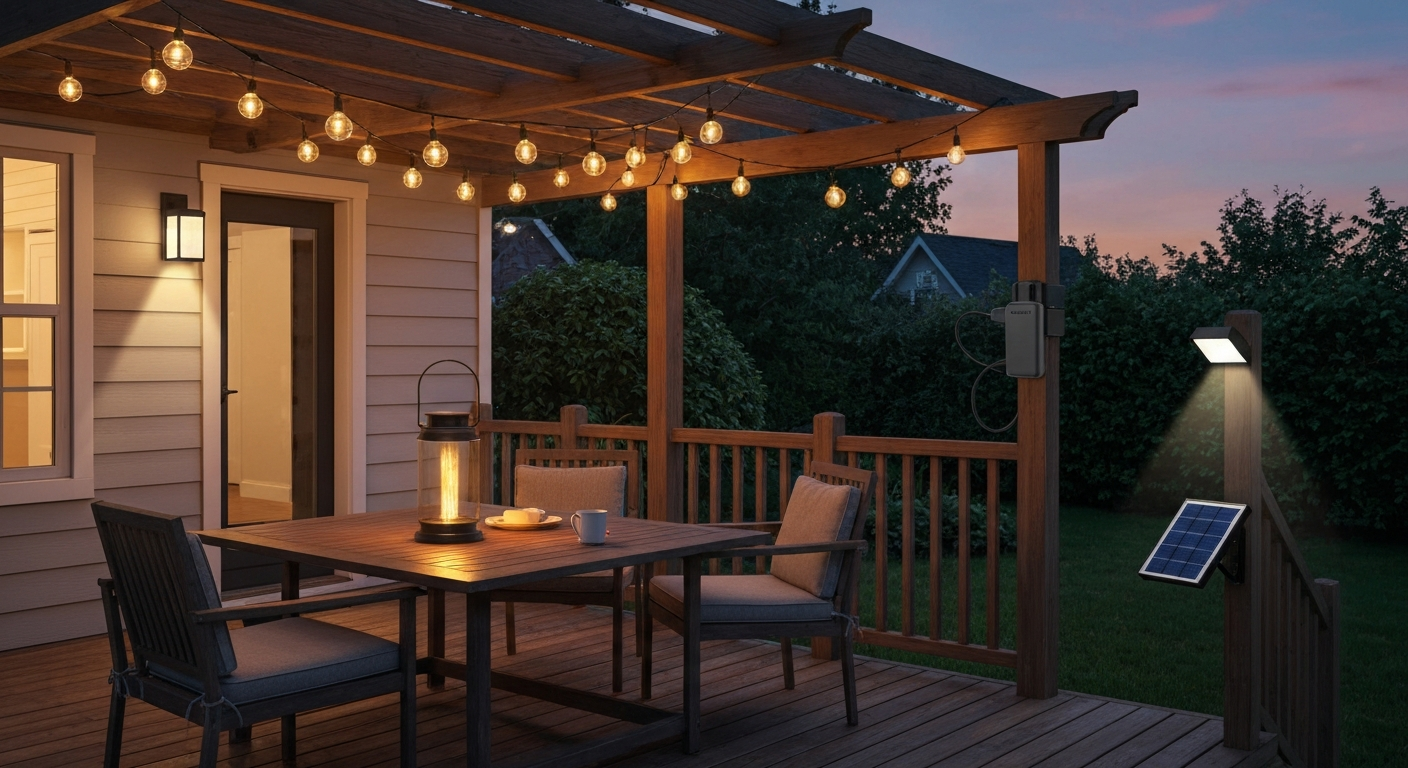
Who these lights are for and what this guide covers
Battery-powered patio lights are the right solution when you don't have outdoor outlets near your seating area, when you're renting and can't run conduit, or when you want flexibility to rearrange a space seasonally. They're also a natural pairing with portable or freestanding patio heaters: when you're already running a propane or infrared heater without hardwired power, battery lights let you complete the setup without an electrician. This guide covers string lights, lanterns, flood lights, post lights, puck lights, and solar-hybrid models. I'll walk through technical specs (lumens, color temperature, CRI, beam angle), battery chemistry and real-world run-time calculations, IP waterproof ratings, mounting and placement strategies, and what to watch for when placing lights near a heat source.
Top picks by use-case and budget
I've organized these picks around what most people actually need on a patio, not a single ranked list. A small bistro setup has different requirements than a large deck with a security concern, and budget varies widely. Here's where each product earns its spot.
| Use-Case | Pick | Key Specs | Price (approx.) | Why It Wins |
|---|---|---|---|---|
| Best overall string lights | BioLite BL85MR | 44 ft, 140 lm, 4,000 mAh, 8 hr (high) / 40 hr (low), USB-C + solar | $99.95 | Longest span with integrated power bank; solar topping keeps it running without an outlet |
| Best budget string lights | Hampton Bay Model 10508 | 12 ft, 10 LEDs, timer (6 hr on/18 hr off), flash mode | $40.37 for 3-pack ($13.46/set) | Lowest cost-per-foot; built-in timer saves batteries; good for covered porches |
| Best solar-hybrid string lights | MPOWERD Luci Solar LED String Lights | 18 ft, 10 nodes, IPX4, USB charging port | ~$35–45 | Dual solar + USB charging; IPX4 for rain; compact 10-node design for bistro setups |
| Best flood/security light | Ring Floodlight Battery (5B21S8-WEN0) | 600 lm, 3,500 K, 6 W, motion-activated, IP65-class | ~$99–129 | Motion trigger, 600 lumens is adequate for a 20 ft detection zone; integrates with Ring ecosystem |
| Best lantern | Goal Zero Lighthouse 600 | 600 lm max, 5,200 mAh, 2.5 hr (high) / 180 hr (low), USB output | $79.95 | Doubles as a device charger; 180-hr low mode for ambient use across multiple nights |
| Best puck lights | Mr Beams MB800 (3-pack) | 30 lm per puck, 3×AAA, motion sensor, ~1 yr battery life | ~$25–30 | Tool-free mounting, auto-off after 20 sec, excellent for step or under-furniture accent use |
| Best post/pathway light | Gama Sonic Luxor (Model 146iP250080) | 50 lm, 2,700 K warm white, monocrystalline solar, aluminum body, 5+ yr battery life | ~$40–60 | Aluminum construction resists corrosion; 5+ yr integrated battery life means minimal maintenance |
How I selected these picks: the buying guide criteria
To build this list I compared products across seven factors: total lumen output against the coverage area, battery capacity (Wh) against advertised run time to verify the math, IP rating against realistic weather exposure for an outdoor patio, build materials (especially UV-resistance and corrosion resistance for coastal or humid climates), charging flexibility (USB-C, solar, or replaceable batteries), price per foot for string lights or price per lumen for floods and lanterns, and documented failure patterns from consumer reviews at REI, Home Depot, and Lowe's. I cross-checked manufacturer lumen claims against IES LM-79 test standards, which is the accepted laboratory method for measuring actual luminous flux using an integrating sphere or goniophotometer with a calibrated spectroradiometer. Any product where the advertised number felt inconsistent with the battery capacity and run-time math got flagged.
- Lumen output: enough to light the area, not just look decorative
- Battery capacity (Wh) verified against run-time claims using the Wh ÷ W formula
- IP rating of at least IPX4 for any exposed outdoor installation
- Charging flexibility: USB, solar, or standard replaceable cells (AA/AAA)
- Build material: aluminum or UV-stabilized plastic for long-term outdoor use
- Price efficiency: cost per foot (strings) or cost per 100 lumens (floods, lanterns)
- Consumer failure pattern review: battery longevity, water ingress, switch reliability
Types of battery-powered patio lights and the best use for each
String lights
String lights are the most popular patio lighting format because they spread warm ambient light across a wide area without requiring a single bright fixture. Battery-powered sets like the Hampton Bay 10508 (12 ft) and BioLite BL85MR (44 ft) hang from pergola beams, umbrella ribs, or fence lines. The main trade-off is run time: a shorter, less powerful set lasts much longer per charge than a 44-ft set running on high. For entertaining use (evenings up to 3–4 hours), a 4,000 mAh rechargeable set like the BioLite is fine. For a setup left on nightly, use the low-brightness mode or add a timer.
Lanterns
Portable lanterns like the Goal Zero Lighthouse 600 work best as centerpieces on patio tables or hung from a hook above a seating area. At 600 lumens on high, the Lighthouse is bright enough to read by. Its 180-hour low-mode run time means you can leave it on a dim setting all night for several weeks on one charge. The dual USB output is a genuine bonus for a patio that doubles as a phone-charging spot. The main complaint in REI customer reviews is switch reliability after 12–18 months of outdoor storage, so bring it inside for winter.
Flood lights
Battery flood lights like the Ring Floodlight Battery (600 lumens, 3,500 K) are for security and task lighting, not ambiance. Motion activation is critical here: it extends battery life significantly compared to a light that runs continuously. The Ring unit's 6 W draw at 600 lumens gives it good efficacy (100 lm/W), which is competitive with wired LED floods. It's best mounted above a gate, staircase, or entry point where a broad, bright wash is needed.
Post and pathway lights
Solar post lights like the Gama Sonic Luxor output 50 lumens at 2,700 K, which is adequate for marking a path but not for general illumination. Their aluminum construction makes them the most durable format for a permanent installation, and the 5+ year integrated battery life is the key advantage over string lights or lanterns. Place them every 6–8 feet along a walkway or at the corners of a deck for reliable low-maintenance accent lighting.
Puck lights
Puck lights like the Mr Beams MB800 (30 lumens, 3×AAA) are ideal for under-step lighting, inside storage benches, or tucked beneath outdoor furniture. The motion sensor with a 20-second timeout is exactly right for a stair nosing or cabinet: it activates only when someone is nearby, which is why Mr Beams rates battery life at roughly one year at 8 activations per night. Don't use puck lights as primary illumination; they're accent and safety lights.
Solar-hybrid lights
Solar-hybrid models like the MPOWERD Luci Solar LED String Lights and the BioLite BL85MR combine an internal rechargeable battery with a solar panel to extend run time without needing an outlet. The key variable is panel size relative to battery capacity. On a fully overcast day, solar charging may provide only 10–20% of what a sunny day yields, so you still need USB as a backup. These are best for patios with at least 4–6 hours of direct or indirect sun exposure per day.
Technical criteria explained
Lumens and how many you actually need
Lumens measure total light output from a fixture, verified under IES LM-79 test conditions using an integrating sphere and calibrated spectroradiometer. For ambient patio use, 100–300 lumens of string light spread across 20–40 ft is comfortable. For a task zone (reading, dining), aim for 300–600 lumens in that area. For security flood lighting, 600 lumens minimum. The BioLite BL85MR puts out 140 lumens total across 44 feet, which creates a soft ambient glow. The Ring Floodlight pushes 600 lumens from a single directional fixture, which is a fundamentally different use.
Color temperature (CCT)
Color temperature is measured in Kelvin. Warm white (2,700–3,000 K) is relaxing and flattering for outdoor entertaining, which is why the Gama Sonic Luxor and most decorative string lights use it. Cool white or neutral white (3,500–4,000 K) is better for security and task lighting, which is why the Ring Floodlight is spec'd at 3,500 K. Avoid 5,000 K+ (daylight) on a residential patio; it creates a clinical, harsh feel and can disturb neighbors.
CRI (Color Rendering Index)
CRI measures how accurately a light source renders colors compared to natural light, on a scale of 0–100. For patio lighting, a CRI of 80+ is sufficient for ambient and decorative use. If you're cooking outdoors or want food and plants to look natural, aim for CRI 90+. Most budget battery-powered string lights don't publish CRI; if it matters to you, look for it in the product spec sheet or LM-79 test report.
Beam angle and light distribution
Beam angle determines how wide or narrow the light spreads. String lights with omnidirectional bulbs scatter light in all directions, which is ideal for ambiance. Flood lights and puck lights have defined beam angles: a wide flood (120°+) covers a broad area at low intensity; a spot (30°–60°) concentrates brightness on a small zone. The Mr Beams MB800 pucks use a wide dispersion to light a step surface without a harsh center hot spot. The Ring Floodlight uses a wider flood pattern to cover an entry zone.
Mounting options and light distribution patterns
Battery-powered lights mount via clip hooks (string lights), stake (pathway), adhesive or screw-mount (pucks), and wall bracket or stake (floods). The absence of a power cord is the main advantage, but it also means you're relying on the mounting hardware alone to keep the fixture in position through wind. For string lights, plan on at least one anchor point every 8–10 feet. For pucks, the MB800 uses a magnetic mount plus adhesive backing, which is adequate for flat horizontal surfaces but not vertical walls in high-wind areas.
Battery details and run-time calculations
Alkaline vs rechargeable Li-ion vs NiMH
Alkaline AA/AAA batteries (used in Hampton Bay 10508 and Mr Beams MB800) are convenient, widely available, and have a long shelf life, but they're non-rechargeable and their capacity drops noticeably in cold weather. NiMH rechargeables (standard AA) offer 1,800–2,500 mAh and can run 500–1,000 cycles, but standard NiMH self-discharges at a meaningful rate in storage. Low-self-discharge NiMH like Panasonic Eneloop (1,900–2,500 mAh) solve that problem and are a good swap-in for any AA/AAA battery compartment. Lithium-ion (Li-ion) cells, used in the BioLite, Goal Zero, and MPOWERD products, offer higher energy density, low self-discharge (~1–2% per month), and longer cycle life, but they require a battery management system (BMS) and are more sensitive to temperature extremes. Peer-reviewed research confirms that elevated temperatures accelerate Li-ion capacity fade, so storing these units indoors during hot summer months or cold winters will extend their usable life.
| Chemistry | Typical Capacity | Rechargeable | Self-Discharge | Cold Weather Performance | Best For |
|---|---|---|---|---|---|
| Alkaline AA/AAA | 2,500–3,000 mAh (AA) | No | Very low (shelf life 5–10 yr) | Degrades noticeably below 0°C | Budget lights, infrequent use, emergency backup |
| NiMH (standard) | 1,800–2,500 mAh (AA) | Yes (~500–1,000 cycles) | Moderate (self-discharges in weeks) | Moderate drop below freezing | Moderate-use lights with frequent cycling |
| NiMH LSD (e.g., Eneloop) | 1,900–2,500 mAh (AA) | Yes (~500–2,100 cycles) | Very low (~10–20%/yr) | Better than standard NiMH | Best drop-in upgrade for AA/AAA battery lights |
| Li-ion (18650/prismatic) | 2,000–5,200 mAh (cell) | Yes (300–500+ cycles) | Very low (~1–2%/month) | Capacity drops, risk below -20°C | Premium rechargeable lights, string lights, lanterns, floods |
USB charging: what the specs mean
Most rechargeable battery patio lights charge via USB-A or USB-C at 5 V and 1–2 A (USB Battery Charging spec BC1.2), which delivers 5–10 W and will typically recharge a 4,000 mAh battery in 3–5 hours. The BioLite BL85MR uses USB-C, which is more durable and reversible than Micro-USB. If a product supports USB Power Delivery (USB-PD), it can negotiate higher voltages and currents, cutting charge time significantly. Always check that the included cable or charger matches the USB-IF spec for your device; using a non-compliant charger can cause slow charging or, in rare cases, safety issues.
How to calculate run time yourself
The standard run-time formula is: Runtime (hours) = Battery capacity (Wh) ÷ Device power draw (W) × system efficiency (0.8–0.9). The efficiency factor accounts for driver losses and real-world derating. Using the BioLite as a worked example: 4,000 mAh at 3.6 V nominal = 14.4 Wh. Divide by 8 hours (high mode) = 1.8 W average draw, which is consistent with low-power LED string controllers. At low mode, 14.4 Wh ÷ 40 hours = 0.36 W, a completely plausible figure for a dimmed 20-bulb LED string. When a manufacturer's claim doesn't pass this check, treat the run-time figure skeptically. For alkaline-based lights like the Hampton Bay 10508, check the total mAh of the battery pack (typically 4×AA = ~10–12 Wh) and apply the same formula.
Replacement batteries and long-term costs
The Mr Beams MB800 uses 3×AAA per puck. At 8 activations per night, Mr Beams rates one set of batteries at roughly one year. That's a reasonable cost, but over 5 years in a 3-puck kit, you're looking at 15 battery replacements. Switching to NiMH LSD rechargeables in the AA/AAA compartments of any compatible light cuts that recurring cost to essentially zero. For integrated Li-ion packs (BioLite, Goal Zero), replacement isn't user-serviceable on most models, so battery longevity depends on how well you store and charge the unit.
Waterproof ratings and durability: reading the IP code
IP (Ingress Protection) ratings are defined by IEC 60529. The code has two digits: the first covers solid particle intrusion (dust), the second covers liquid intrusion. When a digit is replaced by X (as in IPX4), that axis wasn't tested. For patio lights, the second digit is what matters most.
| IP Rating | Water Protection Level | Practical Meaning for Patio Use |
|---|---|---|
| IPX4 | Splashing from any direction | Suitable for rain; not for directed water streams or spray cleaning |
| IP65 | Dust-tight + low-pressure water jets | Safe in rain and light hose spray; good for exposed wall or flood mounts |
| IP67 | Dust-tight + 1 m immersion for 30 min | Suitable for areas prone to standing water; not needed for most patios |
| IP68 | Dust-tight + continuous immersion (depth per manufacturer) | Submersible; overkill for most patio installations |
The MPOWERD Luci string lights carry IPX4, which means they'll handle rain but shouldn't be hit with a pressure washer. The Ring Floodlight Battery is listed at IP65-class protection, making it more robust for a fixed wall mount exposed to weather year-round. One important caveat: IP ratings are tested on new units in a lab. Seal degradation from UV exposure, thermal cycling, and mechanical wear can reduce effective protection over time. This is especially relevant for the battery/control box junction on string lights, which is the most common point of water ingress in long-term consumer reviews.
Materials and corrosion resistance
Aluminum bodies (Gama Sonic Luxor) resist corrosion well and hold up in coastal or high-humidity environments. UV-stabilized polycarbonate diffusers are more durable than standard ABS plastic in direct sun. Look for stainless steel or coated hardware on mounting brackets and hanging hooks; zinc-plated or plain steel will rust within a season in humid climates. For string lights specifically, the control box and battery housing are typically ABS plastic, and their gasket quality is the single biggest durability variable. Consumer reviews for MPOWERD and Goal Zero products specifically flag split diffusers on inflatable lanterns and battery compartment ingress after 12–18 months of outdoor storage.
Mounting, placement, and installation tips
String light spacing and height
For overhead string lights, the sweet spot is 8–10 feet above the deck surface. Lower than 7 feet and taller guests can snag them; higher than 12 feet and the light scatter becomes too diffuse. Space anchor points no more than 8–10 feet apart to prevent sag. Use screw-in cup hooks for wood pergola beams or spring-loaded hooks clipped to a guide wire for longer spans. For a 44-ft BioLite run across a 20 x 20 ft patio, plan a zigzag or catenary pattern with 5–6 anchor points.
Integrating lights with patio heaters
If you're running a freestanding propane or infrared patio heater, keep battery-powered string lights and their control boxes at least 3 feet away from the heat output zone. Umbrella-mounted heaters that direct heat upward through a central pole can reach temperatures that degrade plastic control boxes and wiring insulation directly above them. Overhead string lights draped near a pyramid-style propane heater should be positioned to the sides of the heater's radiant cone, not directly above it. For infrared patio heaters mounted on walls or pergola beams, route string light wiring at least 6 inches away from the fixture housing, since wall-mount infrared units can run hot at their reflector housing.
Safety on decks
Battery-powered lights eliminate the tripping hazard of power cords running across deck surfaces, which is a genuine advantage over corded options. That said, mounting hardware still needs to be secure: a loose hook or anchor point under wind load can bring a string light down onto a hot heater or into a foot traffic path. On elevated decks with railings, the puck lights and pathway stakes should be attached with corrosion-resistant fasteners, not just adhesive, which can fail in sustained moisture. Step lighting with puck lights like the MB800 is one of the most practical safety applications for a deck: 30 lumens per step is enough to prevent trips without affecting night vision.
Placement checklist before you install
- Map your patio layout including heater locations, furniture, and foot traffic paths
- Identify anchor points for string lights (pergola beams, fence posts, guide wires); aim for one anchor every 8–10 ft
- Confirm IP rating is appropriate for the fixture's exposure (open vs. covered patio, coastal vs. inland)
- Keep control boxes and battery packs away from direct heater output; minimum 3 ft clearance
- For flood lights, mount at 8–10 ft height for a 20-ft detection/coverage radius
- For pathway stakes, space 6–8 ft apart and aim for consistent soil depth to keep all fixtures level
- For puck lights on steps, confirm adhesive or screw mount is rated for outdoor use before installation
- Test all lights on their highest mode after installation to confirm no blind spots or over-bright zones
Maintenance, battery disposal, and environmental notes
The biggest maintenance task for battery-powered patio lights is managing the battery through seasonal storage. For Li-ion-based products (BioLite, Goal Zero, MPOWERD), store at 40–80% charge in a cool, dry location (10–25°C ideal) over winter. Storing at full charge or near-zero charge accelerates capacity fade. Elevated temperatures during summer outdoor storage also accelerate aging, which peer-reviewed electrochemical research confirms: higher average temperature and deeper discharge cycles both reduce Li-ion usable life. See the MDPI review 'A Review on Temperature‑Dependent Electrochemical Properties, Aging, and Performance of Lithium‑Ion Cells, MDPI (peer‑reviewed review)' for a summary of how higher average temperature and deeper cycles reduce Li‑ion usable life MDPI review on temperature‑dependent aging and performance of Li‑ion cells. For alkaline or NiMH AA/AAA lights, remove the batteries entirely before storing for more than 2–3 months to prevent leakage.
On the environmental side, alkaline batteries should never go in the general trash in most jurisdictions: drop them at a retailer battery recycling bin (Home Depot and Lowe's both run take-back programs). NiMH and Li-ion packs require specialized recycling; the Call2Recycle program covers both in the US and Canada. If you're concerned about the environmental footprint of your outdoor setup more broadly, it's worth noting that battery-powered LED lighting is significantly more efficient than propane torches or flame-based options, and solar-hybrid models like the BioLite and MPOWERD reduce grid dependency further.
Common failure modes and how to avoid them
Based on consumer review analysis across REI, Home Depot, and Lowe's for the specific products in this guide, these are the failure patterns that show up repeatedly, and what you can do about each one.
- Battery capacity loss after seasonal storage: avoid by storing at partial charge indoors; affects all Li-ion products (BioLite, Goal Zero, MPOWERD)
- Water ingress at the control box or USB port: most common failure for string lights; seal the USB port cover after charging and bring control boxes under cover during heavy rain
- Switch or control electronics failure (won't turn on/off): documented in Goal Zero Lighthouse reviews after 12–18 months; minimize by keeping the unit dry and not storing outdoors long-term
- Seam or diffuser splits on inflatable lanterns (MPOWERD Luci): avoid by not inflating beyond rated capacity and storing deflated
- Diminished brightness or color shift over time: normal LED lumen depreciation; typically 10–20% over 20,000–50,000 hours; not a defect unless it happens within the first year
Quick comparison: which pick is right for your setup
If you're building a patio lighting setup from scratch, start with the BioLite BL85MR for overhead string ambiance and add Ring Floodlight Battery at the entry point if security matters. Fill in step edges and under-furniture gaps with Mr Beams MB800 pucks. That three-product combination covers ambient, security, and accent lighting for under $260 total, with no electrician required. If budget is the primary constraint, the Hampton Bay 3-pack at $40.37 covers 36 feet of string lighting at the cost of the BioLite's solar charging and range. The MPOWERD Luci sits in the middle: solar-hybrid, compact, and IPX4-rated, but with a shorter 18-ft span. For another relevant comparison, see are patio heaters safe on decks.
| Scenario | Recommended Pick(s) | Total Budget |
|---|---|---|
| Small covered porch, minimal budget | Hampton Bay 10508 3-pack | ~$40 |
| Open patio, solar preferred, mid-range budget | MPOWERD Luci + Gama Sonic Luxor (pathway) | ~$80–100 |
| Large patio, entertaining-focused | BioLite BL85MR + Goal Zero Lighthouse 600 | ~$180 |
| Full setup: ambient + security + accent | BioLite BL85MR + Ring Floodlight + Mr Beams MB800 | ~$230–260 |
| Patio heater pairing (no outlets) | BioLite BL85MR (heater-safe spacing applies) | ~$100 |
Waterproofing, heater safety, and deck use: what you need to know
A few questions come up repeatedly when people combine battery lights with patio heaters on decks. On waterproofing: IPX4 is the minimum you should accept for any fixture that sits in an exposed outdoor position. IP65 or higher is worth the extra few dollars for a flood light that will be mounted permanently on a wall or post. On heater proximity: battery-powered lights themselves don't create a fire risk, but plastic components and wiring near a heat source can degrade. If you need details on water exposure and safe clearances, see our guidance on whether outdoor patio heaters can get wet can outdoor patio heaters get wet. See our piece 'Are electric patio heaters waterproof?' for specifics on IP ratings, mounting guidance, and how to protect heaters from rain and moisture when used outdoors. The same logic that applies to asking whether patio heaters are safe on decks applies here: it's about clearance, material compatibility, and not placing combustibles near heat output zones. For a deeper look at emissions, fuel types, and climate impact, see our related piece on whether patio heaters are bad for the environment are patio heaters bad for the environment. If you’re specifically wondering whether infrared patio heaters are safe on decks, see our guide on are infrared patio heaters safe for details on clearance, mounting, and material compatibility. On deck use specifically: battery lights are actually safer than corded lights on decks from a trip-and-fall standpoint, but secure mounting matters as much as the absence of a cord. For a focused discussion on electric units and safety best practices, see our guide on are electric patio heaters safe (63d4e041-a35f-4c73-b0e3-78a911880f99).
FAQ
Which battery-powered patio lights are best for different use-cases and budgets?
Top picks by use-case: - String lights (budget/social ambiance): Hampton Bay 12 ft battery string — inexpensive, easy install, good for short seasonal use. - Solar + rechargeable string (mid-range, low-maintenance): MPOWERD Luci 18 ft solar + USB rechargeable — IPX4 splash resistance, good for patios with intermittent sun. - Premium rechargeable string with power bank (longer runtime/more bulbs): BioLite Outdoor Solar String (BL85MR family) — integrated 4,000 mAh battery, USB‑C + solar charging, ~8 hr high / ~40 hr low. - Lanterns (task/ambient + portable): Goal Zero Lighthouse 600 — up to 600 lm, 5200 mAh internal pack, long low-mode runtime and USB hub. - Battery flood lights (security/task): Ring battery floodlight — ~600 lm, motion activated, aimed for security; check IP and mounting details. - Puck/path lights (localized accent): Mr Beams MB800 puck lights — motion-activated, AAA powered, low cost for steps/pathways. Choose by required lumen output, run-time, recharge method, and IP/durability.
How should I evaluate technical specs (lumens, color temperature, beam angle) when choosing patio lights?
Lumens: pick based on function — ambient string/lanterns 100–600 lm total; task/flood 300–1,000+ lm. Color temperature (CCT): 2700–3000 K for warm, cozy patio ambience; 3,000–4,000 K for neutral/utility lighting; >4,000 K looks cooler and more clinical. Beam angle: narrow beams (≤40°) concentrate light for task/security; wide beams (≥90°) provide diffuse ambient illumination. Use LM‑79 or manufacturer photometric data where available for reliable lumen/CCT claims.
How do I calculate realistic run-time from battery specs?
Use: Runtime ≈ Battery capacity (Wh) ÷ Device power draw (W) × system efficiency (0.8–0.9). Convert mAh to Wh: Wh ≈ (mAh ÷ 1000) × nominal voltage (e.g., 3.6–3.7 V for Li‑ion). Include derating for age, temperature, and driver losses. Example: 4,000 mAh Li‑ion ≈14.4 Wh; a 1.8 W string draws ≈14.4 ÷ 1.8 ≈8 hr (matches product spec). For alkaline AA or NiMH packs, calculate using pack voltage and mAh ratings; NiMH usable Wh is lower than Li‑ion for same mAh due to lower voltage.
Alkaline vs rechargeable (NiMH) vs Li‑ion — which battery chemistry is best for patio lights?
Alkaline: cheap, long shelf life, non‑rechargeable — good for low‑use seasonal fixtures but costly long term and creates more waste. NiMH (rechargeable AAs): moderate energy density, safe, replaceable cells (e.g., Eneloop low‑self‑discharge), good for consumer battery compartments. Li‑ion (built-in packs): highest energy density, lowest self‑discharge, USB recharge and compact — best runtime and convenience but require BMS/protection, are sensitive to high heat, and usually non‑user‑replaceable. Choose based on serviceability (replaceable AAs vs built‑in Li‑ion), runtime needs, and environmental preferences.
What charging options should I look for (USB, solar, replaceable cells)?
USB‑C or USB‑A charging: convenient, fast charging when ports follow USB‑IF specs; look for supported input amps (1–2 A typical). Solar‑hybrid: adds passive recharge outdoors — good for sunny locations but slower and dependent on insolation. Replaceable cells (AA/AAA): allows easy field swap and recycling of single-use alkalines or use of NiMH rechargeables. Prefer USB + replaceable cell options for flexibility; if selecting solar-hybrid, verify panel size and expected charge rates.
How do IP/waterproof ratings impact outdoor reliability?
Use IEC 60529 IP codes: IPX4 acceptable for rain/splash exposure; IP65 adds dust-tight and low‑pressure water-jets; IP67 allows temporary immersion (1 m/30 min). For year‑round outdoor fixtures, prefer IP65+ for enclosures and IP67 for fixtures exposed to puddling/immersion. Note: IP rating tests new units — seal aging, UV, and mechanical wear reduce long‑term protection. Pay attention to USB port sealing and battery/control-box gasket details.
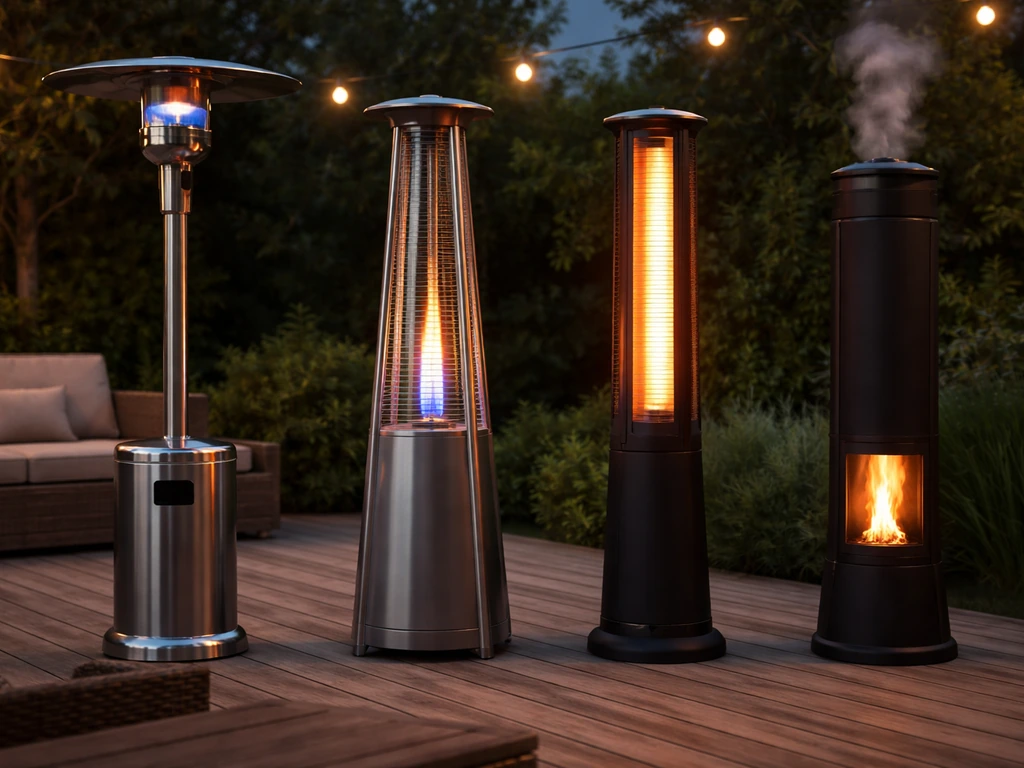
See how propane, gas, electric, infrared, and pellet patio heaters affect air and CO2, plus step-by-step ways to cut imp
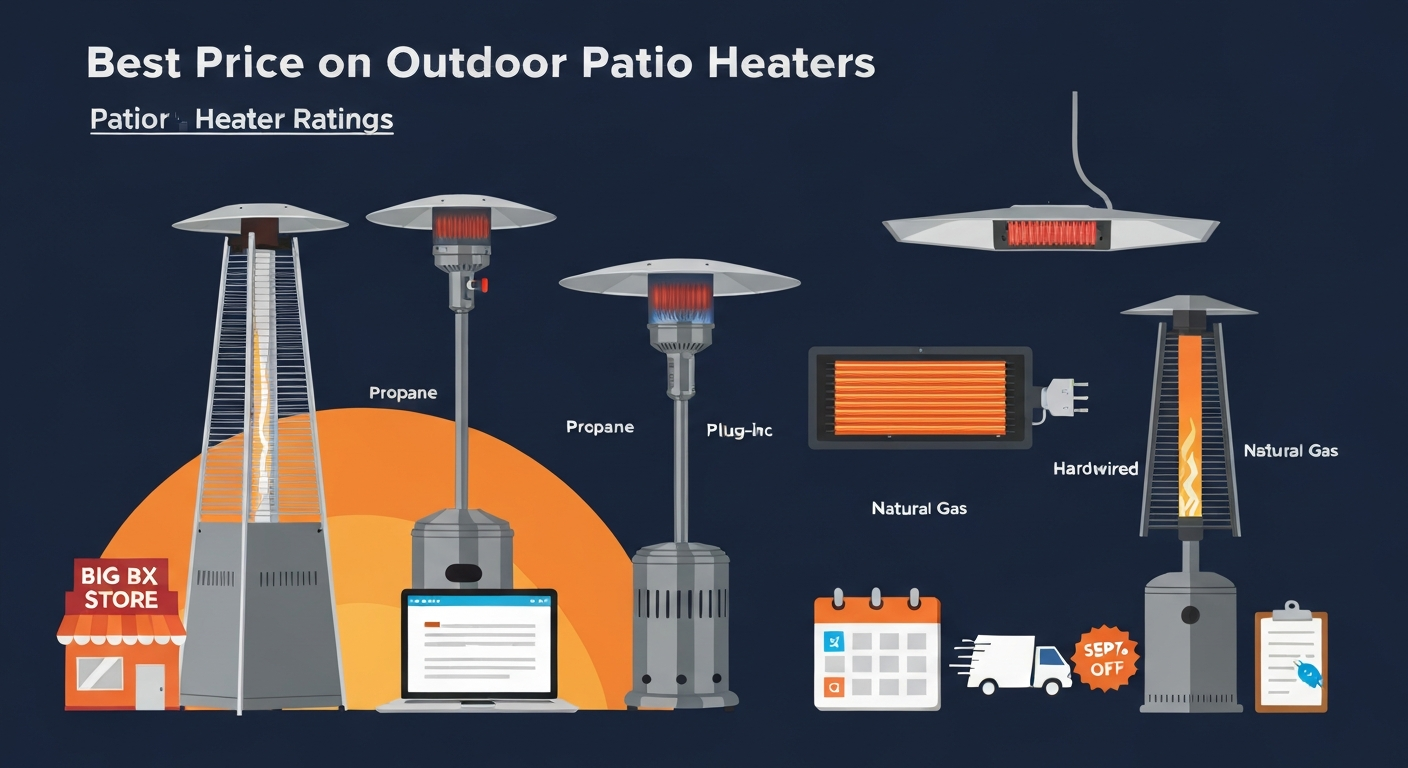
Score the best price on outdoor patio heaters, price ranges, top picks, deal tactics, total-cost & safety checklist.
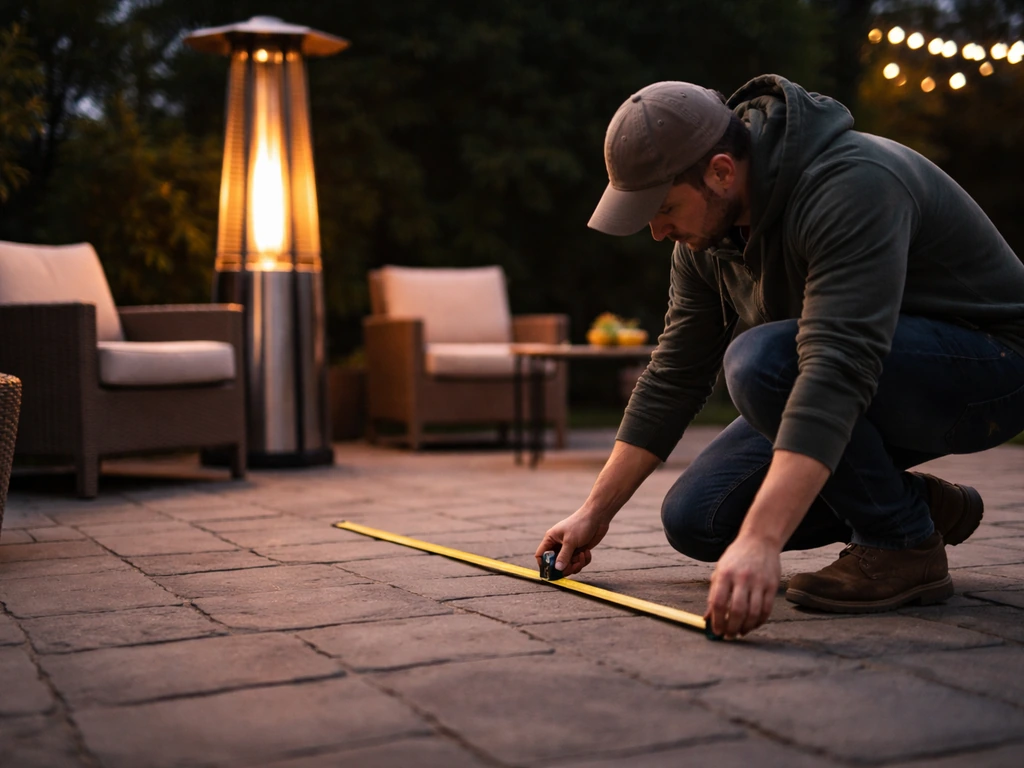
Find where to rent patio heaters near you today, choose the right fuel type, compare costs, and book safely.