
Patio heaters are not banned in the UK. There is no national law that prohibits homeowners, landlords, or businesses from using outdoor heaters. What does exist is a patchwork of local rules, product-safety standards, gas regulations, and environmental controls that can restrict certain heater types in certain places. The most common restrictions involve solid-fuel and pellet heaters in smoke-control areas, portable LPG heaters in licensed HMOs, and commercial heaters on public pavements where a pavement café licence applies conditions. If you are trying to work out whether your specific heater is legal where you live or trade, the answer almost always comes down to which type of heater you have and which local authority area you are in.
Are Patio Heaters Banned in the UK? Legal Guide 2026

Caleb Vale
11 Aug 2026
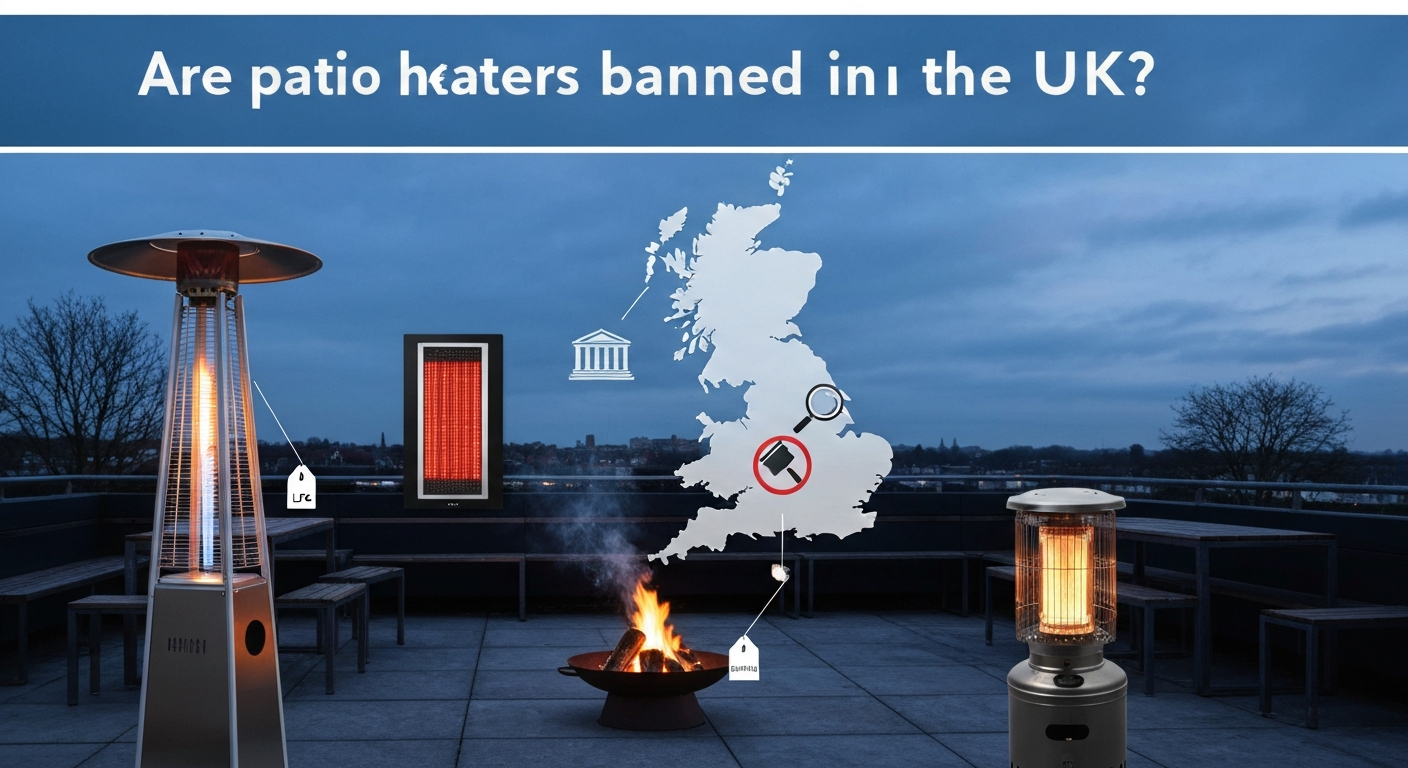
How UK law is structured: national rules vs local bylaws
At the national level, the UK does not have a single piece of legislation that targets patio heaters. Instead, several overlapping frameworks create the legal landscape. The Clean Air Act (administered by DEFRA and enforced by local councils) governs what fuels and appliances can emit smoke. The Gas Safety (Installation and Use) Regulations cover how gas appliances must be installed and maintained. The Health and Safety at Work etc. Act places duties on employers and businesses using heaters in commercial settings. Product-safety law, overseen by the Office for Product Safety and Standards, sets the baseline standards every heater sold in the UK must meet.
On top of those national frameworks, local councils have genuine power to add restrictions through two main routes: smoke-control area designations under the Clean Air Act, and licensing conditions attached to pavement café licences, premises licences, and HMO licences. This means a heater that is perfectly legal in a rural garden in Yorkshire could be prohibited on a licensed pavement terrace in central London or inside an HMO in Leeds. The practical takeaway is that you need to check both the national product rules and your local council's current conditions before buying or deploying a heater commercially.
Which heater types are most likely to face restrictions
Not all heater types face the same level of scrutiny. The key variables are whether the heater produces smoke or particulate emissions, uses a regulated fuel such as LPG or natural gas, and whether it is fixed or portable. Here is how each main type sits within the regulatory picture.
| Heater Type | Main Regulatory Risk | Restricted in Smoke-Control Areas? | Gas Safe Required? | Typical Compliance Route |
|---|---|---|---|---|
| Propane/LPG | Gas safety, cylinder storage, HMO bans | No (no smoke) | Yes, for fixed/commercial installs | Gas Safe engineer, UKLPG cylinder rules, BS EN 14543 |
| Natural Gas (piped) | Gas safety, fixed-install permit | No (no smoke) | Yes, mandatory | Gas Safe registered engineer, building regs for fixed pipework |
| Electric/Infrared | Electrical wiring standards | No | No | Fixed installs wired to BS 7671, UKCA/CE mark on appliance |
| Pellet/Solid fuel | Smoke emissions | Yes, unless exempt appliance used | No | DEFRA exempt appliance list, authorised fuel list |
| Paraffin/Oil | HMO and landlord restrictions, fire risk | No (limited smoke) | No | Check local HMO licence conditions; often banned in HMOs |
Electric and infrared heaters face the fewest restrictions by far. They produce zero combustion emissions, so smoke-control rules do not apply, and the only compliance requirement for a fixed installation is that the wiring meets BS 7671 (the UK wiring regulations). A portable plug-in model just needs a valid UKCA or CE mark. This is why electric and infrared models are the go-to recommendation when a site has restrictions, and it is worth looking at dedicated reviews of the best electric patio heaters in the UK before committing to a gas model if you are in any doubt about your local rules. For model comparisons and buying advice, see electric patio heater reviews UK for up-to-date testing and recommendations. For examples and buying guidance, see our guide to the best electric patio heaters 2021 UK, which reviews top models and their pros and cons. For a snapshot of top-rated models and buying tips, see our guide to the best patio heaters UK 2020. For model-by-model comparisons and testing notes, see our guide to the best patio heaters 2017 UK.
Smoke-control areas and air-quality limits
Smoke-control areas (SCAs) are designations made by local councils under the Clean Air Act framework. Inside an SCA, it is an offence to emit smoke from a chimney or fixed appliance, and you must only burn authorised fuels or use DEFRA-exempt appliances. The Environment Act 2021 updated enforcement by giving local authorities in England the power to issue civil financial penalties for smoke emissions in SCAs, which removed the need for criminal prosecution in many cases and made enforcement faster.
For outdoor heaters, the SCA rules become relevant if you are using a wood-burning fire pit, a pellet burner, or any solid-fuel appliance that generates visible smoke. If your appliance appears on DEFRA's exempt appliances list (searchable via the Clean Air Act Data Entry System on GOV.UK), you can use it in an SCA. If it does not appear there, you are taking a risk. Gas patio heaters (LPG or natural gas) and electric heaters do not produce smoke in the regulatory sense, so SCA rules generally do not apply to them. The first thing to do if you are considering a solid-fuel or pellet outdoor heater is to check DEFRA's tool, then confirm with your local council whether your address falls inside an SCA.
Beyond SCAs, some councils and the Greater London Authority have broader air-quality policies that may discourage or restrict the commercial use of gas patio heaters on emissions grounds. These are policy positions rather than hard legal bans at the time of writing, but they can be reflected as conditions in pavement café licences or planning approvals.
Commercial use, hospitality terraces, and temporary event permissions
If you run a pub, café, restaurant, or pop-up event and want to use patio heaters on a public pavement or licensed outdoor space, you are dealing with at least two separate permission layers. The first is a pavement café licence (or a premises licence with outdoor permissions), which is granted by the local council. The second is your general health-and-safety duties under the Health and Safety at Work etc. Act, which require you to carry out a risk assessment for any heater in a commercial public space.
Councils vary significantly in how they handle heaters within pavement licence conditions. City of York Council, for example, includes explicit conditions on heater use, placement, and storage in its pavement café guidance. Lambeth Council publishes separate guidance for outdoor heater licence holders covering safety and storage requirements. North Somerset Council has openly debated banning gas patio heaters on public land entirely. These are local policy decisions, not national law, but they have real teeth because a council can attach compliance conditions to a licence or refuse renewal if conditions are breached.
For temporary events, operators must also consider whether a Temporary Event Notice (TEN) is needed under licensing law, and whether the local environmental health team needs to be involved if the event involves significant fuel use or emissions. The safest approach for a commercial operator is to contact the local licensing team and environmental health department early in the planning process, before purchasing heaters, to understand exactly what conditions will apply. See Smoke control area enforcement (local authority roles), GOV.UK for guidance on local enforcement, licensing and event contexts Smoke control area enforcement (local authority roles) — GOV.UK (useful for local enforcement & event contexts).
Landlords, leasehold flats, and common-area restrictions
This is one of the more overlooked areas of restriction, and it catches a lot of people out. For landlords renting out properties, HSE guidance is explicit: gas appliances supplied as part of a tenancy must be installed, maintained, and inspected by a Gas Safe registered engineer. For LPG patio heaters provided to tenants, UKLPG guidance recommends annual checks by a competent technician for commercial and landlord-supplied units. Failure to comply exposes landlords to liability under both gas safety law and general landlord duties.
HMO (Houses in Multiple Occupation) licences add another layer. Leeds City Council, for instance, explicitly bans portable paraffin, oil, and LPG heaters in licensed HMOs as a licence condition. This type of restriction is increasingly common across local authority HMO licensing schemes because of the fire and CO risk from portable fuelled heaters in shared accommodation. If you manage an HMO anywhere in the UK, the safest assumption is that portable gas heaters are not permitted in common areas unless your local council's HMO conditions say otherwise in writing.
For leasehold flats with shared outdoor spaces such as roof terraces or communal gardens, the relevant restrictions usually come from the lease itself and the freeholder or management company rather than from statute. Many leases prohibit open flames or gas appliances in shared areas. Always check the lease and get written consent from the freeholder before installing or regularly using any gas or solid-fuel heater in a communal space.
Planning, building regulations, and permit triggers for fixed outdoor heaters
A free-standing portable patio heater that you wheel out and wheel back in does not usually trigger planning permission or building regulations. The situation changes when you start installing fixed infrastructure: a permanently mounted wall-bracket electric heater with dedicated external wiring, a natural gas supply run to an outdoor area, or a fixed canopy with integrated heaters can all bring planning and building-regulation considerations into play.
Fixed pipework for natural gas or LPG must be installed by a Gas Safe registered engineer, and any new gas installation in a property will generally need to be notified or assessed under Part J of the Building Regulations, which covers combustion appliances and fuel-storage systems. For fixed electrical installations outdoors, the work must comply with BS 7671 and, if carried out in England and Wales, must be notified to Building Control under Part P of the Building Regulations (or carried out by a registered competent person scheme member).
Commercial properties and listed buildings face stricter scrutiny. A listed building may need listed building consent for any fixed heater installation. A commercial terrace in a conservation area may need prior approval before adding permanent overhead heating structures. When in doubt, a quick pre-application conversation with your local planning authority costs nothing and can save significant expense later.
Fuel storage, cylinder rules, and safe distances for gas and propane heaters
LPG cylinders are covered by specific storage and handling rules that apply regardless of whether there is a local ban on the heater itself. The UKLPG (UK Liquefied Petroleum Gas Association) publishes technical guidance on safe distances, cylinder storage, regulator and hose specifications, and what constitutes a competent servicing check. For domestic use, the key practical rules are straightforward.
- Store LPG cylinders upright in a well-ventilated space, outdoors or in a dedicated gas store, away from drains, ignition sources, and building openings.
- Cylinders must be kept at least 1 metre from any opening in a building (window, door, ventilation opening) and away from boundaries where possible.
- Use only the correct regulator and hose type specified by the heater manufacturer; hoses should comply with current UKLPG technical standards and be replaced when damaged or at the manufacturer's recommended interval.
- Never store LPG cylinders in a basement, cellar, or below-ground space, as LPG is heavier than air and will accumulate.
- Turn off the cylinder valve when the heater is not in use, particularly overnight or when unattended.
- Commercial operators and landlords supplying LPG heaters should arrange annual competent-person checks in line with UKLPG guidance.
The Gas Safety (Installation and Use) Regulations require that gas appliances are correctly installed and maintained. For a freestanding LPG patio heater used domestically as intended, a homeowner connecting a standard snap-on or screw-on cylinder does not need a Gas Safe engineer for that connection. However, any permanent pipework, fixed regulator installations, or commercial/landlord deployments should involve a Gas Safe registered engineer. Patio heaters sold in the UK that burn gas should conform to BS EN 14543, the British/European standard for flueless outdoor radiant heaters. Check that the product carries a UKCA or CE mark and references this standard in its documentation.
The practical alternative: why electric and infrared heaters avoid most of these issues
From a compliance standpoint, electric and infrared heaters are the simplest choice. They carry no gas safety obligations for domestic portable use, they are not affected by smoke-control area rules, they do not require cylinder storage, and they are accepted in virtually all licensing conditions where gas heaters are not. The trade-off is running cost: electricity is more expensive per kilowatt-hour than LPG in most UK scenarios, and infrared heaters heat people and surfaces rather than the surrounding air, which means they can feel insufficient in very open, exposed spaces. That said, modern quartz and carbon infrared elements have improved dramatically, and for a sheltered residential terrace or a licensed commercial terrace where gas is restricted, they represent the most straightforward compliant option. Our detailed reviews of the best electric patio heaters in the UK cover specific models across different wattages and price points if you want to compare performance before committing.
How to check if your heater is compliant: an action checklist
If you are buying a new heater or reviewing whether an existing one is compliant, work through the following steps in order. The process takes less than an hour for most domestic situations and gives you a defensible paper trail if you are ever questioned by a council or fire inspector.
- Identify your heater type: gas (LPG or natural gas), electric, infrared, solid fuel, pellet, or paraffin.
- Check whether your address is inside a smoke-control area using the DEFRA/HETAS mapping tool on GOV.UK. If yes, solid-fuel and pellet heaters must be on the DEFRA exempt appliances list.
- If you are using LPG or natural gas outdoors commercially or as a landlord, confirm the appliance carries a UKCA or CE mark and references BS EN 14543.
- For any fixed installation (permanent wiring, piped gas), contact a Gas Safe registered engineer for gas or a Part P registered electrician for electrical work before proceeding.
- If you operate a licensed premises, read your current pavement café licence or premises licence conditions in full. Call your local licensing team if any condition is ambiguous.
- If you manage an HMO, check your current HMO licence conditions from the issuing council. Assume portable LPG and paraffin heaters are prohibited unless the licence explicitly permits them.
- If you hold a leasehold flat or manage a communal outdoor area, review the lease and get written freeholder consent before installing any gas or solid-fuel appliance in a shared space.
- Keep copies of Gas Safe certificates, product compliance documents, and any written council permissions in one file. Councils and fire services may ask for these on inspection.
Enforcement and what actually happens if you breach the rules
For smoke-control area offences in England, the Environment Act 2021 introduced civil financial penalties as an alternative to criminal prosecution, giving councils a faster and more flexible enforcement route. Penalties vary but can be issued without going to court. For gas safety breaches in a commercial or landlord context, HSE and local authority environmental health teams have inspection powers and can prohibit use of an appliance, issue improvement notices, or prosecute. Pavement licence conditions are enforced by the council licensing team, and breaches can result in licence conditions being tightened, suspended, or revoked. In short, the enforcement landscape is real, particularly for commercial operators and landlords. For domestic homeowners using a mainstream electric or gas patio heater in a non-smoke-control area, the risk of enforcement action is low, but checking the rules still costs nothing.
Where to get current information for your specific situation
- Smoke-control area status and exempt appliances: GOV.UK DEFRA/HETAS Clean Air Act Data Entry System.
- Gas safety standards and registered engineers: Gas Safe Register (gassaferegister.co.uk) and HSE gas safety pages.
- LPG cylinder and storage rules: UKLPG technical guidance publications (uklpg.org).
- Pavement café and commercial licensing conditions: your local council licensing team.
- HMO licence conditions: your local council housing or private rented sector team.
- Electrical installation standards: the IET (wiring regulations) and NICEIC/ELECSA competent person schemes.
- Planning and building-regulation queries: your local planning authority for pre-application advice.
FAQ
Are patio heaters banned in the UK?
No — there is no UK‑wide national ban on patio/outdoor heaters. National law focuses on product safety, smoke/emissions controls and gas safety rather than an outright prohibition. Local authorities, smoke‑control areas, landlords and event licences can however restrict or prohibit certain heater types or uses in specific locations.
What national regulations affect patio heaters?
Key national frameworks that affect patio heaters include the Clean Air Act / smoke‑control rules (DEFRA), Gas Safety (Installation and Use) Regulations, product‑safety and electrical standards (Office for Product Safety & Standards), and health & safety duties for employers and venue operators (HSE). These regulate fuels, emissions, competent installation, and appliance safety rather than banning patio heaters across the UK.
When can a local council restrict or ban patio heaters?
Local councils enforce smoke‑control areas, planning and licensing conditions (pavement/café licences), environmental health and public‑land policies. They can: impose conditions on pavement licences, ban certain heater types on council land, require removal for events, or apply civil penalties for smoke emissions within smoke‑control areas. Local policy decisions (not national law) drive specific bans.
Which heater types are most likely to be restricted?
Solid‑fuel and pellet burners that produce smoke are most likely to be affected in smoke‑control areas. Portable LPG/gas heaters can be restricted by local licence conditions, landlord/HMO rules, or council public‑land policies. Electric and infrared (electric) heaters are least likely to be banned because they produce no combustion emissions, but they are still subject to product‑safety and electrical installation rules.
Do smoke‑control areas affect patio heaters?
Yes. Smoke‑control areas (Clean Air Act) restrict burning unauthorised solid fuels and appliances that emit smoke. DEFRA/HETAS maintain an authorised fuels/exempt appliances database. Solid‑fuel/pellet outdoor burners may be illegal in smoke‑control areas unless the appliance/fuel is specifically exempt.
What must landlords and businesses know about providing patio heaters?
Landlords and businesses have heightened duties: gas appliances must be installed/maintained by competent persons (Gas Safe engineers for gas/LPG). Landlord/HMO guidance in some areas bans portable paraffin or LPG heaters for safety. Businesses using heaters in public/outdoor seating must comply with licensing, insurance, fire safety, and HSE duties.
Next Articles
Electric Patio Heater Reviews UK: Picks & Buying Guide
Electric patio heater reviews UK: tested top picks, running costs, installation, safety & buying guide.
Best Electric Patio Heaters 2021 UK: Top Picks & Buying Guide
Best electric patio heaters 2021 UK, expert reviews, data‑led comparisons, buying checklist and installation & safety指南
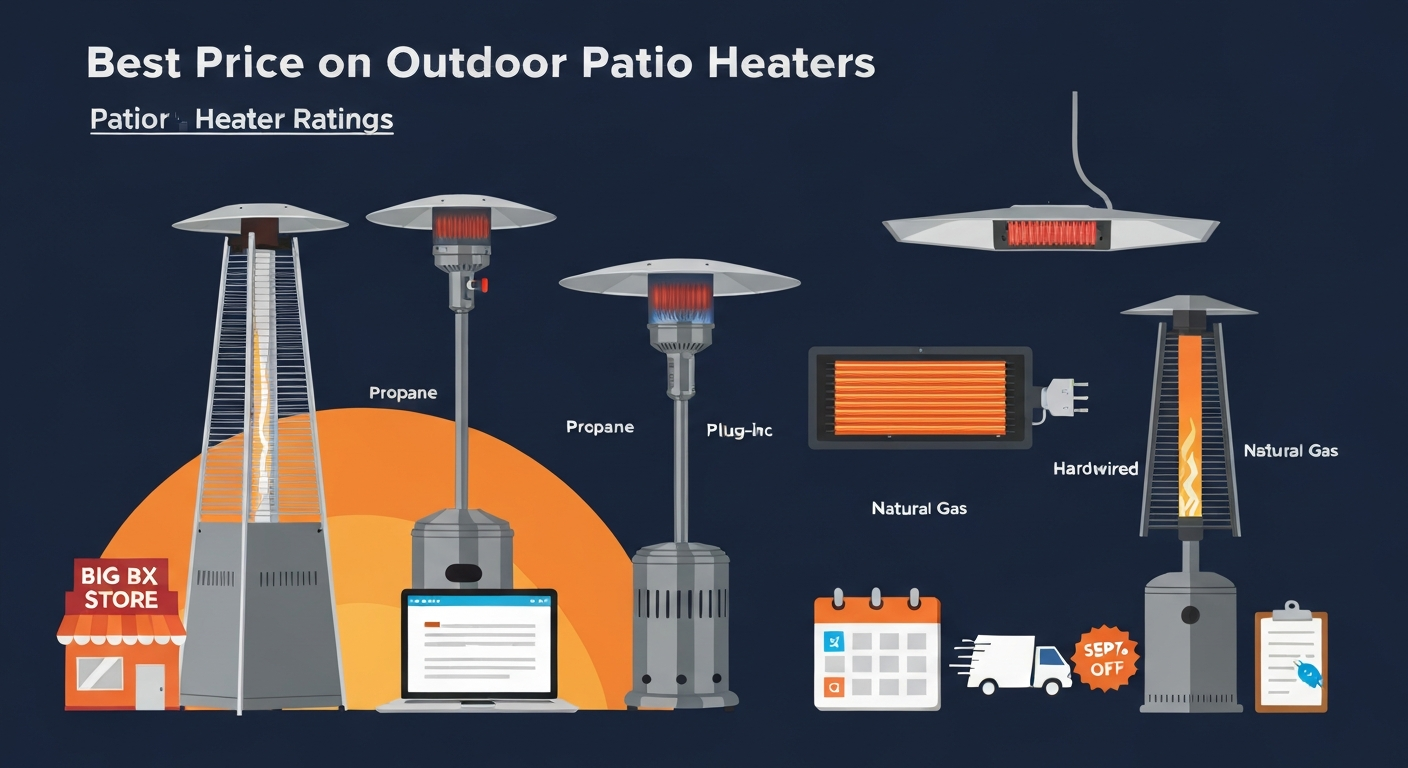
Best Price on Outdoor Patio Heaters: Compare Costs & Deals
Score the best price on outdoor patio heaters, price ranges, top picks, deal tactics, total-cost & safety checklist.